Explained encyclopedia results · 45

Clear search

The Hereafter Life

Narrated by MuslimAuthentic hadith

Allah, Glorified and Exalted, will say on the Day of Judgment: O son of Adam, I was ill, but you did not visit Me

Narrator in the source: Abu Hurayrah reported: I heard the Messenger of Allah say:

Abu Hurayrah (may Allah be pleased with him) reported: The Messenger of Allah (may Allah's peace and blessings be upon him) said: "Allah, Glorified and Exalted, will say on the Day of Judgment: 'O son of Adam, I was ill, but you did not visit Me.' He will respond: 'O Lord, how could I visit You and You are the Lord of the worlds?' Allah will say: 'Did you not know that My Servant, so-and-so, was ill but you did not visit him? Do you not know that if you had visited him, you would have found Me with him? O son of Adam, I asked you for food, but you did not feed Me.' He will respond: 'O Lord, how could I feed You and You are the Lord of the worlds?' He will say: 'Did you not know that My Servant, so-and-so, asked you for food, but you did not feed him? Do you not know that if you had fed him, you would have found (its reward) with Me? O son of Adam, I asked you for water, but you did not give Me any.' He will respond: 'O Lord, how could I give You (water) to drink and You are the Lord of the worlds?' And Allah will say: 'My Servant, so-and-so, asked you for a drink, but you did not give him one. Do you not know that if you had given him a drink, you would have found (its reward) with Me?'"
Grade in the source
Authentic hadith
Reported by
Narrated by Muslim
Original Arabic wording
عن أبي هريرة رضي الله عنه قَال: قَالَ رسولُ الله صلى الله عليه وسلم : "إنَّ اللهَ عز وجل يَقُولُ يَومَ القِيَامَةِ: يَا ابْنَ آدَمَ، مَرِضْتُ فَلَمْ تَعُدنِي! قَالَ: يَا رَبِّ، كَيْفَ أعُودُكَ وَأنْتَ رَبُّ العَالَمِينَ؟!، قَالَ: أمَا عَلِمْتَ أنَّ عَبْدِي فُلاَناً مَرِضَ فَلَمْ تَعُدْهُ! أمَا عَلِمْتَ أنَّكَ لَوْ عُدْتَهُ لَوَجَدْتَني عِنْدَهُ! يَا ابْنَ آدَمَ، اسْتَطْعَمْتُكَ فَلَمْ تُطْعِمنِي! قَالَ: يَا رَبِّ، كَيْفَ أطْعِمُكَ وَأنْتَ رَبُّ العَالَمِينَ؟! قَالَ: أمَا عَلِمْتَ أنَّهُ اسْتَطْعَمَكَ عَبْدِي فُلانٌ فَلَمْ تُطْعِمْهُ! أمَا عَلِمْتَ أنَّكَ لَوْ أطْعَمْتَهُ لَوَجَدْتَ ذَلِكَ عِنْدِي! يَا ابْنَ آدَمَ، اسْتَسْقَيْتُكَ فَلَمْ تَسْقِنِي! قَالَ: يَا رَبِّ، كَيْفَ أسْقِيكَ وَأنْتَ رَبُّ العَالَمينَ؟! قَالَ: اسْتَسْقَاكَ عَبْدِي فُلاَنٌ فَلَمْ تَسْقِهِ! أمَا عَلِمْتَ أنَّكَ لَوْ سَقَيْتَهُ لَوَجَدْتَ ذَلِكَ عِنْدِي".
Understand this hadith

Abu Hurayrah (may Allah be pleased with him) reported that the Prophet (may Allah's peace and blessings be upon him) said: “Allah, Glorified and Exalted, will say on the Day of Judgment: 'O son of Adam, I was ill, but you did not visit Me.' He will respond: 'O Lord, how could I visit You and You are the Lord of the worlds?'" meaning: You are independent and not in need of my visit. Allah will say: “Did you not know that My Servant, so-and-so, was ill but you did not visit him? Do you not know that if you had visited him, you would have found Me with him?” There is nothing difficult to understand in this Hadīth in the part where Allah, the Almighty, says: "I was ill, but you did not visit Me", because it is impossible for Allah, the Almighty, to become ill, as illness is an attribute of deficiency and Allah, Glorified and Exalted, is free from deficiency. What is meant by "ill" here is that one of the righteous slaves of Allah was sick and the allies of Allah, Glorified and Exalted, were close to Him. For this reason, Allah said: "…if you had visited him, you would have found Me with him", and did not say: "you would have found (its reward) with Me", as He said in regard to the food and drink. This indicates how close the sick person is to Allah, the Almighty. Hence, the scholars said: "The sick person is worthy of having his supplication answered, whether he supplicates for someone or against someone." “O son of Adam, I asked you for food, but you did not feed Me.” It is known that Allah, the Almighty, does not seek food for Himself, as He says: {He who feeds and is not fed} [Sūrat al-An‘ām: 14]. Allah is independent and does not need anyone or anything or food or drink, but if one of Allah’s servants feels hungry and someone knows about it but does not feed him, Allah, the Almighty, says: “Do you not know that if you had fed him, you would have found (its reward) with Me?” This means that you would have found the reward of giving him food saved for you as a good deed, and a good deed can be multiplied ten times and up to seven-hundred times, or as many times as Allah wills. “O son of Adam, I asked you for water, but you did not it give Me any”, meaning: I asked you for a drink, but you did not give Me a drink. He responds: “… how could I give You (water) to drink and You are the Lord of the worlds?” meaning: You are not in need of food or drink. Then Allah says: “My Servant, so-and-so, asked you for a drink, but you did not give him one. Do you not know that if you had given him a drink, you would have found (its reward) with Me?” Providing someone with something to drink when they ask for a drink will win you a reward that will be saved for you as a good deed, and a good deed can be multiplied ten times and up to seven-hundred times or as many times as Allah wills.

References (original Arabic)

نزهة المتقين شرح رياض الصالحين لمجموعة من الباحثين, مؤسسة الرسالة, الطبعة الرابعة عشر, 1407ه. تطريز رياض الصالحين لفيصل بن عبد العزيز المبارك النجدي, تحقيق: عبد العزيز آل حمد, دار العاصمة , الطبعة: الأولى، 1423هـ. بهجة الناظرين شرح رياض الصالحين لسليم الهلالي, دار ابن الجوزي. شرح رياض الصالحين لابن عثيمين , دار الوطن للنشر، الرياض, الطبعة: 1426 هـ. صحيح مسلم, ترقيم محمد فؤاد عبد الباقي, دار إحياء التراث العربي, بيروت.
Agreed uponAuthentic

You will see your Lord as you see this moon, you will not have any difficulty in seeing Him

Narrator in the source: Jarīr ibn ‘Abdullah

Jarīr ibn ‘Abdullah (may Allah be pleased with him) reported: We were in the presence of the Prophet (may Allah's peace and blessings be upon him) when he looked at the moon when it was full, and he said: "You will see your Lord as you see this moon, you will not have any difficulty in seeing Him. So if you are able to not be overcome in observing a prayer before sunrise (the Fajr) and a prayer before sunset (the ‘Asr), then do so." Then, he recited: "{And glorify the praise of your Lord before sunrise and before sunset.}"
Grade in the source
Authentic
Reported by
Agreed upon
Original Arabic wording
عن جَرِيْر بنِ عبدِ الله رضي الله عنه قال: كُنَّا عِنْدَ النَّبِيِّ صَلَّى اللهُ عَلَيْهِ وَسَلَّمَ، فَنَظَرَ إِلَى الْقَمَرِ لَيْلَةً -يَعْنِي الْبَدْرَ- فَقَالَ: «إِنَّكُمْ سَتَرَوْنَ رَبَّكُمْ كَمَا تَرَوْنَ هَذَا الْقَمَرَ، لَا تُضَامُونَ فِي رُؤْيَتِهِ، فَإِنِ اسْتَطَعْتُمْ أَنْ لَا تُغْلَبُوا عَلَى صَلَاةٍ قَبْلَ طُلُوعِ الشَّمْسِ وَقَبْلَ غُرُوبِهَا فَافْعَلُوا» ثُمَّ قَرَأَ: «{وَسَبِّحْ بِحَمْدِ رَبِّكَ قَبْلَ طُلُوعِ الشَّمْسِ وَقَبْلَ الْغُرُوبِ}»
Understand this hadith

One night, the Companions were in the presence of the Prophet (may Allah's peace and blessings be upon him) when he looked at the full moon - on the 14th night of the lunar month - and said: The believers will see their Lord in the real sense clearly with their own eyes. They will not cause a crowd to one another, get tired, or experience hardship when seeing their Almighty Lord. Then, the Messenger of Allah (may Allah's peace and blessings be upon him) said: If you are able to get over whatever distracts you from observing the Fajr and ‘Asr prayers, then do so and observe them fully in their due times in a congregation, for this is one of the causes that lead to looking at the Countenance of Allah Almighty. Then, he (may Allah's peace and blessings be upon him) recited the verse that reads: {And glorify the praise of your Lord before sunrise and before sunset.}

Lessons from the hadith
  • Glad tidings to the believers that they will see Allah Almighty in Paradise.
  • Assertion, encouragement, and giving examples are among the methods of Da‘wah.
References (original Arabic)

صحيح البخاري (1/ 115) (554)، (6/ 139) (4851). صحيح مسلم (1/ 439) (633). بهجة الناظرين شرح رياض الصالحين، لسليم الهلالي (2/ 259). تذكرة المؤتسي شرح عقيدة الحافظ عبد الغني المقدسي، لعبدالرزاق البدر (ص177). شرح رياض الصالحين، لابن عثيمين (6/ 734). نزهة المتقين شرح رياض الصالحين، لمصطفى الخِن وغيره (2/ 776). كنوز رياض الصالحين، لمجموعة من الباحثين (13/ 271). تطريز رياض الصالحين، لفيصل آل مبارك (ص1091).

Narrated by MuslimAuthentic hadith

All rights will be restored on the Day of Judgment, until even the hornless sheep will settle its score with the horned one

Narrator in the source: Abu Hurayrah reported: I heard the Messenger of Allah say:

Abu Hurayrah (may Allah be pleased with him) reported that the Prophet (may Allah's peace and blessings be upon him) said: "All rights will be restored on the Day of Judgment, until even the hornless sheep will settle its score with the horned one."
Grade in the source
Authentic hadith
Reported by
Narrated by Muslim
Original Arabic wording
عن أبي هريرة رضي الله عنه مرفوعاً: «لَتُؤَدُّنَّ الحقوق إلى أهلها يوم القيامة، حتى يُقادَ للشاة الجَلْحَاءِ من الشاة القَرْنَاءِ».
Understand this hadith

The oppressed one will retaliate against his oppressor on the Day of Judgment; even the hornless sheep will settle its score with the one that has horns, {and your Lord is not unjust to anyone.} [Sūrat al-Kahf: 49]

References (original Arabic)

- صحيح مسلم؛ للإمام مسلم بن الحجاج، حققه ورقمه محمد فؤاد عبد الباقي، دار عالم الكتب-الرياض، الطبعة الأولى، 1417هـ. - شرح رياض الصالحين؛ للشيخ محمد بن صالح العثيمين، مدار الوطن، الرياض، 1426هـ. - بهجة الناظرين شرح رياض الصالحين؛ تأليف سليم الهلالي، دار ابن الجوزي- الطبعة الأولى1418ه. - نزهة المتقين شرح رياض الصالحين؛ تأليف د. مصطفى الخِن وغيره، مؤسسة الرسالة-بيروت، الطبعة الرابعة عشر، 1407هـ. - تطريز رياض الصالحين؛ تأليف فيصل آل مبارك، تحقيق د. عبد العزيز آل حمد، دار العاصمة-الرياض، الطبعة الأولى، 1423هـ.

Narrated by MuslimAuthentic hadith

The Hadīth on Intercession

Narrator in the source: حذيفة بن اليمان وأبي هريرة

Hudhayfah ibn al-Yamān and Abu Hurayrah (may Allah be pleased with both of them) reported that the Prophet (may Allah's peace and blessings be upon him) said: "Allah, Blessed and Exalted, will gather mankind (on the Day of Resurrection). The believers will stand until Paradise is brought near to them. So, they will go to Adam (peace be upon him) and say: 'O our Father, request that Paradise be opened for us.' He will say: 'Was it anything other than your father's sin that got you out of Paradise? I am not fit for that. Go to my son Ibrahīm, the intimate friend of Allah.' They will go to Ibrahīm who will say: 'I am not fit for that. Indeed, I was only an intimate friend of a low order. Go to Mūsa whom Allah spoke directly to.' They will go to Mūsa, but he will say: 'I am not fit for that. Go to ‘Īsa, the Word and Spirit of Allah.' ‘Īsa will say: 'I am not fit for that.' So they will go to Muhammad who will stand and will be given permission. Trust and kinship will be sent to stand on the right and left of the Sirāt. The first of you will pass over it like lightning." I (the narrator) said: "May my father and mother be sacrificed for you! What is the passing of lightening like?" He said: "Have you not seen how it comes and goes in the blink of an eye? Then it will be like the passing of wind. Then it will be like the passing of birds. Then it will be like the running of men; their deeds will make them run. Your Prophet will be standing at the Sirāt saying: 'O Lord, give salvation, give salvation!' until the deeds of slaves will not avail them; until a man would not be able to move except by crawling. On the two edges of the Sirāt, there will be suspended hooks, commanded to snatch whom they are ordered to snatch. Some people will sustain injuries but will be saved; others will be dumped in the Fire." By the One in Whose hand is the soul of Abu Hurayrah, the depth of Hell is seventy years.
Grade in the source
Authentic hadith
Reported by
Narrated by Muslim
Original Arabic wording
عن حذيفة بن اليمان وأبي هريرة رضي الله عنهما مرفوعاً: «يجمع الله -تبارك وتعالى- الناس فيقوم المؤمنون حتى تُزْلَفَ لهم الجنة، فيأتون آدم صلوات الله عليه، فيقولون: يا أبانا استفتح لنا الجنة، فيقول: وهل أخرجكم من الجنة إلا خطيئة أبيكم! لست بصاحب ذلك، اذهبوا إلى ابني إبراهيم خليل الله، قال: فيأتون إبراهيم فيقول إبراهيم: لستُ بصاحب ذلك إنما كنت خليلا من وراءِ وراء، اعمدوا إلى موسى الذي كلمه الله تكليما، فيأتون موسى، فيقول: لستُ بصاحب ذلك، اذهبوا إلى عيسى كلمة الله وروحه، فيقول عيسى: لست بصاحب ذلك، فيأتون محمدا صلى الله عليه وسلم فيقوم فيؤذن له، وتُرسَلُ الأمانة والرحم فيقومان جَنْبَتَي الصِّرَاطَ يمينا وشمالا فيَمُرُّ أوَّلُكُم كالبَرْقِ» قلتُ: بأبي وأمي، أي شيء كَمَرِّ البرْقِ؟ قال: «ألم تروا كيف يمر ويرجع في طَرْفِة عَيْنٍ، ثم كَمَرِّ الرِّيح، ثم كَمَرِّ الطَّيْرِ، وشَدِّ الرِّجال تجري بهم أعمالهم، ونبيكم قائم على الصراط، يقول: رب سَلِّمْ سَلِّمْ، حتى تعجز أعمال العباد، حتى يجيء الرجل لا يستطيع السير إلا زَحْفَا، وفي حافتي الصراط كَلالِيبُ مُعَلَّقَةٌ مأمورة بأخذ من أُمِرَتْ به، فَمَخْدُوشٌ نَاجٍ، ومُكَرْدَسٌ في النار». والذي نفس أبي هريرة بيده، إن قَعْرَ جهنم لسبعون خريفا.
Understand this hadith

Allah will gather mankind on the Day of Resurrection for questioning and recompense. The believers will stand until Paradise is brought near to them, but it will not be opened to them due to the long period of standing on the Day of Resurrection. So they will go to Adam (peace be upon him) and ask him to ask Allah to open the gates of Paradise for them. He will decline, saying that he does not deserve that privilege because of his sin which caused the fall of humanity from Paradise. Adam will send them to Ibrahīm (peace be upon him) because he is the close friend of Allah, and close friendship is the highest station of love. So they will go to Ibrahīm who will say to them that he is not of such a lofty degree. He will tell them to go to Mūsa, since Allah the Exalted talked to Mūsa directly without an intermediary. So they will go to Mūsa (peace be upon him) who will say to them that he does not deserve that privilege. He will tell them to go to ‘Īsa, since Allah created him by a word from Him. So they will go to ‘Īsa (peace be upon him) who will say to them that he does not deserve this privilege. So they will go to our Prophet Muhammad (may Allah's peace and blessings be upon him) and they will ask him to ask Allah to judge between them and open Paradise to them. He will respond to their request, will seek permission, and will be granted it. Trust and kinship will stand on the two sides of the Sirāt, which is a bridge that extends over Hell. People will pass on it according to their deeds. Those who, in the life of this world, hastened to do good deeds will pass swiftly on the Bridge, and vice versa. Some will be saved and some will fall into Hell. It takes seventy years to reach the bottom of Hell – May Allah save us from it!

References (original Arabic)

صحيح مسلم, تأليف: مسلم بن حجاج النيسابوري, تحقيق: محمد فؤاد عبدالباقي, دار إحياء التراث العربي. نزهة المتقين شرح رياض الصالحين, تأليف: مصطفى الخن ومصطفى البغا ومحي الدين مستو وعلي الشربجي ومحمد لطفي, مؤسسة الرسالة, ط 14 عام 1407 - 1987م. بهجة الناظرين شرح رياض الصالحين, تأليف: سليم بن عيد الهلالي, دار ابن الجوزي، الطبعة الأولى 1418هـ. شرح رياض الصالحين من كلام سيد المرسلين, تأليف: محمد الصالح العثيمين, طبعة المؤسسة الناشر: مدار الوطن, ط عام 1425هـ. - دليل الفالحين لطرق رياض الصالحين، لمحمد بن علان الشافعي، دار الكتاب العربي -بيروت.

Narrated by MuslimAuthentic

Do you know who the bankrupt is?

Narrator in the source: Abu Hurayrah reported: I heard the Messenger of Allah say:

Abu Hurayrah (may Allah be pleased with him) reported: The Messenger of Allah (may Allah's peace and blessings be upon him) said: "Do you know who the bankrupt is?" They said: "The bankrupt among us is the one who has neither money nor belongings." He said: "Verily, the bankrupt in my Ummah is the one who comes on the Day of Resurrection with prayers, fasting, and Zakah, but he comes while he has hurled abuse at this one, slandered that one, unlawfully consumed the wealth of this one, shed the blood of that one, and beat this one. So, this one will be given of his good deeds and that one will be given of his good deeds. If his good deeds run out before justice is fulfilled, some of their sins will be cast upon him and then he will be thrown into Hellfire."
Grade in the source
Authentic
Reported by
Narrated by Muslim
Original Arabic wording
عَنْ أَبِي هُرَيْرَةَ رضي الله عنه أَنَّ رَسُولَ اللهِ صَلَّى اللهُ عَلَيْهِ وَسَلَّمَ قَالَ: «أَتَدْرُونَ مَا الْمُفْلِسُ؟» قَالُوا: الْمُفْلِسُ فِينَا مَنْ لَا دِرْهَمَ لَهُ وَلَا مَتَاعَ، فَقَالَ: «إِنَّ الْمُفْلِسَ مِنْ أُمَّتِي يَأْتِي يَوْمَ الْقِيَامَةِ بِصَلَاةٍ وَصِيَامٍ وَزَكَاةٍ، وَيَأْتِي قَدْ شَتَمَ هَذَا، وَقَذَفَ هَذَا، وَأَكَلَ مَالَ هَذَا، وَسَفَكَ دَمَ هَذَا، وَضَرَبَ هَذَا، فَيُعْطَى هَذَا مِنْ حَسَنَاتِهِ، وَهَذَا مِنْ حَسَنَاتِهِ، فَإِنْ فَنِيَتْ حَسَنَاتُهُ قَبْلَ أَنْ يُقْضَى مَا عَلَيْهِ أُخِذَ مِنْ خَطَايَاهُمْ فَطُرِحَتْ عَلَيْهِ، ثُمَّ طُرِحَ فِي النَّارِ».
Understand this hadith

The Prophet (may Allah's peace and blessings be upon him) asked his Companions: Do you know who the bankrupt is? They said: The bankrupt among us is the one who has no wealth or property. He said: The bankrupt in my Ummah on the Day of Resurrection is the one who comes with righteous deeds such as prayer, fasting, and Zakah, but he comes having insulted and cursed this one, slandered that one, consumed the wealth of this one and denied it, shed the blood of that one and oppressed him, and beaten this one and humiliated him. So, the wronged ones will be given from his good deeds. If his good deeds run out before he has settled the rights and grievances due upon him, some of the sins of the wronged ones will be taken and placed in the records of the wrongdoer. Then, he will be thrown into Hellfire, as no good deeds will remain for him.

Lessons from the hadith
  • The Hadīth warns against committing prohibitions, especially those that violate people's material and moral rights.
  • The rights among people are based on competing, and the rights of the Creator, apart from Shirk (polytheism), are based on forgiveness.
  • One should use a conversational technique that attracts the attention of the addressed person and provokes his interest, especially in education.
  • It defines the real bankrupt; he is the one whose opponents take his righteous deeds on the Day of Judgment.
  • Retribution in the Hereafter may wipe out all good deeds and leave nothing of them.
  • Allah Almighty treats His servants on the basis of justice and the truth.
References (original Arabic)

صحيح مسلم (4/ 1997) (2581). بهجة الناظرين شرح رياض الصالحين، لسليم الهلالي (1/ 312). نزهة المتقين شرح رياض الصالحين، مجموعة من الباحثين (1/ 241). شرح رياض الصالحين، لابن عثيمين (2/ 527).

Narrated by Bukhari & MuslimAuthentic hadith

By the One in Whose hand Muhammad's soul is! I hope that you would be one-half of the inhabitants of Paradise; for none shall enter Paradise except a Muslim soul, and you, compared to the polytheists, are no more than a white hair on the skin of a black ox

Narrator in the source: Ibn Mas‘ūd

Ibn Mas‘ūd (may Allah be pleased with him) reported: There were about forty of us with the Messenger of Allah (may Allah's peace and blessings be upon him) in a tent when he said: "Would it please you to be one-fourth of the inhabitants of Paradise?" We said: 'Yes.' He said: "Would it please you to be one-third of the inhabitants of Paradise?" We said: 'Yes.' Thereupon he said: "By the One in Whose hand Muhammad's soul is! I hope that you would be one-half of the inhabitants of Paradise; for none shall enter Paradise except a Muslim soul, and you, compared to the polytheists, are no more than a white hair on the skin of a black ox, or a black hair on the skin of a red ox."
Grade in the source
Authentic hadith
Reported by
Narrated by Bukhari & Muslim
Original Arabic wording
عن ابن مسعود رضي الله عنه قال: كنا مع رسول الله صلى الله عليه وسلم في قُبَّةٍ نحوا من أربعين، فقال: «أترضون أن تكونوا ربع أهل الجنة؟» قلنا: نعم، قال: «أترضون أن تكونوا ثلث أهل الجنة؟» قلنا: نعم، قال: «والذي نفس محمد بيده، إني لأرجو أن تكونوا نصف أهل الجنة وذلك أن الجنة لا يدخلها إلا نفس مسلمة، وما أنتم في أهل الشرك إلا كالشعرة البيضاء في جلد الثور الأسود، أو كالشعرة السوداء في جلد الثور الأحمر».
Understand this hadith

The Prophet (may Allah's peace and blessings be upon him) was sitting with about forty men of his Companions in a small tent. He asked them: Would you like to be one-fourth the inhabitants of Paradise? They replied in the affirmative. Then he asked: Would you like to be one-third the inhabitants of Paradise? They again replied in the affirmative. Then the Prophet (may Allah's peace and blessings be upon him) swore by his Lord and said: I hope that you would be one-half the inhabitants of Paradise, and the other half from the other nations, for no one will enter Paradise except Muslims, so the disbelievers will not enter therein. He then added that Muslims, compared to the polytheists from all other nations, are very little in number, just like the one single hair of a different color on the hairy skin of an ox.

References (original Arabic)

دليل الفالحين لطرق رياض الصالحين، لابن علان، نشر دار الكتاب العربي. نزهة المتقين شرح رياض الصالحين، مصطفى الخن والبغا ومستو والشربجي ومحمد أمين ,نشر: مؤسسة الرسالة، الطبعة: الرابعة عشر، 1407هـ - 1987م. كنوز رياض الصالحين، رئيس الفريق العلمي حمد العمار نشر: دار كنوز إشبيليا، الطبعة: الأولى، 1430هـ - 2009م. بهجة الناظرين شرح رياض الصالحين، للهلالي، نشر: دار ابن الجوزي. صحيح البخاري، نشر: دار طوق النجاة (مصورة عن السلطانية بإضافة ترقيم ترقيم محمد فؤاد عبد الباقي)، الطبعة: الأولى، 1422هـ. فتح المجيد شرح كتاب التوحيد، لعبد الرحمن بن عبد الوهاب بن سليمان، المحقق: محمد حامد الفقي-الناشر: مطبعة السنة المحمدية، القاهرة، مصر، الطبعة: السابعة، 1377هـ/1957م. صحيح مسلم، تحقيق: محمد فؤاد عبد الباقي، نشر: دار إحياء التراث العربي – بيروت.

Narrated by MuslimAuthentic hadith

On the Day of Resurrection, Allah will deliver to every Muslim a Jew or a Christian and say: This is your ransom from Hellfire

Narrator in the source: Abu Mūsa al-Ash‘ari

Abu Mūsa al-Ash‘ari (may Allah be pleased with him) reported that the Prophet (may Allah's peace and blessings be upon him) said: "On the Day of Resurrection, Allah will deliver to every Muslim a Jew or a Christian and say: 'This is your ransom from Hellfire.'" Another narration reads: "On the Day of Resurrection, there will come people from the Muslims with sins as huge as mountains, and Allah will forgive them."
Grade in the source
Authentic hadith
Reported by
Narrated by Muslim
Original Arabic wording
عن أبي موسى الأشعري رضي الله عنه مرفوعاً: «إذا كان يومُ القيامة دفع اللهُ إلى كل مسلم يهوديا أو نصرانيا، فيقول: هذا فِكَاكُكَ من النار». وفي رواية: «يجيء يومَ القيامة ناسٌ من المسلمين بذنوبٍ أمثالِ الجبال يغفرها الله لهم».
Understand this hadith

The meaning of this Hadīth is explained in the report of Abu Hurayrah (may Allah be pleased with him) which reads: "Each person has an abode in Paradise and an abode in Hell. If the believer enters Paradise, the disbeliever in Hell will take his place in it, because he deserves that due to his disbelief." "This is your ransom from the Hellfire" means that you were exposed to the risk of entering Hell, but this is your ransom. This is because Allah, the Almighty, decreed a number of inmates to enter Hell and fill it. When the disbelievers enter it because of their disbelief and sins, they will become like ransom for the Muslims. Allah knows best.

References (original Arabic)

رياض الصالحين، للنووي، نشر: دار ابن كثير للطباعة والنشر والتوزيع، دمشق – بيروت، تحقيق: ماهر ياسين الفحل، الطبعة: الأولى، 1428هـ - 2007م. نزهة المتقين شرح رياض الصالحين، نشر: مؤسسة الرسالة، الطبعة: الرابعة عشر، 1407ه 1987م. كنوز رياض الصالحين، نشر: دار كنوز إشبيليا، الطبعة: الأولى، 1430ه 2009م. بهجة الناظرين شرح رياض الصالحين، للهلالي، نشر: دار ابن الجوزي. صحيح مسلم، تحقيق: محمد فؤاد عبد الباقي، نشر: دار إحياء التراث العربي – بيروت..

Agreed uponAuthentic

No owner of gold or silver who does not pay what is due on it except that on the Day of Judgment they will be made for him sheets of fire

Narrator in the source: Abu Hurayrah reported: I heard the Messenger of Allah say:

Abu Hurayrah (may Allah be pleased with him) reported: The Messenger of Allah (may Allah's peace and blessings be upon him) said: "No owner of gold or silver who does not pay what is due on it except that on the Day of Judgment they will be made for him sheets of fire and will be heated in the fire of Hell. His side, forehead, and back will be seared therewith. Whenever they cool down, they will be heated for him again on a day, the length of which is fifty thousand years, until judgment is pronounced among the slaves and he sees his path, either to Paradise or Hellfire." It was said: O Messenger of Allah, what about camels? He said: "And no owner of camels who does not pay what is due on them, and this includes milking them on their watering day, except that on the Day of Judgment he will be thrown down in a vast, smooth plain, and they will come, more numerous than they have ever been without even a single young one missing thereof. They will trample him with their hooves and bite him with their mouths. Whenever the first of them passes over him, the last of them will be made to return and pass over him on a day, the length of which is fifty thousand years, until judgment is pronounced among the slaves and he sees his path, either to Paradise or Hellfire." It was said: O Messenger of Allah, what about cows and sheep? He said: "And no owner of cows and sheep who does not pay what is due on them except that on the Day of Judgment he will be thrown down in a vast, smooth plain and they will come without any of them missing. There will be none among them with twisted horns, without horns, or with a broken horn. They will gore him with their horns and trample him with their hooves. Whenever the first of them passes over him, the last of them will be made to return and pass over him on a day, the length of which is fifty thousand years, until judgment is pronounced among the slaves and he sees his path, either to Paradise or Hellfire." It was said: O Messenger of Allah, what about horses? He said: "Horses are three: they are a burden for a man, a shield for another man, and a reward for a third man. As for the one for whom they are a burden, he is a man who kept them by way of showing off, boasting, and expressing hostility towards Muslims; so they are a burden for him. As for the one for whom they are a shield, he is a man who kept them for the sake of Allah and did not forget the right of Allah concerning their backs and their necks, and so they are a shield for him. As for the one for whom they are a reward, he is a man who kept them in a meadow or pasture for the sake of Allah to be used for the interest of Muslims. Whatever they eat from that meadow and pasture will be recorded for him as good deeds, and even their dung and urine will be recorded for him as good deeds. They will not break their halter and prance a course or two without their hoof marks and their dung written for him as good deeds. And their owner does not take them past a river from which they drink, though he did not intend thereby to quench their thirst, except that Allah will record for him the amount they drink as good deeds."
Grade in the source
Authentic
Reported by
Agreed upon
Original Arabic wording
عَنْ أَبي هُرَيْرَةَ رضي الله عنه قَالَ: قَالَ رَسُولُ اللهِ صَلَّى اللهُ عَلَيْهِ وَسَلَّمَ: «مَا مِنْ صَاحِبِ ذَهَبٍ وَلَا فِضَّةٍ، لَا يُؤَدِّي مِنْهَا حَقَّهَا، إِلَّا إِذَا كَانَ يَوْمُ الْقِيَامَةِ، صُفِّحَتْ لَهُ صَفَائِحُ مِنْ نَارٍ، فَأُحْمِيَ عَلَيْهَا فِي نَارِ جَهَنَّمَ، فَيُكْوَى بِهَا جَنْبُهُ وَجَبِينُهُ وَظَهْرُهُ، كُلَّمَا بَرَدَتْ أُعِيدَتْ لَهُ، فِي يَوْمٍ كَانَ مِقْدَارُهُ خَمْسِينَ أَلْفَ سَنَةٍ، حَتَّى يُقْضَى بَيْنَ الْعِبَادِ، فَيَرَى سَبِيلَهُ، إِمَّا إِلَى الْجَنَّةِ، وَإِمَّا إِلَى النَّارِ» قِيلَ: يَا رَسُولَ اللهِ، فَالْإِبِلُ؟ قَالَ: «وَلَا صَاحِبُ إِبِلٍ لَا يُؤَدِّي مِنْهَا حَقَّهَا، وَمِنْ حَقِّهَا حَلَبُهَا يَوْمَ وِرْدِهَا، إِلَّا إِذَا كَانَ يَوْمُ الْقِيَامَةِ، بُطِحَ لَهَا بِقَاعٍ قَرْقَرٍ، أَوْفَرَ مَا كَانَتْ، لَا يَفْقِدُ مِنْهَا فَصِيلًا وَاحِدًا، تَطَؤُهُ بِأَخْفَافِهَا وَتَعَضُّهُ بِأَفْوَاهِهَا، كُلَّمَا مَرَّ عَلَيْهِ أُولَاهَا رُدَّ عَلَيْهِ أُخْرَاهَا، فِي يَوْمٍ كَانَ مِقْدَارُهُ خَمْسِينَ أَلْفَ سَنَةٍ، حَتَّى يُقْضَى بَيْنَ الْعِبَادِ، فَيَرَى سَبِيلَهُ إِمَّا إِلَى الْجَنَّةِ، وَإِمَّا إِلَى النَّارِ» قِيلَ: يَا رَسُولَ اللهِ، فَالْبَقَرُ وَالْغَنَمُ؟ قَالَ: «وَلَا صَاحِبُ بَقَرٍ، وَلَا غَنَمٍ، لَا يُؤَدِّي مِنْهَا حَقَّهَا، إِلَّا إِذَا كَانَ يَوْمُ الْقِيَامَةِ بُطِحَ لَهَا بِقَاعٍ قَرْقَرٍ، لَا يَفْقِدُ مِنْهَا شَيْئًا، لَيْسَ فِيهَا عَقْصَاءُ، وَلَا جَلْحَاءُ، وَلَا عَضْبَاءُ تَنْطَحُهُ بِقُرُونِهَا وَتَطَؤُهُ بِأَظْلَافِهَا، كُلَّمَا مَرَّ عَلَيْهِ أُولَاهَا رُدَّ عَلَيْهِ أُخْرَاهَا، فِي يَوْمٍ كَانَ مِقْدَارُهُ خَمْسِينَ أَلْفَ سَنَةٍ، حَتَّى يُقْضَى بَيْنَ الْعِبَادِ، فَيَرَى سَبِيلَهُ إِمَّا إِلَى الْجَنَّةِ، وَإِمَّا إِلَى النَّارِ» قِيلَ: يَا رَسُولَ اللهِ، فَالْخَيْلُ؟ قَالَ: «الْخَيْلُ ثَلَاثَةٌ: هِيَ لِرَجُلٍ وِزْرٌ، وَهِيَ لِرَجُلٍ سِتْرٌ، وَهِيَ لِرَجُلٍ أَجْرٌ، فَأَمَّا الَّتِي هِيَ لَهُ وِزْرٌ، فَرَجُلٌ رَبَطَهَا رِيَاءً وَفَخْرًا وَنِوَاءً عَلَى أَهْلِ الْإِسْلَامِ، فَهِيَ لَهُ وِزْرٌ، وَأَمَّا الَّتِي هِيَ لَهُ سِتْرٌ، فَرَجُلٌ رَبَطَهَا فِي سَبِيلِ اللهِ، ثُمَّ لَمْ يَنْسَ حَقَّ اللهِ فِي ظُهُورِهَا وَلَا رِقَابِهَا، فَهِيَ لَهُ سِتْرٌ وَأَمَّا الَّتِي هِيَ لَهُ أَجْرٌ، فَرَجُلٌ رَبَطَهَا فِي سَبِيلِ اللهِ لِأَهْلِ الْإِسْلَامِ، فِي مَرْجٍ وَرَوْضَةٍ، فَمَا أَكَلَتْ مِنْ ذَلِكَ الْمَرْجِ، أَوِ الرَّوْضَةِ مِنْ شَيْءٍ، إِلَّا كُتِبَ لَهُ، عَدَدَ مَا أَكَلَتْ حَسَنَاتٌ، وَكُتِبَ لَهُ، عَدَدَ أَرْوَاثِهَا وَأَبْوَالِهَا، حَسَنَاتٌ، وَلَا تَقْطَعُ طِوَلَهَا فَاسْتَنَّتْ شَرَفًا، أَوْ شَرَفَيْنِ، إِلَّا كَتَبَ اللهُ لَهُ عَدَدَ آثَارِهَا وَأَرْوَاثِهَا حَسَنَاتٍ، وَلَا مَرَّ بِهَا صَاحِبُهَا عَلَى نَهْرٍ، فَشَرِبَتْ مِنْهُ وَلَا يُرِيدُ أَنْ يَسْقِيَهَا، إِلَّا كَتَبَ اللهُ لَهُ، عَدَدَ مَا شَرِبَتْ، حَسَنَاتٍ» قِيلَ: يَا رَسُولَ اللهِ، فَالْحُمُرُ؟ قَالَ: «مَا أُنْزِلَ عَلَيَّ فِي الْحُمُرِ شَيْءٌ، إِلَّا هَذِهِ الْآيَةَ الْفَاذَّةُ الْجَامِعَةُ»: {فَمَنْ يَعْمَلْ مِثْقَالَ ذَرَّةٍ خَيْرًا يَرَهُ، وَمَنْ يَعْمَلْ مِثْقَالَ ذَرَّةٍ شَرًّا يَرَهُ} [الزلزلة: 8].
Understand this hadith

The Prophet (may Allah's peace and blessings be upon him) clarified some types of properties and mentioned the recompense of those who do not pay their Zakah on the Day of Judgment. Such properties include: First: Gold and silver and what is similar to them, including money and commercial goods, which are subject to Zakah but were not paid. In this case, they are melted down and poured in the form of plates and heated in the fire of Hell and used to torment their owner, searing therewith his side, forehead, and back. Whenever they cool down, they are reheated, and he continues being tormented in such a way throughout the Day of Judgment, the length of which is fifty thousand years, until Allah judges between the creation and he becomes either from the dwellers of Paradise or Hellfire. Second: The owner of camels who does not pay their Zakah and the right due on them, including milking them for the needy who are present. In this case, such camels are brought, and they are huge, fat, and more in number than they were. Their owner will be laid down, thrown, and stretched for them on the Day of Judgment on a wide, level land where they can trample him with their hooves and bite him with their teeth. Whenever the last of them passes over him, the first of them will be made to return to pass over him, and he continues being tormented in such a way throughout the Day of Judgment, the length of which is fifty thousand years, until Allah judges between the creation and he becomes either from the dwellers of Paradise or Hellfire. Third: The owner of cows and sheep—sheep and goats—who does not pay the Zakah due on them. In this case, they are brought in great numbers, more than they were, and nothing will be missing thereof. He will be laid down, thrown, and stretched for them on the Day of Judgment on a wide level land. None of them will have a twisted horn, no horn, or a broken horn; rather, they will be in perfect shape. They will gore him with their horns and trample him with their hooves. Whenever the last of them passes over him, the first of them will be made to return to pass over him. and he will continue being tormented in such a way throughout the Day of Judgment, the length of which is fifty thousand years, until Allah judges between the creation and he becomes either from the dwellers of Paradise or Hellfire. Fourth: The owner of horses, and he is one of three types: First: They are a burden for him, and this is the person who keeps them for the sake of showing off, boasting, and waging war against Muslims. Second: They are a shield for him, and this is the person who keeps them for Jihad in the cause of Allah and treats them kindly, foddering and feeding them, and lending their males for breeding. Third: They are a reward for him, and this is the person who keeps them for Jihad in the cause of Allah for the Muslims' benefit. They are kept in a meadow and pasture to graze. Whatever they eat is recorded for him as good deeds, and their dung and urine are recorded for him as good deeds as well. They do not break their halter, i.e., the rope used for tethering them, run, and gallop in high lands, except that Allah will record for him the number of their hoof marks and their dung as good deeds. Moreover, their owner will not take them past a river from which they drink, although he did not intend to water them, except that Allah will record for him the amount of what they drink as good deeds. Then the Prophet (may Allah's peace and blessings be upon him) was asked about donkeys and whether they are like horses. He said: No legislation has been revealed regarding them in particular except that unique verse, which generally refers to all types of acts of obedience and sins, namely the verse in which Allah Almighty says: {So whoever does an atom’s weight of good will see it, and whoever does an atom’s weight of evil will see it.} [Surat az-Zalzalah: 7-8] So, whoever possesses donkeys as an act of obedience will attain reward for that, and whoever keeps them to commit sins will be punished for that, and this is a general ruling that includes all deeds.

Lessons from the hadith
  • Paying Zakah is obligatory and withholding it entails a stern warning.
  • One who withholds Zakah out of indolence is not a disbeliever but he is in great danger.
  • Man gets rewarded for the details that occur while performing an act of obedience, even if he did not have such details in mind, as long as he has intended the act of obedience itself.
  • There are due rights in one's wealth other than Zakah.
  • Among the rights due in camels is to milk them for the needy who are present in the place where the camels are watered because it is easier for the needy than going to homes and kinder to the cattle. Ibn Battāl said: There are two due rights in one's wealth: an individual obligation and another, and milking is among the rights pertaining to noble morals.
  • Among the due rights in camels, cows, and sheep is lending their males for breeding in case of being requested.
  • The ruling on donkeys and everything else that is not mentioned by name in religious texts is: They are included in the statement of Allah Almighty: {So whoever does an atom’s weight of good will see it, and whoever does an atom’s weight of evil will see it.}
  • The verse encourages doing good deeds, even if little, and warns against doing evil deeds, even if trivial.
References (original Arabic)

صحيح البخاري (6/ 175) (4962). صحيح مسلم (2/ 680) (987). كنوز رياض الصالحين، لمجموعة من الباحثين. بهجة الناظرين، لسليم الهلالي (2/ 350). نزهة المتقين، لمجموعة من الباحثين (2/ 862). شرح رياض الصالحين، لابن عثيمين (5/ 253). تيسير الكريم الرحمن في تفسير كلام المنان، لعبد الرحمن آل سعدي (ص335). فتح الباري شرح صحيح البخاري، لابن حجر (3/ 268). شرح الزرقاني على موطأ مالك، لمحمد الزرقاني (2/ 164). مرقاة المفاتيح شرح مشكاة المصابيح، لعلي القاري (4/ 1262).

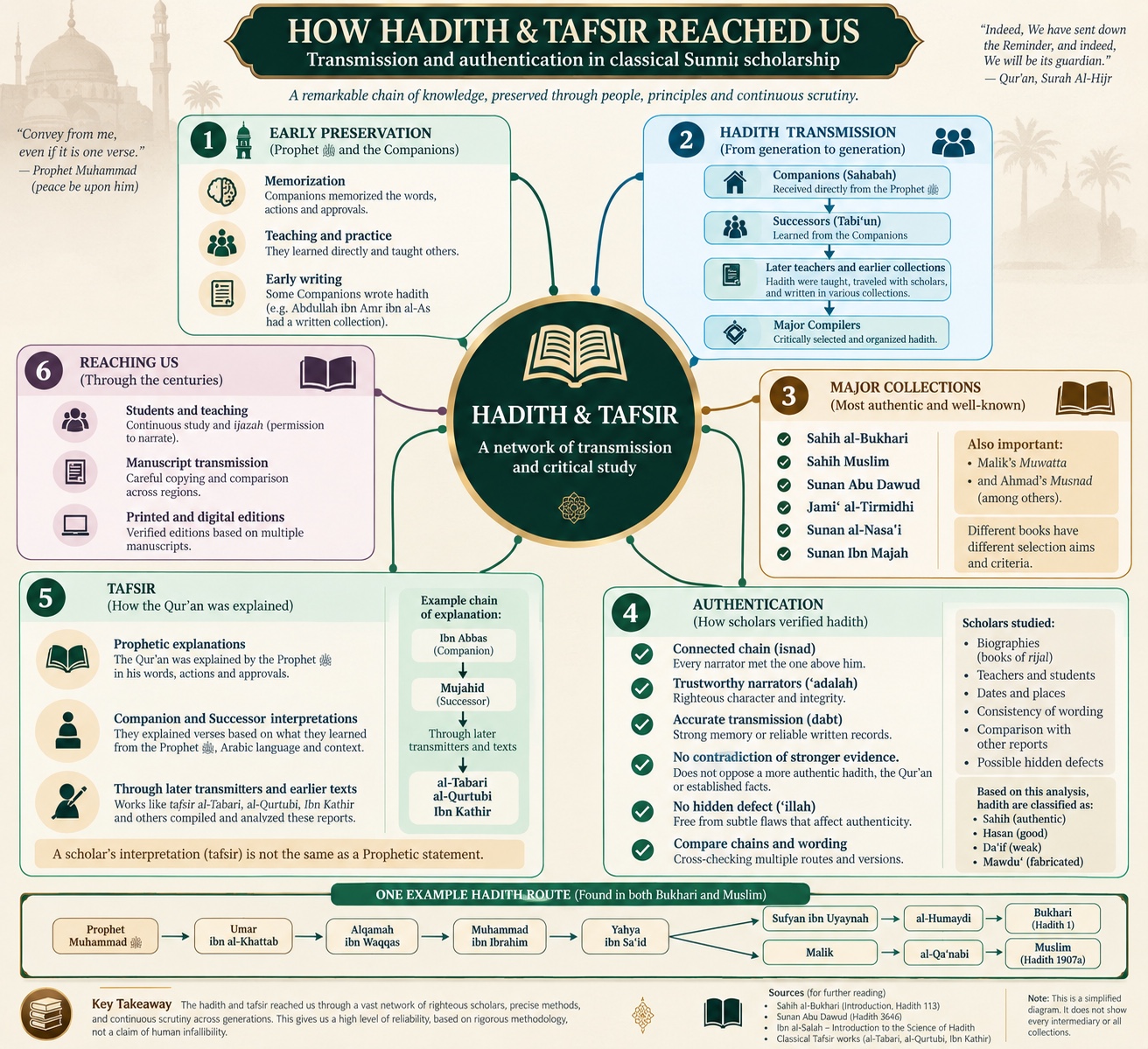
How hadith and tafsir reached us: preservation, transmission, collections, authentication and study
Tap the diagram to open it full size.
SEE THE WHOLE STORY

How hadith reached us

A simplified history of preservation, transmission and compilation; stages overlap.

  1. 1
    Prophetic lifetimeLearning from the Prophet ﷺ

    Companions heard, memorized and practised the teachings; some also wrote them down.

    The Prophet ﷺ and examples of Companions who learned from him

    • Prophet Muhammad ﷺ
    • Abdullah ibn Amr ibn al-As
    • Abu Hurayrah
    • Aishah bint Abi Bakr
    • Anas ibn Malik
    Selected notable names; not an exhaustive list. Activities and generations overlap.Reference ↗
  2. 2
    First century AHThe Companions teach

    Companions passed on what they learned as teaching spread between regions.

    The seven most prolific Companion narrators

    • Abu Hurayrah
    • Abdullah ibn Umar ibn al-Khattab
    • Anas ibn Malik
    • Aishah bint Abi Bakr
    • Abdullah ibn Abbas
    • Jabir ibn Abdullah
    • Abu Said al-Khudri
    Selected notable names; not an exhaustive list. Activities and generations overlap.Reference ↗
  3. 3
    Late first / early second century AHSuccessors and organized recording

    Successors learned from Companions. Umar ibn Abd al-Aziz encouraged recording hadith; writing had already existed earlier.

    Notable Successors and organizers of hadith recording

    • Umar ibn Abd al-Aziz — commissioned recording
    • Muhammad ibn Muslim ibn Shihab al-Zuhri
    • Abu Bakr ibn Muhammad ibn Amr ibn Hazm
    • Amrah bint Abd al-Rahman
    • Al-Qasim ibn Muhammad ibn Abi Bakr
    Selected notable names; not an exhaustive list. Activities and generations overlap.Reference ↗
  4. 4
    Second to early fourth century AHCollections take shape

    Collections grew, including Malik’s Muwatta, later Bukhari and Muslim, and the Sunan, each with its own selection criteria.

    Notable compilers of hadith collections

    • Malik ibn Anas — Al-Muwatta
    • Ahmad ibn Hanbal — Al-Musnad
    • Ishaq ibn Rahawayh — Al-Musnad
    • Muhammad ibn Ismail al-Bukhari — Al-Sahih
    • Muslim ibn al-Hajjaj — Al-Sahih
    • Abu Dawud Sulayman ibn al-Ashath — Al-Sunan
    • Muhammad ibn Isa al-Tirmidhi — Al-Jami
    • Ahmad ibn Shuayb al-Nasai — Al-Sunan
    • Muhammad ibn Yazid Ibn Majah — Al-Sunan
    Selected notable names; not an exhaustive list. Activities and generations overlap.Reference ↗
  5. 5
    Across the centuriesCriticism, commentary and manuscripts

    Scholars continued examining chains and texts, comparing routes, explaining reports and copying books. These activities overlap rather than forming isolated stages.

    Notable scholars of criticism, hidden defects and commentary

    • Shubah ibn al-Hajjaj
    • Yahya ibn Said al-Qattan
    • Ahmad ibn Hanbal
    • Ali ibn al-Madini
    • Yahya ibn Main
    • Abu Hatim al-Razi
    • Yahya ibn Sharaf al-Nawawi — commentary on Sahih Muslim
    • Ahmad ibn Ali Ibn Hajar al-Asqalani — Fath al-Bari
    Selected notable names; not an exhaustive list. Activities and generations overlap.Reference ↗
  6. 6
    Modern periodCritical editions and digital access

    Printed editions and searchable libraries widened access. Availability alone does not authenticate a report; check its source and scholarly assessment.

    IslamWeb

    An online library for reading hadith collections, commentary and scholarly references.

    Visit IslamWeb ↗
One small step at a time

Learn hadith without overwhelm

Each lesson gives one idea, one example and one short question. Pause and return whenever you like.

Start step one →
UnderstandWhat is hadith?
FollowChains
CheckGrades
PractiseBy yourself
Step three

Browse by topic

Choose the topic closest to your question to see explained hadiths.

Show detailed topics
Revelation and Collection of the Qur'an14Modes of Qur'anic Recitation and Tajweed7Qur'anic Exegesis16General Qur'anic Topics14Excellence of the Qur'an31Meanings and Attributes of the Qur'an1Occasions of Revelation5Abrogating and Abrogated Verses1Collecting the Qur'an2Seven Modes of the Qur'anic Revelation2Science of Tajweed4Stops and Starts1Rules and Principles of Exegesis1Rulings of the Qur'an and Codices4Manners of Reading and Memorizing the Qur'an7Refuting Allegations against the Qur'an3Inference from the Qur'an1Merit of Taking Care of the Qur'an13Virtues of Surahs and Verses17General Sunnah Topics10Significance and Status of the Sunnah9Writing the Sunnah3Belief in Allah the Mighty and Majestic133Belief in the Angels30Belief in the Revealed Books3Belief in the Messengers49Belief in the Last Day109Belief in the Divine Decree and Fate25Names and Rulings78The Companions36The Prophet's Family15Allegiance and Dissociation14People of the Sunnah and the Community1Sects and Schools1Oneness of Allah's Lordship8Oneness of Allah's Worship42Oneness of Allah's Names and Attributes75The Angels20The Jinn7Pre-Islamic Scriptures1The Qur'an1Prophethood4Pre-Islamic Prophets and Messengers, peace be upon them22Our Prophet Muhammad, may Allah's peace and blessings be upon him20Miracles of the Pious Allies of Allah4The Barzakh Life (After death Period)19Portents of the Hour27The Hereafter Life45Levels of Divine Decree and Fate9Issues of Divine Decree and Fate9Islam22Nullifiers of Islam5Issues of Pre-Islamic Era8Increase and Decrease of Faith9Branches of Faith7Disbelief7Polytheism10Hypocrisy10Immorality3Religious Innovation7Merit of the Companions30Belief in the the Companions2Degrees of the Companions5Merit of the Prophet's Family6Merit of the Mothers of the Believers4Belief in the Prophet's Family1Rights of the Prophet's Family4Rulings of Allegiance and Dissociation5Forbidden Emulation6Emigration and its Rulings2Desertion and its Conditions2Characteristics of the People of the Sunnah and the Community1Old Sects and Schools1Jurisprudence of Acts of Worship736Jurisprudence of Transactions103Religious Obligations6Family Jurisprudence168Spiritual and Physical Therapy22Foods and Drinks42Crimes22Prescribed Punishments42Judiciary14Principles of Islamic Jurisprudence18Purification132Prayer349Funerals33Zakah39Fasting57Hajj and ‘Umrah63Jihad84Sales19Conditions of Sale1Sale-Related Stipulations2Selling Assets and Fruits3Advance Payment1Usury6Loan3Mortgage1Collateral and Surety1Conciliation and Neighborhood Rulings4Interdiction1Partnership1Sharecropping3Leasing1Racing and Gambling2Usurpation2Preemption1Found Item and Foundling2Endowment6Gift10Bequest4Manumission15Oaths and Vows22Conditions of Inheritance1Impediments of Inheritance3Agnates1Inheritance Shares of Blood Relatives1Inheritance Shares of Embryos1Marriage62Divorce12Remarriage with One's Divorcee1Wife-Initiated Divorce2Oath to Abstain from Intercourse with One's Wife1Zihaar (Likening one's wife to an unmarrriagble woman)3Oath of Condemnation11Waiting Period12Breastfeeding9Custody3Expenses10Clothing and Adornment12Muslim Society7Rulings of Women28Rulings of Newborns8Prophetic Medicine5Rulings of Medication3Ruqyah (Healing and Protective Supplications)9Rulings of Foods and Drinks6Lawful and Unlawful Animals and Birds16Slaughtering9Hunting6Rulings of Animals Slaughtered by the Disbelievers1Forbidden Drinks8Retribution10Blood Money9Rulings of Prescribed Punishments2Conditions of implementing Prescribed Punishments4Prescribed Punishment for Adultery11Prescribed Punishment for Calumny4Prescribed Punishment for Drinking Alcohol8Prescribed Punishment for Theft7Prescribed Punishment for Highway Robbery3Prescribed Punishment for Apostasy3Rulings of Discretionary Punishments2Judiciary: Its Ruling, Merit, and Significance1Manners of Judges2Claims and Proofs7Testimonies3Shariah Ruling5Juristic and Usooli (Juristic Priciples) Rules3Religious Assignment and its Conditions1The Book (the Qur'an)1The Sunnah1Abrogation2Significations and Inference3Personal Reasoning and Imitation1Divergence and Preponderance2Shariah Objectives3Virtues164Jurisprudence of Ethics127Shariah-approved Manners184Jurisprudence of Supplications and Remembrance of Allah113Heart-Softeners and Sermons188Excellence of Knowledge15Excellence of Monotheism11Merits of the Noble Qur'an10Merits of Being Dutiful to One's Parents10Merits of Maintaining Kinship Ties2Merits of Prophet's Family8Merits of the Companions32Merits of Good Deeds33Merits of Remembering Allah25Merits of Supplication4Merits of Heart Acts11Merits of Organs' Acts8Praiseworthy Morals80Blameworthy Morals46Manners of Scholars and Learners12Etiquettes of Reciting the Noble Qur’an3Manners of Greeting and Seeking Permission23Manners of Speaking and Keeping Silent31Manners of Divergence2Manners of Debate1Manners of Eating and Drinking31Manners of the Road and the Market3Manners and Rulings of Travel20Manners of Sleeping and Waking Up7Manners of Visions9Manners of Visiting and Seeking Permission13Manners of Sneezing and Yawning5Manners of Visiting the Sick9Manners of Dressing15Prophetic Guidance on Remembering Allah8Benefits of Remembering Allah15Morning and Evening Dhikr7Timeless Dhikr8Dhikr on Entering and Leaving the House2Dhikr on Entering and Leaving the Bathroom1Dhikr on Entering and Leaving the Mosque2Hard Times Dhikr3Dhikr on Special Occasions20Rulings of Supplication2Types of Supplication1Manners of Supplication7Causes for Answering or not Answering Supplications10Reported Supplications33Acts of Heart26Heart Diseases5Asceticism and Piety13States of the Righteous Believers12Condemning Sins21Condemning Love of the World26Condemning Whims and Desires9Repentance15Purification of Souls16Terrors of the Graves3Descriptions of Paradise and Hell53Calling to Allah (Da‘wah)36Enjoining Good and Forbidding Evil13Shariah-approved Politics51Islamic Culture1Ruling of Calling to Allah1Manners of Calling to Allah2Backgrounds and Duties of the Callers to Allah2Excellence and Merits of Islam14Universality of Islam3Human Rights in Islam5Animal Rights in Islam10Ruling of Enjoining Good and Forbidding Evil4Excellence of Enjoining Good and Forbidding Evil3Manners of Enjoining Good and Forbidding Evil2Principles of Enjoining Good and Forbidding Evil1Requirements of Enjoining Good and Forbidding Evil2Rulings and Issues of Enjoining Good and Forbidding Evil2Ways of Electing the Supreme Muslim Imam (Ruler)2Requirements of the Supreme Imamate (Leadership)4Duties of the Imam17Imam's Rights over the Subjects19Rebelling against the Muslim Ruler6International Relations in Islam1Consultation System in Islam1Islamic Civilization1Prophet's Biography192History17Prophet's Lineage2Prophet's Wives and Family Issues14Prophet's Children3Prophet's Servants1Prophet's Life before Mission2Prophet's Mission1The Makkan Period5The Emigration (Hijrah)3The Madinan Period1Prophet's Battles and Expeditions27Prophet's Correspondences2Prophet's Death18Muhammadan Qualities99Stories and Conditions of Pre-Islamic Nations9History of Makkah, Madinah, and the Aqsa (Jerusalem)1Wars and Battles1Biographies (of Famous Figures)2Countries and Figures1Periodical Occasions3Ahl-us-Sunnah's (Sunni) Stance on Religious Innovators2Rulings of Water6Removing Impurities13Utensils5Toilet Manners13Natural Cleanliness Practices9Ablution42Ritual Bath28Dry Ablution6Menses, Postpartum Bleeding, Extra-Menses Bleeding12Excellence of Ablution7Pillars of Ablution2Recommended Acts and Manners of Ablution12Method of Ablution11Nullifiers of Ablution8Rulings of the Ritual Bath1Causes of Obligatory Ritual Bath3Recommended Manners of the Ritual Bath3Obligation of Prayer and Ruling on Its Abandoner10Virtue of Prayer17The Azan and Iqaamah20Times Not to Pray6Conditions of Prayer28Pillars of Prayer3Obligatory Acts of Prayer1Recommended Acts of Prayer15Method of Prayer53Dhikr (Invocation) during Prayer23Nullifiers of Prayer2Mistakes during Prayer10Prostration of Forgetfulness, Recitation, Gratitude15Virtue and Rulings of Congregational Prayer16Rulings of the Imam and Followers in Prayer27Prayer of the People with Excuses9Jumu‘ah (Friday) Prayer14Voluntary Prayer59Prayer of Fear3Virtue of Friday2Merit of Jumu‘ah Prayer1Rulings of Jumu‘ah Prayer1Rulings of Jumu‘ah Sermon2Virtue of Voluntary Prayer2Regular Sunnah (Recommended) Prayers6Voluntary Night Prayer (Qiyaam)29Prayer of the Two Eids2Prayer of the Solar and Lunar Eclipse4Rain-Seeking Prayer2Forenoon Prayer4Guidance-Seeking Prayer1Death and Its Rulings11Washing the Dead2Method of Praying over the Dead7Carrying and Burying the Dead4Consolation3Visiting the Graves3Doing Good Deeds on behalf of the Deceased and Gifting them the Reward1Obligation of Zakah and Ruling of Its Abandoning3Rulings and Issues of Zakah2Zakah of Gold and Silver1Zakah of Livestock2Zakah of Land Produce2Zakat-ul-Fitr (Minor-Eid Charity)3Channels of Zakah (People Who Receive Zakah)3Voluntary Charity26Obligation of Fasting and Ruling of Its Abandoning2Virtue of Fasting6Recommended Acts of Fasting7Sighting the Crescent1Fasting on the Day of Doubt1Fasting Missed Days of Ramadaan3Fasting of People with Excuses3Nullifiers of Fasting1Fasting Obligations1What is Permissible for the Fasting Person2Fasting Prohibitions4What is Disliked for the Fasting Person1Voluntary Fasting13Seclusion for Worship in Ramadaan (I‘tikaaf)5Last Ten Days of Ramadaan6Obligation of Hajj and ‘Umrah and Ruling of Its Abandoner1Virtue of Hajj and Umrah7First Ten Days of Dhul Hijjah (Twelfth Lunar Month)1Rulings of Al-Masjid Al-Haraam, the Prophet's Mosque, and the Aqsa Mosque6Rulings of Ihraam (the Ritual State of Consecration)2Prohibitions of Ihraam6Ransom and Hunting Expiation2Types of Rituals (Pilgrimage)2Obligations of ‘Umrah1How to Make Hajj (Pilgrimage)9Pillars of Hajj (Pilgrimage)1Obligations of Hajj (Pilgrimage)1Rulings of the Prophet's Mosque1Sacrificial Animals and Expiations6Sacrifice5Rulings and Issues of Hajj and ‘Umrah16Ruling of Jihad1Excellence of Jihad35Categories of Jihad2Rulings and Issues of Jihad30Manners of Jihad7Rulings of Non-Muslims Living in Muslim Country2Rulings of Truce and Security3Rulings of Terrorism, Assassinations, and Explosions1Forbidden Sales10Oaths2Vows3Excellence of Marriage1Manners of Marriage7Rulings and Conditions of Marriage4Women Unlawful to Marry4Conditions of Marriage1Marrying the Disbelievers2Forbidden Marriages3Dowry7Wedding Banquet5Marital Relations17Words of Divorce1Sunnah Divorce and Innovative Divorce3Revocable and Irrevocable Divorce3Rulings and Issues of Divorce5Rulings of the Waiting Period1The Divorced Woman's Waiting Period2Ascertaining Non-Pregnancy1Ruling of Breastfeeding1Conditions of Breastfeeding2Consequences of Breastfeeding1Jurisprudence for Muslim Women1Intermixing1Polygamy1Men-Women Relationships8Naming the Newborn2Sacrificing for the Newborn3Providing for Children1Raising Children1Rulings of Ruqyah (protective and healing supplications)1Merit and Significance of Knowledge3Merits of the Rightly Guided Caliphs1Forbidden Utterances and Tongue Evils9Physical Attributes2Prophet's Dress Code7Prophet's Furniture, Stuff, and Arms1Prophet's Food and Drink7Prophet's Travel2Moral Attributes55Prophet's Guidance27Prophet's Generosity6Prophet's Modesty1Prophet's Humility7Prophet's Courage1Prophet's Gentleness5Prophet's Forgiveness2Prophet's Mercy17Prophet's Speech2Prophet's Laughing1Prophet's Crying1Prophet's Compassion2Prophet's Asceticism2Prophet's Justice2Prophet's Forbearance4Prophet's Guidance on Public Speaking2Prophet's Guidance on Purification3Prophet's Guidance on Prayer11Prophet's Guidance on Fasting2Prophet's Guidance on Funerals1Prophet's Guidance on Marriage and Treating One's Wife3The Battle of Yamaamah1Rulings and Manners of Eid1The rulings of mosques34Ramadan1Wiping Over Leather Socks and the like10Prophetic characteristics19Interpretation of verses11
Show site selections
CharityFastingZakatPrayer SutrahMarital RightsPurificationPrayerDua & DhikrHajj & UmrahParents & Family TiesRaising ChildrenCharacter & SpeechRepentanceSteadfastnessTawhid & BeliefKnowledge & Sincere AdviceIllness & RuqyahHalal & HaramTransactions & DebtsTrials & SteadfastnessNight PrayerDeath & the AfterlifeGathering EtiquetteSigns of the HourParadise & HellfireQadarThe Hawd & SiratIntercessionResurrection & GatheringThe Scales & RecordsSeeing AllahTrumpetAccount & RecompenseAllah’s Names & AttributesAngelsVirtues of the QuranProvision & Reliance on AllahIntentions & SincerityNeighbours & GuestsSacrifice & EidFamily TiesTrusts & FulfilmentIllness & Visiting the SickSleep & WakingFood & DrinkClothing & AdornmentRoad EtiquetteSneezing & YawningTravel EtiquetteGreetings SalamHospitalityPermission & PrivacyKindness to AnimalsToilet EtiquetteCleanliness & BeautyMosque EtiquetteFriday EtiquetteFuneralsControlling AngerCongregational PrayerAdhanPatience in TrialsBrotherhood & HelpNight Prayer & WitrDuha PrayerVoluntary FastingQuran RecitationModesty (Haya)GratitudeJustice & OppressionReconciliationMercy GentlenessPardon & ConcealmentHumility & ArroganceGood Character & SmilingEnjoining GoodEnvy & a Pure HeartGood Assumptions & PrivacyJoking EtiquetteGood CompanyOrphans & People in NeedChastity & Lowering the GazeDisagreement & ArgumentIstikhara & ConsultationSending Blessings on the ProphetLove for Allah’s SakeHealth & the BodyTruthfulnessMercy KindnessBackbiting & Tale-BearingIntoxicantsOaths & VowsChoosing a SpouseLawful WorkVisiting GravesActions of the HeartTime & LifeHope & Thinking Well of AllahContentment & ZuhdFear of Allah & WatchfulnessRights of MuslimsDream EtiquetteRain & WindMercy to ChildrenKindness to DaughtersElders & Vulnerable PeopleKindness to Workers
Browse collections and chains →

Narrators and Companions

Names follow the source attributions. Not every transmitter is a Companion; read the chain for context.

More names · 499
‘Umar ibn al-Khattāb reported that the Messenger of Allah26Ibn Mas‘ūd20Abu Dharr17Abu Mūsa16‘Uqbah ibn ‘Āmir15‘Imrān ibn Husayn15Abu ’Umāmah reported: ‘Amr ibn ‘Abasah related to me that he heard the Prophet say:11Hudhayfah11Buraydah reported: The Messenger of Allah10Abu ad-Dardā’ reported: The Prophet9An-Nu‘mān ibn Bashīr reported that the Prophet9أم سلمة9Sahl ibn Sa‘d reported that the Messenger of Allah said on the Day of Khaybar:9‘Ubādah ibn as-Sāmit9Abu Bakrah reported: The Prophet8Sa‘d ibn Abi Waqqās8Mu‘ādh ibn Jabal8’Ubayy ibn Ka‘b7Abu Sa‘īd reported that the Prophet7’Usāmah ibn Zayd reported: The Prophet7Al-Barā’7Al-Barā’ ibn ‘Āzib7Thawbān reported: The Messenger of Allah7عمرو بن شعيب7Abu Qatādah reported: The Messenger of Allah6Jubayr ibn Mut‘im reported: I heard the Prophet say:6Jarīr ibn ‘Abdullah6Zayd ibn Arqam reported: I only say to you what the Messenger of Allah used to say. He used to say:6Samurah ibn Jundub reported: The Messenger of Allah6عبدالله بن أبي أوفى6Abu ’Umāmah al-Bāhili reported: I heard the Messenger of Allah say:5أبو قتادة الأنصاري5Abu Mas‘ūd reported: The Prophet5Al-Mughīrah ibn Shu‘bah reported that the Prophet5Jābir ibn Samurah5Zayd ibn Thābit5Zayd ibn Khālid al-Juhani5Salamah ibn al-Akwa‘5Sahl ibn Sa‘d as-Sā‘idi reported that the Messenger of Allah5Mu‘āwiyah reported: I heard the Prophet say:5Abu Ayyūb al-Ansāri reported that the Prophet4Az-Zubayr ibn al-‘Awwām reported that the Prophet4’Umm ‘Atiyyah4Hudhayfah ibn al-Yamān4Rāfi‘ ibn Khadīj4‘Abdullāh ibn Zayd4كعب بن مالك4Abu Sa‘īd al-Khudri and Abu Hurayrah reported that the Prophet3Abu Salamah ibn ‘Abdur-Rahmān reported that Jābir ibn ‘Abdullah al-Ansāri said: While narrating about the halt in revelation, he said in his Hadīth:3Abu Mas‘ūd al-Ansāri3أبو مسعود البدري3أبو مسعود عقبة بن عمرو الأنصاري البدري3Asmā’ bint Abi Bakr reported: The Prophet3السائب بن يزيد3An-Nawwās ibn Sim‘ān reported that the Prophet (ﷺ)3Jundub ibn ‘Abdullah3Hakīm ibn Hizām3سمرة3Shaddād ibn Aws reported: There are two things which I learned by heart from the Messenger of Allah; he3Sohaib reported: The Messenger of Allah3Talhah ibn ‘Ubaydullah3عبدالله بن بسر3‘Adyy ibn Hātim reported: The Messenger of Allah3عروة3‘Uqbah ibn ‘Āmir al-Juhani3عمرو بن العاص3عوف بن مالك الأشجعي3Mu‘ādh3Wā’il ibn Hujr3واثلة بن الأسقع3ابن شهاب2Abu Ayyūb reported: The Prophet2Abu Bakr as-Siddīq2أبو ثعلبة الخشني2أبو جحيفة2أبو رافع2أبو رمثة2Abu ‘Abdur-Rahmān ‘Abdullah ibn Mas‘ūd2Abu ‘Abdullah Jābir ibn ‘Abdullah al-Ansāri2Abu Muhammad ‘Abdullah ibn ‘Amr ibn al-‘Ās reported: The Messenger of Allah (ﷺ)2أبو هريرة عن النبي صلى الله عليه وسلم2Abu Wāqid al-Laythi2أسماء2الحسن2Al-‘Abbās ibn ‘Abdul-Muttalib2المقداد2Al-Miqdām ibn Ma‘di Karib reported that the Prophet2An-Nawwās ibn Sim‘ān al-Ansāri2’Umm Salamah, the Mother of the Believers, reported that the Messenger of Allah2Tamīm ad-Dāri reported: I heard the Messenger of Allah say:2جابر بن عبدالله الأنصاري2رفاعة بن رافع الزرقي2Sa‘d2سعيد بن الحارث2سعيد بن جبير2Safīnah2Salmān reported: The Messenger of Allah2Salmān al-Fārisi reported: The Messenger of Allah2Shurayh ibn Hāni’2عائشة بنت أبي بكر2‘Abdur-Rahmān ibn Samurah reported: The Messenger of Allah2عبدالله بن الزبير2‘Abdullah ibn ash-Shikhkhīr2عبدالله بن زيد بن عاصم المازني2عبدالله بن سرجس2‘Abdullāh ibn Mughaffal reported: The Prophet2‘Uthmān ibn ‘Affān reported: The Prophet2‘Uthmān ibn Abi al-‘Ās2‘Uthmān ibn ‘Affān reported: The Messenger of Allah2عروة بن الزبير2عقبة بن الحارث2عمرو بن عبسة2فاطمة بنت قيس2مالك بن الحويرث2Mahmūd ibn Labīd reported that the Messenger of Allah2مسروق2Ma‘qil ibn Yasār reported that the Messenger of Allah2Wā’il al-Hadrami reported: Salamah ibn Yazīd al-Ju‘fi asked the Messenger of Allah, saying:2Abān ibn ‘Uthmān reported: I heard ‘Uthmān ibn ‘Affān say: I heard the Messenger of Allah say:1Ibrāhīm an-Nakha‘i reported that Hammām ibn al-Hārith1Ibn Abi Awfa1ابن أبي عمار1Abu Mulaykah1ابن أبي نعم1ابن الديلمي1ابن جبير1ابن شماسة المهري1ابن عباس -1ابن عباس وعمران بن الحصين1أبو إدريس الخولاني رحمه الله1أبو الأسود1Abu al-Ja‘d ad-Damri, who had a companionship with the Prophet, reported that the Messenger of Allah1أبو الحوراء السعدي1أبو الخطاب قتادة1Abu az-Zubayr1أبو السمح1أبو الشعثاء1Abu al-‘Abbās, ‘Abdullah ibn ‘Abbās reported: I was riding behind the Messenger of Allah (ﷺ) one day and he1أبو العباس سهل بن سعد الساعدي1أبو العلاء بن عمير1أبو الفضل العباس بن عبد المطلب1أبو المنهال1أبو المنهال سيار بن سلامة1Abu al-Hayyāj al-Asadi1أبو أمامة إياس بن ثعلبة الأنصاري الحارثي1Abu ’Umāmah Iyās ibn Tha‘labah al-Hārithi reported that the Messenger of Allah1Abu Burdah reported from his father Abu Mūsa al-Ash‘ari1Abu Burdah al-Ansāri reported that he heard the Messenger of Allah say:1Abu Burdah ibn Abi Mūsa1Abu Barzah al-Aslami reported that the Messenger of Allah1أبو برزة نضلة بن عبيد الأسلمي1Abu Bashīr al-Ansāri1أبو بكرة -ضي الله عنه1أبو بكرة نفيع بن الحارث الثقفي1أبو تميم الجيشاني1أبو ثعلبة1Abu Tha‘labah al-Khushani Jurthūm ibn Nāshir reported that the Messenger of Allah (ﷺ)1أبو جحيفة وهب بن عبدالله1أبو جحيفة وهب بن عبدالله السوائي1أبو جري الهجيمي1أبو جري جابر بن سليم1أبو جعفر عبدالله بن جعفر1أبو جعفر محمد بن علي بن الحسين بن علي بن أبي طالب1أبو جمرة -نصر بن عمران الضبعي1أبو جهيم بن الحارث بن الصمة الأنصاري1Abu Hāzim reported: I accompanied Abu Hurayrah for five years, and I heard him narrate from the Prophet, who1Abu Hāzim ibn Dinār1أبو حمزة أنس بن مالك1Abu Humayd as-Sā‘idi1Abu Humayd or Abu Usayd reported: The Messenger of Allah1أبو خبيب -بضم الخاء المعجمة- عبدالله بن الزبير1أبو خراش حدرد بن أبي حدرد الأسلمي1أبو ذر جندب بن جنادة1أبو ربعي حنظلة بن الربيع الأسيدي الكاتب1أبو رفاعة تميم بن أسيد1أبو رقية تميم بن أوس الداري1أبو رمثة التيمي1Abu Zuhayr ‘Umārah ibn Ru’aybah reported: The Messenger of Allah1أبو زيد الأنصاري1أبو زيد بن أخطب1أبو زيد عمرو بن أخطب الأنصاري1Abu Sa‘īd al-Khudri and Abu Hurayah reported that the Prophet1أبو سعيد رافع بن المعلى1Abu Sa‘īd Sa‘d ibn Mālik ibn Sinān al-Khudri reported that the Messenger of Allah (ﷺ)1أبو سعيد وأبي هريرة1أبو سفيان صخر بن حرب1أبو سلمة بن عبد الرحمن بن عوف1أبو سليمان مالك بن الحويرث1Abu Shurayh reported that the Prophet1أبو شريح -خويلد بن عمرو الخزاعي العدوي1أبو شريح خويلد بن عمرو الخزاعي عن النبي صلى الله عليه وسلم1أبو شريح خويلد بن عمرو الخزاعي و أبي هريرة1Abu Sirmah reported: The Messenger of Allah1أبو صفوان سويد بن قيس1أبو طريف عدي بن حاتم1Abu Talhah reported: The Prophet1أبو طلحة زيد بن سهل1‘Abdur-Rahmān as-Sulami1أبو عبد الرحمن عبدالله بن عمر بن الخطاب1Abu ‘Abdullah al-Jadali reported: I asked ‘Ā’ishah, Mother of the Believers, about the morals of the Messenger of Allah and she1أبو عبدالله النعمان بن بشير1أبو عبدالله جابر بن سمرة1أبو عبدالله جابر بن عبدالله1أبو عبدالله خباب بن الأرت1Abu ‘Abs ‘Abdur-Rahmān ibn Jabr reported that the Messenger of Allah1Abu ‘Ubayd, the ex-slave of Ibn Az'har,1أبو عزة الهذلي1أبو عطية1أبو علي سويد بن مقرن1أبو علي طلق بن علي1أبو عمرو- وقيل1أبو قتادة الحارث بن ربعي1Abu Qatādah as-Salami reported: The Messenger of Allah1أبو قتادة وأنس بن مالك1أبو قلابة عبدالله بن زيد الجرمي البصري1أبو كبشة عمرو بن سعد الأنماري1أبو لبابة بشير بن عبد المنذر1أبو مالك الأشجعي سعد بن طارق1Abu Mālik al-Ash‘ari reported: The Messenger of Allah1Abu Mālik al-Hārith ibn ‘Āsim al-Ash‘ari reported: The Messenger of Allah (ﷺ)1أبو محمد الحسن بن علي بن أبي طالب - سبط رسول الله صلى الله عليه وسلم وريحانته1Abu Marthad al-Ghanawi reported: The Messenger of Allah1أبو مريم الأزدي1Abu Muslim al-Khawlāni reported: The dear and trustworthy one, as he is dear to me and I deem him trustworthy, ‘Awf ibn Mālik al-Ashja‘i said to me:1أبو ميمونة سلمى مولى من أهل المدينة رجل صدق1أبو نجيح العرباض بن سارية1أبو نجيد عمران بن حصين الخزاعي1أبو نضرة1أبو هريرة -1Abu Hurayrah ‘Abdur-Rahmān ibn Sakhr reported: I heard the Messenger of Allah (ﷺ) say:1Abu Hurayrah reported: The Messenger of Allah1أبو هريرة وأبي قتادة وأبي إبراهيم الأشهلي عن أبيه -وأبوه صحابي1أبو هريرة وجابر1أبو هريرة وزيد بن خالد الجهني1أبو هريرة وعبدالله بن عباس1أبو هريرة وعبدالله بن عمرو وعائشة1أبو هريرة-1أبو واقد الحارث بن عوف1أبو يحيى خريم بن فاتك1Abu Ya‘la Shaddād ibn Aws reported that the Messenger of Allah (ﷺ)1أبو يونس سليم بن جبير مولى أبي هريرة1أسامة1أسامة بن زيد بن حارثة1أسماء بنت أبي بكر الصديق1أسماء بنت عميس1أسيد بن أبي أسيد التابعي1أسيد بن حضير وأنس بن مالك1أسير بن عمرو1Al-Aswad ibn Yazīd1Al-Agharr, who was one of the Prophet's Companions, reported that the Messenger of Allah1البراء بن عازب –1الجعد1Al-Husayn ibn ‘Ali ibn Abi Tālib reported: The Messenger of Allah1الحكم1الزبير بن عدي1السائب بن يزيد الصحابي1الصعب بن جثامة1الضحاك بن فيروز1العالية بنت سبيع1Al-‘Irbād ibn Sāriyah1الفريعة بنت مالك بن سنان1المستورد بن شداد1المسور بن مخرمة1المعرور بن سويد1Al-Mughīrah1Al-Miqdād ibn al-Aswad reported: I heard the Messenger of Allah say:1Al-Miqdād ibn ‘Amr al-Kindi1المقدام1Al-Miqdām ibn Ma‘dikarib reported: The Messenger of Allah1’Umm ad-Dardā’ and Abu ad-Dardā’ reported that the Prophet used to say:1The Mother of the Believers, ’Umm ‘Abdullah ‘Ā’ishah reported: The Messenger of Allah (ﷺ)1أم المؤمنين ميمونة بنت الحارث1أم ثابت كبشة بنت ثابت أخت حسان بن ثابت1’Umm Habībah, the Prophet's wife, reported: I heard the Messenger of Allah say:1أم حبيبة بنت أبي سفيان1’Umm Salamah, Mother of the Believers and wife of the Prophet, reported: The Messenger of Allah1أم شريك1أم عطية نسيبة الأنصارية1’Umm Qays bint Mihsan1أم كلثوم بنت عقبة بن أبي معيط1أم ورقة بنت عبدالله بن الحارث الأنصارية1The Commander of the Believers, Abu Hafs ‘Umar ibn al-Khattāb reported: I heard the Messenger of Allah (ﷺ) say:1’Umaymah bint Ruqayqah1أنس -1أنس بن سيرين1أنس بن مالك وأبي هريرة1إياس بن سلمة1Iyās ibn ‘Abdullah ibn Abi Dhubāb reported: The Messenger of Allah1أيوب1بجالة1Buraydah ibn al-Hasīb1بريدة بن الحصيب الأسلمي1بسر بن سعيد1Some of the Prophet's wives reported that the Prophet1Bahz ibn Hakīm reported from his father from his grandfather that he1ثابت بن الضحاك1ثابت عن أنس1ثوبان مولى رسول الله صلى الله عليه وسلم1جابر بن عبدالله وأبو هريرة1جابر بن يزيد بن الأسود1جابر عن النبي صلى الله عليه وسلم1جبلة بن سحيم1جذامة بنت وهب1Jarīr reported: The Prophet1جعفر بن محمد1Jundub1جندب بن سفيان البجلي1جندب بن عبدالله البجلي1Jundub ibn ‘Abdullāh al-Qasri reported: The Messenger of Allah1Juwayriyah, Mother of the Believers,1Hārithah ibn Wahb al-Khuzā‘i reported: I heard the Prophet say:1حبيب بن مسلمة الفهري1حذيفة -1حذيفة بن اليمان وأبي هريرة1حسان بن بلال1حصين بن عبد الرحمن1حطان بن عبدالله الرقاشي1حفصة1حفصة زوج النبي1حمران مولى عثمان بن عفان1حمنة بنت جحش1حميد بن عبد الرحمن1حنظلة بن حذيم1حنظلة بن قيس1خالد بن عرفطة1Khuraym ibn Fātik reported: The Messenger of Allah1Khawlah al-Ansāriyyah reported: I heard the Messenger of Allah say:1Khawlah bint Hakīm reported: I heard the Messenger of Allah say:1خيثمة1رافع بن خديج الأنصاري الأوسي1رافع بن سنان1رويفع1رويفع بن ثابت الأنصاري1Zirr ibn Hubaysh1زهدم بن مضرب الجرمي1زياد بن جبير1زياد بن علاقة1Ziyād ibn Labīd1زيد بن ثابت الأنصاري -1Zayd ibn Khālid reported: The Messenger of Allah1زيد مولى رسول الله صلى الله عليه وسلم1زينب بنت أبي سلمة1Zaynab bint Jahsh reported: The Prophet came to her in an alarmed state, saying:1سالم بن أبي الجعد1سالم بن عبدالله بن عمر بن الخطاب1سبرة بن معبد الجهني1سبيعة الأسلمية1Sa‘d ibn ‘Ubādah reported that he1Sa‘īd ibn al-Musayyab reported that his father1سعيد بن زيد1سفيان بن عبدالله الثقفي1سلمة بن صخر1Sulaymān ibn Surad1سليمان بن يسار رحمه الله1Samurah ibn Jundab and Al-Mughīrah ibn Shu‘bah reported: The Messenger of Allah1Sahl reported that the Prophet1Sahl ibn Hunayf reported: The Prophet1سهل بن عمرو1Sahl ibn Mu‘ādh ibn Anas related from his father that the Messenger of Allah1سهيل1شقيق بن سلمة رحمه الله1شكل بن حميد1صالح بن خوات بن جبير1صخر بن وداعة الغامدي1صفوان بن أمية1Safwān ibn Muhriz reported: A man said to Ibn ‘Umar: What did you hear the Messenger of Allah say about the Najwa (secret talk)? He said: I heard him say:1صفوان بن يعلى1صفية بنت حيي1صفية بنت شيبة1طارق المحاربي1Tāriq ibn Ashīm al-Ashja‘i reported: I heard the Messenger of Allah say:1طارق بن شهاب البجلي الأحمسي1Tāwūs reported: I found some of the Prophet's Companions say: "Everything is decreed." I heard ‘Abdullah ibn ‘Umar say: The Messenger of Allah1طلق بن علي1عائذ بن عمرو1عائذ بن عمرو المزني1‘Ā’ishah and ‘Abdullāh ibn ‘Abbās1عائشة وابن عباس1عائشة وأم سلمة1عاصم1عاصم الأحول1عامر1عامر بن ربيعة1عامر بن عبدالله بن الزبير1‘Ubādah reported that the Prophet1عبد الرحمن بن أبي بكرة1عبد الرحمن بن أبي عميرة وكان من أصحاب رسول الله صلى الله عليه وسلم عن النبي صلى الله عليه وسلم1‘Abdur-Rahmān ibn Abi Layla reported: I came across Ka‘b ibn ‘Ujrah who said: Shall I offer you a present?1عبد الرحمن بن أبي ليلى أنهم كانوا عند حذيفة1عبد الرحمن بن عوف1عبد الرحمن بن غنم1عبد الرحمن بن يزيد النخعي1عبد العزيز بن رفيع1عبد خير1عبد خيرقال1عبدالله ابن عباس1عبدالله بن أبي بكر بن حزم1عبدالله بن بحينة1عبدالله بن بسر الأسلمي1عبدالله بن جعفر1عبدالله بن حنين1‘Abdullah ibn Khubayb1عبدالله بن زمعة1عبدالله بن زيد بن عاصم1عبدالله بن سلام1عبدالله بن شقيق1عبدالله بن عبد الرحمان بن أبي صعصعة1عبدالله بن عتبة بن مسعود1عبدالله بن عكيم1‘Abdullah ibn ‘Umar and Abu Hurayrah reported that they heard the Messenger of Allah speak on his wooden pulpit and say:1عبدالله بن عمر وأبي هريرة وأبي ذر1عبدالله بن عمرو بن العاص عن رسول الله صلى الله عليه وسلم1عبدالله بن عمرو بن العاصي1‘Abdullah ibn ‘Anamah1عبدالله بن كعب بن مالك1Abdullah ibn Mālik ibn Buhaynah1عبدالله بن معقل1عبدالله بن مغفل المزني1عبدالله بن وقدان السعدي1‘Abdullah ibn Yazīd al-Khatmi reported: Al-Barā’—and he is not a liar—said to me:1عبيد الله بن عبدالله بن عتبة1‘Ubaydullah ibn ‘Adiyy ibn al-Khiyār1‘Ubaidullah ibn Mihsan al-Ansāri reported: The Messenger of Allah1عثمان الشحام1عثمان بن أبي العاص الثقفي1‘Adiyy ibn Hātim reported that the Prophet1عدي بن عميرة الكندي1‘Arfajah reported: I heard the Messenger of Allah say:1عروة بن الزبير عن عائشة زوج النبي صلى الله عليه وسلم1‘Ikrimah1علقمة1علي بن الحسين1علي بن ربيعة1‘Ammār ibn Yāsir1عمر الجمعي1‘Umar ibn Abi Salamah1‘Amr ibn al-Hārith, the brother-in-law of the Messenger of Allah (ﷺ) and the brother of the Mother of the Believers, Juwayriyah bint al-Hārith,1عمرو بن تغلب1عمرو بن خارجة1‘Amr ibn Sulaym al-Ansāri reported: I bear witness that Abu Sa‘īd said: I bear witness that the Messenger of Allah1‘Amr ibn Shu‘ayb reported from his father on the authority of his grandfather that the Messenger of Allah1‘Amr ibn ‘Āmir related that Anas ibn Mālik1عمرو بن عوف الأنصاري1عوف بن مالك -أو1عياض بن حمار أخي بني مجاشع1عياض بن حمار المجاشعي1فضالة بن عبيد1فضالة بن عبيد وسلمان الفارسي وعقبة بن عامر الجهني1Qatādah1Qatādah related:1Qutbah ibn Mālik reported: The Prophet used to say:1قيس بن أبي حازم1قيس بن طلق1Qays ibn ‘Āsim1قيس بن عباد1كبشة بنت كعب بن مالك -وكانت تحت ابن أبي قتادة1كثير بن زياد1Ka‘b ibn ‘Ujrah reported that the Messenger of Allah1كعب بن عياض1Laqīt ibn Sabirah1مالك بن أوس بن الحدثان1مجاهد1محمد بن زيد1محمد بن عباد بن جعفر1محمد بن عمرو بن عطاء1محمد بن مسلمة1محمد بن يحيى بن حبان1مرداس الأسلمي1مسلمة سعيد بن يزيد1Mus‘ab ibn Sa‘d reported: Sa‘d saw that he had superiority over those beneath him. So, the Prophet1Matar ibn ‘Ukāmis reported: The Messenger of Allah1مطرف بن عبدالله1معاذ بن أنس1معاذ بن انس1معاذ بن أنس الجهني1Mu‘ādhah1معاذة العدوية1Mu‘āwiyah al-Qushayri1معاوية بن الحكم السلمي1معاوية بن حيدة1Ma‘dān ibn Abi Talhah al-Ya‘mari1Ma‘qil ibn Yasār reported: I heard the Messenger of Allah say:1معن بن يزيد بن الأخنس1ميمونة1Maymūnah, Mother of the believers,1نافع بن عتبة1هانئ مولى عثمان1هشام بن حكيم بن حزام1Wābisah1Wahshiyy ibn Harb1Warrād, the scribe of Al-Mughīrah ibn Shu‘bah, related: Al-Mughīrah ibn Shu‘bah dictated to me in a letter to Mu‘āwiyah:1Yahya ibn ‘Umārah al-Māzini1يزيد بن الأسود1يزيد بن الأصم1يزيد بن حيان1يزيد بن شريك بن طارق1يسار مولى ابن عمر1يعلى بن أمية1يوسف بن عبدالله بن سلام1

Hadith scholars: compilers of the six books

Scholars whose assessments appear in the data