Start with what you need now
Find a hadith, learn step by step, or browse by topic.
Suggestions appear as you type. Exact wording is prioritised.
Filter by narrator, topic and grade
You do not need the full wording or vowel marks.
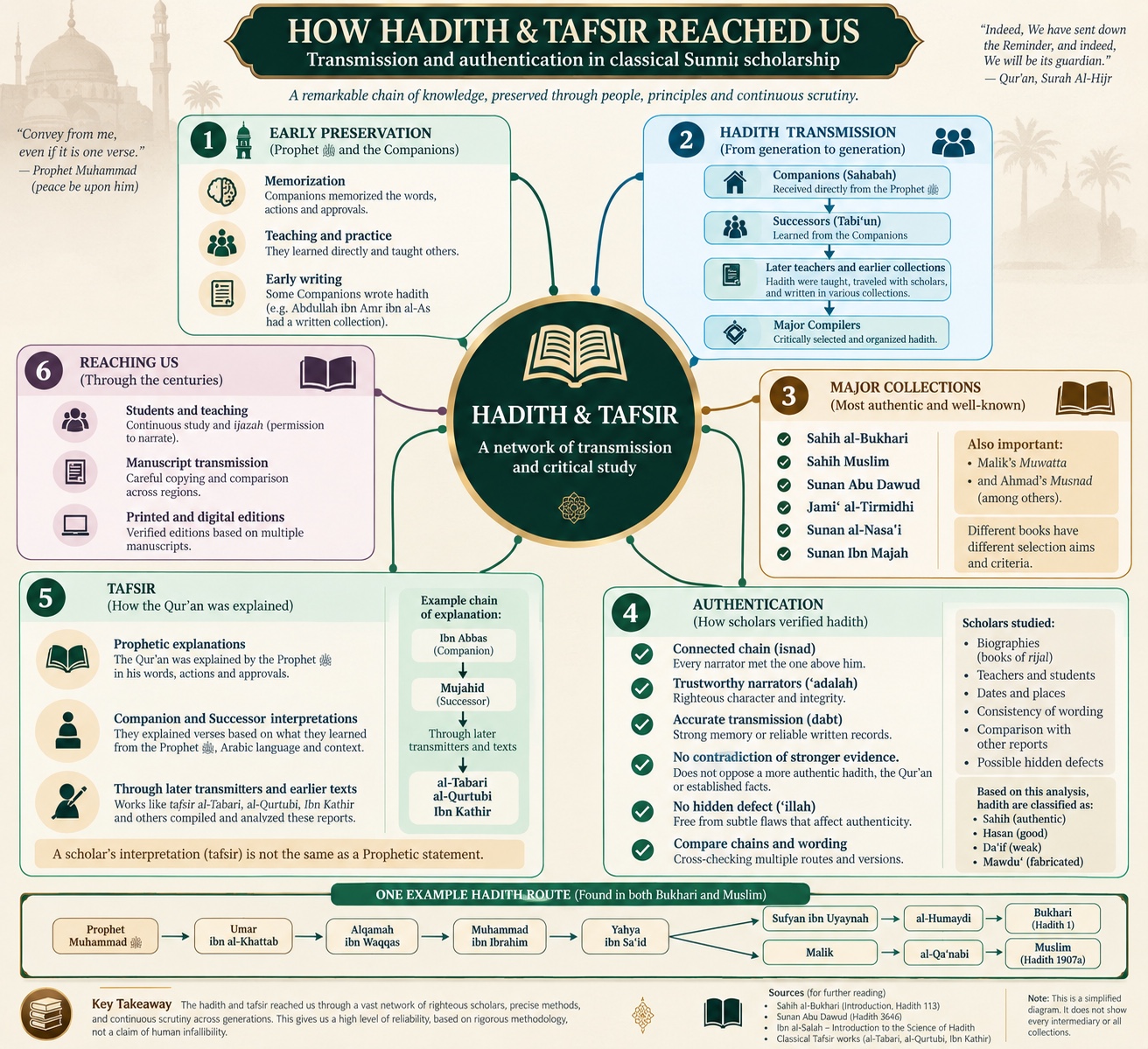
How hadith reached us
A simplified history of preservation, transmission and compilation; stages overlap.
- 1Prophetic lifetimeLearning from the Prophet ﷺ
Companions heard, memorized and practised the teachings; some also wrote them down.
The Prophet ﷺ and examples of Companions who learned from him
- Prophet Muhammad ﷺ
- Abdullah ibn Amr ibn al-As
- Abu Hurayrah
- Aishah bint Abi Bakr
- Anas ibn Malik
- 2First century AHThe Companions teach
Companions passed on what they learned as teaching spread between regions.
The seven most prolific Companion narrators
- Abu Hurayrah
- Abdullah ibn Umar ibn al-Khattab
- Anas ibn Malik
- Aishah bint Abi Bakr
- Abdullah ibn Abbas
- Jabir ibn Abdullah
- Abu Said al-Khudri
- 3Late first / early second century AHSuccessors and organized recording
Successors learned from Companions. Umar ibn Abd al-Aziz encouraged recording hadith; writing had already existed earlier.
Notable Successors and organizers of hadith recording
- Umar ibn Abd al-Aziz — commissioned recording
- Muhammad ibn Muslim ibn Shihab al-Zuhri
- Abu Bakr ibn Muhammad ibn Amr ibn Hazm
- Amrah bint Abd al-Rahman
- Al-Qasim ibn Muhammad ibn Abi Bakr
- 4Second to early fourth century AHCollections take shape
Collections grew, including Malik’s Muwatta, later Bukhari and Muslim, and the Sunan, each with its own selection criteria.
Notable compilers of hadith collections
- Malik ibn Anas — Al-Muwatta
- Ahmad ibn Hanbal — Al-Musnad
- Ishaq ibn Rahawayh — Al-Musnad
- Muhammad ibn Ismail al-Bukhari — Al-Sahih
- Muslim ibn al-Hajjaj — Al-Sahih
- Abu Dawud Sulayman ibn al-Ashath — Al-Sunan
- Muhammad ibn Isa al-Tirmidhi — Al-Jami
- Ahmad ibn Shuayb al-Nasai — Al-Sunan
- Muhammad ibn Yazid Ibn Majah — Al-Sunan
- 5Across the centuriesCriticism, commentary and manuscripts
Scholars continued examining chains and texts, comparing routes, explaining reports and copying books. These activities overlap rather than forming isolated stages.
Notable scholars of criticism, hidden defects and commentary
- Shubah ibn al-Hajjaj
- Yahya ibn Said al-Qattan
- Ahmad ibn Hanbal
- Ali ibn al-Madini
- Yahya ibn Main
- Abu Hatim al-Razi
- Yahya ibn Sharaf al-Nawawi — commentary on Sahih Muslim
- Ahmad ibn Ali Ibn Hajar al-Asqalani — Fath al-Bari
- 6Modern periodCritical editions and digital access
Printed editions and searchable libraries widened access. Availability alone does not authenticate a report; check its source and scholarly assessment.
IslamWebAn online library for reading hadith collections, commentary and scholarly references.
Visit IslamWeb ↗
Learn hadith without overwhelm
Each lesson gives one idea, one example and one short question. Pause and return whenever you like.
Browse by topic
Choose the topic closest to your question to see explained hadiths.
Show detailed topics
Show site selections
Narrators and Companions
Names follow the source attributions. Not every transmitter is a Companion; read the chain for context.