Explained encyclopedia results · 15

Clear search

Excellence of Knowledge

Narrated by MuslimAuthentic

Indeed, I have not asked you to swear because I suspect you, but Jibrīl (Gabriel) came and told me that Allah Almighty is boasting about you before the angels

Narrator in the source: Abu Sa‘īd al-Khudri reported that the Messenger of Allah

Abu Sa‘īd al-Khudri reported: Mu‘āwiyah came upon a group of people sitting in a circle in the mosque and said: What has made you sit together? They said: We have sat together to remember Allah. He said: I adjure you by Allah, has nothing else made you sit together? They replied: By Allah, nothing else has made us sit together. He said: Indeed, I have not asked you to swear because I suspect you, and there was no one in the position I was in from the Messenger of Allah (may Allah's peace and blessings be upon him) who narrates fewer Hadīths from him than me. Verily, the Messenger of Allah (may Allah's peace and blessings be upon him) came upon a group of his Companions sitting in a circle and said: "What has made you sit together?" They said: We have sat together to remember Allah and praise Him for having guided us to Islam and for bestowing favor upon us. He said: "I adjure you by Allah, has nothing else made you sit together?" They said: By Allah, nothing else has made us sit together. He said: "Indeed, I have not asked you to swear because I suspect you, but Jibrīl (Gabriel) came and told me that Allah Almighty is boasting about you before the angels."
Grade in the source
Authentic
Reported by
Narrated by Muslim
Original Arabic wording
عَنْ أَبِي سَعِيدٍ الْخُدْرِيِّ قَالَ: خَرَجَ مُعَاوِيَةُ عَلَى حَلْقَةٍ فِي الْمَسْجِدِ، فَقَالَ: مَا أَجْلَسَكُمْ؟ قَالُوا: جَلَسْنَا نَذْكُرُ اللهَ، قَالَ آللَّهِ مَا أَجْلَسَكُمْ إِلَّا ذَاكَ؟ قَالُوا: وَاللهِ مَا أَجْلَسَنَا إِلَّا ذَاكَ، قَالَ: أَمَا إِنِّي لَمْ أَسْتَحْلِفْكُمْ تُهْمَةً لَكُمْ، وَمَا كَانَ أَحَدٌ بِمَنْزِلَتِي مِنْ رَسُولِ اللهِ صَلَّى اللهُ عَلَيْهِ وَسَلَّمَ أَقَلَّ عَنْهُ حَدِيثًا مِنِّي: وَإِنَّ رَسُولَ اللهِ صَلَّى اللهُ عَلَيْهِ وَسَلَّمَ خَرَجَ عَلَى حَلْقَةٍ مِنْ أَصْحَابِهِ، فَقَالَ: «مَا أَجْلَسَكُمْ؟» قَالُوا: جَلَسْنَا نَذْكُرُ اللهَ وَنَحْمَدُهُ عَلَى مَا هَدَانَا لِلْإِسْلَامِ، وَمَنَّ بِهِ عَلَيْنَا، قَالَ: «آللَّهِ مَا أَجْلَسَكُمْ إِلَّا ذَاكَ؟» قَالُوا: وَاللهِ مَا أَجْلَسَنَا إِلَّا ذَاكَ، قَالَ: «أَمَا إِنِّي لَمْ أَسْتَحْلِفْكُمْ تُهْمَةً لَكُمْ، وَلَكِنَّهُ أَتَانِي جِبْرِيلُ فَأَخْبَرَنِي أَنَّ اللهَ عَزَّ وَجَلَّ يُبَاهِي بِكُمُ الْمَلَائِكَةَ».
Understand this hadith

Mu‘āwiyah ibn Abi Sufyān (may Allah be pleased with him and his father) came upon a group of people sitting in a circle in the mosque and asked them about the purpose behind their gathering. They replied: We are remembering Allah. He (may Allah be pleased with him) asked them to swear that they had only gathered and sat for the purpose of remembering Allah, and they swore to him. Then he said to them, I have not asked you to swear because I suspect you or question your truthfulness. He, then, was informed about his status by the Prophet (may Allah's peace and blessings be upon him) and that no one was closer to him than he was, given the fact that his sister ’Umm Habībah was the Prophet's wife and that he was one of the scribes of the revelation, yet he did not narrate many Hadīths. He narrated to them that the Prophet (may Allah's peace and blessings be upon him) came out of his home one day and found them sitting in the mosque, remembering Allah and praising Him for guiding them to Islam and for bestowing favor upon them. He (may Allah's peace and blessings be upon him) asked them and demanded they swear, just as Mu‘āwiyah (may Allah be pleased with him) did with his companions. The Prophet (may Allah's peace and blessings be upon him) then informed them of the reason behind asking them and requiring them to swear, saying: Gabriel, the angel, (peace be upon him) came to him and informed him that Allah Almighty was boasting about you and taking pride in you before the angels; showing them your merit and the excellence of your deed and praising you in their presence.

Lessons from the hadith
  • The merit of Mu‘āwiyah (may Allah be pleased with him) and his keenness to follow the Prophet's example in conveying knowledge.
  • Permissibility of asking someone to swear without accusation to draw attention to the significance of the report.
  • The merit of Dhikr (remembrance of Allah) and knowledge sessions, and the fact that Allah loves them and takes pride in them before the angels.
References (original Arabic)

صحيح مسلم (4/ 2075) (2701). نزهة المتقين (2/ 993). بهجة الناظرين، لسليم الهلالي (2/ 522). كنوز رياض الصالحين، لمجموعة من الباحثين (17/ 271).

Narrated by At-TermedhyAuthentic hadith

There were two brothers during the time of the Prophet (may Allah's peace and blessings be upon him). One of them used to come to the Prophet (may Allah's peace and blessings be upon him) and the other used to work to earn a living. Once, the working brother complained to the Prophet (may Allah's peace and blessings be upon him) about his brother. Thereupon, he replied: Perhaps you are granted sustenance because of him

Narrator in the source: Anas

Anas ibn Mālik (may Allah be pleased with him) reported: There were two brothers during the time of the Prophet (may Allah's peace and blessings be upon him). One of them used to come to the Prophet (may Allah's peace and blessings be upon him) and the other used to work to earn a living. Once, the working brother complained to the Prophet (may Allah's peace and blessings be upon him) about his brother. Thereupon, he replied: "Perhaps you are granted sustenance because of him."
Grade in the source
Authentic hadith
Reported by
Narrated by At-Termedhy
Original Arabic wording
عن أنس بن مالك رضي الله عنه قال: كان أخوانِ على عهد النبي صلى الله عليه وسلم وكان أحدُهما يأتي النبي صلى الله عليه وسلم والآخر يَحتَرِف، فَشَكَا الُمحتَرِف أَخَاه للنبي صلى الله عليه وسلم فقال: «لعَلَّك تُرزَقُ بِهِ».
Understand this hadith

Anas (may Allah be pleased with him) said that there were two brothers at the time of the Prophet (may Allah's peace and blessings be upon him). One of them used to regularly attend the Prophet's gatherings and stay with him in order to acquire knowledge, and learn his words and actions. As for the other brother, he used to have a profession and work to earn a living. Once the one who was working complained to the Prophet (may Allah's peace and blessings be upon him) about his brother who did not work. So, he told him soothingly that perhaps his financial support of his brother was the reason that sustenance had been made easy for him to attain. That is because Allah continues to aid the one, as long as he aids his brother.

References (original Arabic)

بهجة الناظرين شرح رياض الصالحين لسليم الهلالي، ط1، دار ابن الجوزي، الدمام، 1415هـ. تطريز رياض الصالحين للشيخ فيصل المبارك، ط1، تحقيق: عبد العزيز بن عبد الله آل حمد، دار العاصمة، الرياض، 1423هـ. جامع الترمذي، تحقيق وتعليق: أحمد محمد شاكر وآخرون، ط2، شركة مكتبة ومطبعة مصطفى البابي الحلبي، مصر، 1395هـ. دليل الفالحين لطرق رياض الصالحين، لمحمد علي بن محمد بن علان، ط4، اعتنى بها: خليل مأمون شيحا، دار المعرفة، بيروت، 1425هـ. صحيح الجامع الصغير وزياداته، للألباني، نشر: المكتب الإسلامي. رياض الصالحين للنووي، ط1، تحقيق: ماهر ياسين الفحل، دار ابن كثير، دمشق، بيروت، 1428هـ. نزهة المتقين شرح رياض الصالحين، لمجموعة من الباحثين، ط14، مؤسسة الرسالة، 1407هـ.

Narrated by At-TermedhyGood hadith

Whoever goes out to seek knowledge is in the cause of Allah until he returns

Narrator in the source: Anas

Anas (may Allah be pleased with him) reported that the Prophet (may Allah's peace and blessings be upon him) said: “Whoever goes out to seek knowledge is in the cause of Allah until he returns.”
Grade in the source
Good hadith
Reported by
Narrated by At-Termedhy
Original Arabic wording
عن أنس رضي الله عنه مرفوعاً: «من خَرج في طلب العلم فهو في سَبِيلِ الله حتى يرجع».
Understand this hadith

Anyone who leaves his home or country in search of Shariah knowledge is in the same category of the one who goes out to fight in the cause of Allah, the Almighty, until he returns to his family. Indeed, the knowledge seeker is like a fighter in the cause of Allah in reviving religion, putting the devil to disgrace, and tiring his own soul out in a good cause.

Lessons from the hadith
  • Seeking knowledge is a form of jihad in the cause of Allah.
  • A seeker of knowledge receives the same reward as a fighter in the battlefield, for both of them do something that strengthens the Shariah of Allah and protects it against anything contrary to it.
  • If a person goes out to seek knowledge, he will be rewarded for his walk as he goes and comes back.
References (original Arabic)

جامع الترمذي، تحقيق وتعليق:أحمد محمد شاكر وآخرون، مكتبة ومطبعة مصطفى البابي الحلبي، ط2، مصر، 1395هـ. دليل الفالحين لطرق رياض الصالحين، لمحمد علي بن محمد بن علان، ط4، اعتنى بها: خليل مأمون شيحا، دار المعرفة، بيروت، 1425ه. رياض الصالحين للنووي، ط1، تحقيق: ماهر ياسين الفحل، دار ابن كثير، دمشق، بيروت، 1428هـ. رياض الصالحين، ط4، تحقيق: عصام هادي، وزارة الأوقاف والشؤون الإسلامية القطرية، دار الريان، بيروت، 1428هـ. صحيح الترغيب والترهيب، للألباني، ط5، مكتبة المعارف – الرياض. مرعاة المفاتيح شرح مشكاة المصابيح، للمباركفوري، الطبعة الثالثة، إدارة البحوث العلمية والدعوة والإفتاء، الجامعة السلفية - بنارس الهند، 1404هـ. مرقاة المفاتيح شرح مشكاة المصابيح، للقاري، ط1، دار الفكر، بيروت، 1422هـ. نزهة المتقين شرح رياض الصالحين، لمجموعة من الباحثين، ط14، مؤسسة الرسالة، 1407هـ.

Agreed uponAuthentic

The guidance and knowledge with which Allah has sent me are like abundant rain that fell on some ground

Narrator in the source: Abu Mūsa

Abu Mūsa (may Allah be pleased with him) reported that the Prophet (may Allah's peace and blessings be upon him) said: "The guidance and knowledge with which Allah has sent me are like abundant rain that fell on some ground. A part of it was good, absorbing the water, so it brought forth abundant herbage and pasture; and there were some bare patches in it that retained the water by which Allah gave benefit to people who drank, watered, and grew plants. But some of it fell on another flat portion that could not retain the water or produce herbage. That is like the one who becomes versed in Allah's religion and receives benefit from the message entrusted to me by Allah, so he knows for himself and teaches others; and it is like the one who does not show regard to that and does not accept Allah's guidance with which I have been sent."
Grade in the source
Authentic
Reported by
Agreed upon
Original Arabic wording
عَنْ أَبِي مُوسَى رَضيَ اللهُ عنه عَنِ النَّبِيِّ صَلَّى اللهُ عَلَيْهِ وَسَلَّمَ قَالَ: «مَثَلُ مَا بَعَثَنِي اللَّهُ بِهِ مِنَ الهُدَى وَالعِلْمِ كَمَثَلِ الغَيْثِ الكَثِيرِ أَصَابَ أَرْضًا، فَكَانَ مِنْهَا نَقِيَّةٌ، قَبِلَتِ المَاءَ، فَأَنْبَتَتِ الكَلَأَ وَالعُشْبَ الكَثِيرَ، وَكَانَتْ مِنْهَا أَجَادِبُ، أَمْسَكَتِ المَاءَ، فَنَفَعَ اللَّهُ بِهَا النَّاسَ، فَشَرِبُوا وَسَقَوْا وَزَرَعُوا، وَأَصَابَتْ مِنْهَا طَائِفَةً أُخْرَى، إِنَّمَا هِيَ قِيعَانٌ لاَ تُمْسِكُ مَاءً وَلاَ تُنْبِتُ كَلَأً، فَذَلِكَ مَثَلُ مَنْ فَقُهَ فِي دِينِ اللَّهِ وَنَفَعَهُ مَا بَعَثَنِي اللَّهُ بِهِ، فَعَلِمَ وَعَلَّمَ، وَمَثَلُ مَنْ لَمْ يَرْفَعْ بِذَلِكَ رَأْسًا، وَلَمْ يَقْبَلْ هُدَى اللَّهِ الَّذِي أُرْسِلْتُ بِهِ».
Understand this hadith

The Prophet (may Allah's peace and blessings be upon him), expressing amazement, likened the one who benefits from what he brought—of guidance and the path that leads to the ultimate goal—and from religious knowledge to a land upon which abundant rain falls. This land, in turn, is of three types: The first type: a pure and fertile land that absorbs the rainwater, causing abundant vegetation—both fresh and dry—to grow, from which people benefit. The second type: land that holds water but does not grow vegetation. It retains the water, allowing people to benefit from it—drinking from it, watering their animals, and irrigating their crops. And the third type: a flat, smooth land that neither retains water nor grows any vegetation. It neither benefits itself from the rainwater, nor does it benefit others. Likewise are those who hear what the Prophet (may Allah's peace and blessings be upon him) was sent with—of knowledge and guidance. The first type: the scholar who understands the religion of Allah, acts upon his knowledge, and teaches it to others. He is like the fertile land that absorbs the water, benefiting itself and causing the growth of the plantation, and thereby benefiting others. The second type: the one who memorizes and preserves knowledge but does not have a deep understanding or the ability to derive rulings. He collects knowledge and spends his time doing so, but he either does not act upon its supererogatory aspects or does not comprehend what he has gathered. He is like a tool for others— benefiting them—and is similar to land that holds water, from which people benefit. The third type: the one who hears knowledge but neither preserves it, nor acts upon it, nor conveys it to others. He is like a barren or smooth land that has no vegetation, neither absorbing water nor allowing others to benefit from it.

Lessons from the hadith
  • A clarification of the virtue of seeking knowledge and teaching it, and a warning against turning away from both.
  • Using parables and analogies helps clarify meanings for people.
  • Al-Qurtubi said: Just as rain revives dead land, religious knowledge revives the dead heart. Then, the Prophet (may Allah's peace and blessings be upon him) likened those who hear this knowledge to the various types of land upon which the rain falls.
  • People vary in their ranks in terms of their reception of religious knowledge.
References (original Arabic)

صحيح البخاري (1/ 27) (79). صحيح مسلم (4/ 1787) (2282). بهجة الناظرين شرح رياض الصالحين، لسليم الهلالي (2/ 464). شرح رياض الصالحين، لابن عثيمين (2/ 294). نزهة المتقين شرح رياض الصالحين، لمجموعة من الباحثين (2/ 950).

Narrated by MuslimAuthentic

Whoever relieves a believer from one of the hardships of this world, Allah will relieve him from one of the hardships of the Day of Judgment

Narrator in the source: Abu Hurayrah reported: I heard the Messenger of Allah say:

Abu Hurayrah (may Allah be pleased with him) reported: The Messenger of Allah (may Allah's peace and blessings be upon him) said: "Whoever relieves a believer from one of the hardships of this world, Allah will relieve him from one of the hardships of the Day of Judgment. Whoever makes things easy for someone in difficulty, Allah will make things easy for him in this world and the Hereafter. Whoever covers a Muslim, Allah will cover him in this world and the Hereafter. Allah is in the aid of the slave as long as the slave is in the aid of his brother. Whoever treads a path seeking knowledge, Allah will make easy for him a path to Paradise. No group of people gather in one of the houses of Allah, reciting the Book of Allah and studying it among themselves, except that tranquility descends upon them, mercy envelops them, the angels surround them, and Allah mentions them to those near Him. And whoever is slowed down by his deeds will not be hastened forward by his lineage."
Grade in the source
Authentic
Reported by
Narrated by Muslim
Original Arabic wording
عَنْ أَبِي هُرَيْرَةَ رضي الله عنه قَالَ: قَالَ رَسُولُ اللهِ صَلَّى اللهُ عَلَيْهِ وَسَلَّمَ: «مَنْ نَفَّسَ عَنْ مُؤْمِنٍ كُرْبَةً مِنْ كُرَبِ الدُّنْيَا نَفَّسَ اللهُ عَنْهُ كُرْبَةً مِنْ كُرَبِ يَوْمِ الْقِيَامَةِ، وَمَنْ يَسَّرَ عَلَى مُعْسِرٍ يَسَّرَ اللهُ عَلَيْهِ فِي الدُّنْيَا وَالْآخِرَةِ، وَمَنْ سَتَرَ مُسْلِمًا سَتَرَهُ اللهُ فِي الدُّنْيَا وَالْآخِرَةِ، وَاللهُ فِي عَوْنِ الْعَبْدِ مَا كَانَ الْعَبْدُ فِي عَوْنِ أَخِيهِ، وَمَنْ سَلَكَ طَرِيقًا يَلْتَمِسُ فِيهِ عِلْمًا سَهَّلَ اللهُ لَهُ بِهِ طَرِيقًا إِلَى الْجَنَّةِ، وَمَا اجْتَمَعَ قَوْمٌ فِي بَيْتٍ مِنْ بُيُوتِ اللهِ يَتْلُونَ كِتَابَ اللهِ وَيَتَدَارَسُونَهُ بَيْنَهُمْ إِلَّا نَزَلَتْ عَلَيْهِمِ السَّكِينَةُ، وَغَشِيَتْهُمُ الرَّحْمَةُ، وَحَفَّتْهُمُ الْمَلَائِكَةُ، وَذَكَرَهُمُ اللهُ فِيمَنْ عِنْدَهُ، وَمَنْ بَطَّأَ بِهِ عَمَلُهُ لَمْ يُسْرِعْ بِهِ نَسَبُهُ».
Understand this hadith

The Prophet (may Allah's peace and blessings be upon him) clarified that the reward a Muslim receives from Allah is of the same nature as the actions he performs for other Muslims. Whoever relieves, alleviates, removes, or eliminates a hardship and a difficulty from a believer in this world, Allah will reward him by relieving him from one of the hardships of the Day of Judgment. And whoever facilitates and makes things easy for someone in difficulty and removes his difficulty, Allah will make it easy for him in this world and the Hereafter. And whoever conceals the faults of a Muslim, such as knowing what should not be exposed of slips and errors, Allah will conceal his faults in this world and the Hereafter. Allah supports His slave as long as the slave supports his brother in his religious and worldly interests. Support could be through supplication, physical action, money, etc. Whoever walks in pursuit of religious knowledge, doing it for the sake of Allah Almighty, Allah will facilitate for him a path to Paradise. No group of people gather in one of the houses of Allah, reciting the Book of Allah and studying it among themselves, except that tranquility and solemnity descend upon them, the mercy of Allah envelops and encompasses them, the angels surround them, and Allah praises them in the presence of those near Him. It is enough of an honor that Allah mentions the slave in the highest assembly. The one whose good deeds are insufficient will not be elevated to the rank of those with righteous deeds. Hence, he should not rely upon his noble lineage and the merit of his forefathers while neglecting the performance of good deeds.

Lessons from the hadith
  • Ibn Daqīq al-‘Īd said: This is a great Hadīth, comprising various types of knowledge, rules, and etiquettes. It highlights the merit of fulfilling the needs of Muslims and benefiting them in whatever way is possible, whether through knowledge, wealth, assistance, offering useful advice, giving counsel, or other means.
  • Encouraging the act of making things easy for the one in difficulty.
  • A Muslim is encouraged to help other Muslims, as Allah Almighty helps the one who helps his brother in proportion to his help.
  • Among the ways of concealing a Muslim’s faults is: to refrain from seeking out his shortcomings. One of the predecessors is reported to have said: I met people who had no faults, yet they spoke about the faults of others, so people started mentioning their faults. And I met people who had faults but refrained from mentioning the faults of others, so their faults were forgotten.
  • It is not a requirement of concealing the faults of others to neglect the prohibition of evil and not to change it. Rather, it should be changed and concealed at the same time, and this applies to those who are not known for corruption or persistence in transgression. As for one who is known for such behavior, it is not recommended to conceal his faults; instead, his affair should be referred to those in authority, provided that this does not lead to greater harm. This is because concealing his faults encourages him in his corruption and emboldens him to harm others, as well as emboldening others from among the wicked and stubborn.
  • Encouraging the act of seeking knowledge, reciting, and studying the Qur’an.
  • An-Nawawi said: This is evidence of the merit of gathering to recite the Quran in the mosque... and similar gatherings in a school, a garrison, or the like also attain this merit, Allah willing.
  • Allah has made the recompense contingent upon deeds, not upon lineages.
References (original Arabic)

صحيح مسلم (4/ 2074) (2699). التحفة الربانية، لإسماعيل الأنصاري (ص82). الأحاديث الأربعون النووية وعليها الشرح الموجز المفيد، لعبد الله المحسن (ص69). شرح الأربعين النووية ، لابن عثيمين (ص355).

Agreed uponAuthentic

When Allah intends good for someone, He grants him the understanding of the religion

Narrator in the source: Mu‘āwiyah reported: I heard the Prophet say:

Mu‘āwiyah (may Allah be pleased with him) reported: I heard the Prophet (may Allah's peace and blessings be upon him) say: "When Allah intends good for someone, He grants him the understanding of the religion. Indeed, I am only a distributor, and Allah is the Giver. This Ummah will continue to follow Allah's laws, not being harmed by those who oppose them, until Allah's command comes to pass."
Grade in the source
Authentic
Reported by
Agreed upon
Original Arabic wording
عن معاوية رضي الله عنه قال: سمعت النبي صلى الله عليه وسلم يقول: «مَنْ يُرِدِ اللهُ بِهِ خَيْرًا يُفَقِّهْهُ فِي الدِّينِ، وَإِنَّمَا أَنَا قَاسِمٌ، وَاللهُ يُعْطِي، وَلَنْ تَزَالَ هَذِهِ الْأُمَّةُ قَائِمَةً عَلَى أَمْرِ اللهِ، لَا يَضُرُّهُمْ مَنْ خَالَفَهُمْ، حَتَّى يَأْتِيَ أَمْرُ اللهِ».
Understand this hadith

The Prophet (may Allah's peace and blessings be upon him) informs that when Allah wills to do good to someone, He endows him with the understanding of His religion. He also states that he is only a distributor who distributes the sustenance, knowledge, and other things that Allah Almighty gave him, and that the true Giver is Allah, and all else are mere causes that can only bring benefit with Allah's permission. He adds that this Ummah will continue to hold onto Allah's laws and not be harmed by those who oppose them until the Hour comes.

Lessons from the hadith
  • The Hadīth shows the greatness and merit of the Shar‘i knowledge and its learning and urges us to seek it.
  • Adherence to the truth must exist within this Ummah. If one group forsakes it, another will follow it.
  • Understanding of the religion is part of Allah's intention of goodness for His servants.
  • The Prophet (may Allah's peace and blessings be upon him) only gives according to Allah's Command and His Will, and he himself possesses nothing.
References (original Arabic)

صحيح البخاري (1/ 25) (71). صحيح مسلم (2/ 718) (1037). توضيح الأحكام من بلوغ المرام، للبسام (7/ 485). منحة العلام في شرح بلوغ المرام، لعبد الله الفوزان (10/ 324). فتح ذي الجلال والإكرام، لابن عثيمين (6/ 424). سبل السلام بشرح بلوغ المرام، للصنعاني (2/ 688).

Narrated by At-TirmidhiHasan/Sound by virtue of corroborating evidence

The superiority of the scholar over the worshiper is like my superiority over the lowest among you

Narrator in the source: Abu ’Umāmah al-Bāhili reported: I heard the Messenger of Allah say:

Abu ’Umāmah al-Bāhili (may Allah be pleased with him) reported: Two men were mentioned to the Messenger of Allah (may Allah's peace and blessings be upon him): one of them was a devout worshipper and the other a scholar. The Messenger of Allah (may Allah's peace and blessings be upon him) said: "The superiority of the scholar over the worshiper is like my superiority over the lowest among you." Then, the Messenger of Allah (may Allah's peace and blessings be upon him) said: "Indeed, Allah, His angels, the inhabitants of the heavens and the earth, even the ant in its hole, and even the fish, invoke blessings upon one who teaches people goodness."
Grade in the source
Hasan/Sound by virtue of corroborating evidence
Reported by
Narrated by At-Tirmidhi
Original Arabic wording
عَنْ أَبِي أُمَامَةَ البَاهِلِيِّ رَضيَ اللهُ عنه قَالَ: ذُكِرَ لِرَسُولِ اللهِ صَلَّى اللَّهُ عَلَيْهِ وَسَلَّمَ رَجُلاَنِ أَحَدُهُمَا عَابِدٌ وَالآخَرُ عَالِمٌ، فَقَالَ رَسُولُ اللهِ صَلَّى اللَّهُ عَلَيْهِ وَسَلَّمَ: «فَضْلُ العَالِمِ عَلَى العَابِدِ كَفَضْلِي عَلَى أَدْنَاكُمْ»، ثُمَّ قَالَ رَسُولُ اللهِ صَلَّى اللَّهُ عَلَيْهِ وَسَلَّمَ: «إِنَّ اللَّهَ وَمَلاَئِكَتَهُ وَأَهْلَ السَّمَوَاتِ وَالأَرَضِينَ حَتَّى النَّمْلَةَ فِي جُحْرِهَا وَحَتَّى الحُوتَ لَيُصَلُّونَ عَلَى مُعَلِّمِ النَّاسِ الخَيْرَ».
Understand this hadith

Two men were mentioned to the Messenger of Allah (may Allah's peace and blessings be upon him): one of them a devout worshipper and the other a scholar, and he was asked which of them is better? He (may Allah's peace and blessings be upon him) said: The superiority of the scholar who possesses religious knowledge, acts upon it, and teaches it, over the devout worshipper who is devoted to worship while only knowing what is obligatory for him of knowledge, is like his superiority and honor (may Allah's peace and blessings be upon him) over the least of his Companions. Then the Prophet (may Allah's peace and blessings be upon him) explained the reason for this superiority: that Allah Almighty, those who bear the Throne from His angels, the inhabitants of the heavens from among all the angels, and the inhabitants of the earth from among humans, jinn, and all animals, even the ant in its hole deep in the earth, and the fish in the sea—thus including the creatures of both land and sea—all of them supplicate for good for the one who teaches people the religious knowledge that leads to their salvation and success.

Lessons from the hadith
  • Among the methods of calling to Allah is using encouragement and giving parables (examples).
  • The great honor of the scholars is that they have acquired knowledge and fulfilled its duties through practice and calling others to it.
  • Encouragement to respect scholars and the knowledge seekers and to supplicate for them.
  • Encouragement to teach people goodness, as it is a means of their salvation and happiness.
References (original Arabic)

سنن الترمذي (4/ 416) (2685). كنوز رياض الصالحين، لمجموعة من الباحثين (16/ 481). مرقاة المفاتيح شرح مشكاة المصابيح، لعلي القاري (1/ 298). فيض القدير شرح الجامع الصغير، للمناوي (4/ 432). بهجة الناظرين شرح رياض الصالحين، لسليم الهلالي (2/ 469). تطريز رياض الصالحين، لفيصل آل مبارك (ص758). نزهة المتقين شرح رياض الصالحين، لمجموعة من الباحثين (2/ 954).

Narrated by Ibn Majah - Narrated by At-Termedhy - Narrated by Abu Daoud - Narrated by Ahmad - Ad-DaarimiGood hadith

Whoever follows a path in pursuit of knowledge, Allah will facilitate for him a path to Paradise

Narrator in the source: Abu ad-Dardā’ reported: The Prophet

Abu Ad-Dardā’ (may Allah be pleased with him) reported: The Messenger of Allah (may Allah's peace and blessings be upon him) said: "Whoever follows a path in pursuit of knowledge, Allah will facilitate for him a path to Paradise. Indeed, the angels lower their wings for the seeker of knowledge, out of pleasure at what he does. Verily, the inhabitants of the heavens and the earth, even the fish in the water, ask forgiveness from Allah for the knowledgeable. The superiority of a scholar over a devout worshiper is like the superiority of the moon over the rest of the stars. Indeed, the scholars are the inheritors of the prophets, who bequeath neither dinar nor dirham, only knowledge. So whoever acquires it has actually taken abundant wealth."
Grade in the source
Good hadith
Reported by
Narrated by Ibn Majah - Narrated by At-Termedhy - Narrated by Abu Daoud - Narrated by Ahmad - Ad-Daarimi
Original Arabic wording
عن أبي الدرداء رضي الله عنه عن النبي صلى الله عليه وسلم قال: «مَنْ سَلَكَ طَريقا يَبْتَغي فيه عِلْما سَهَّل الله له طريقا إلى الجنة، وإنَّ الملائكةَ لَتَضَعُ أجْنِحَتها لطالب العلم رضًا بما يَصنَع، وإنَ العالم لَيَسْتَغْفِرُ له مَنْ في السماوات ومَنْ في الأرض حتى الحيتَانُ في الماء، وفضْلُ العالم على العَابِدِ كَفَضْلِ القمر على سائِرِ الكواكب، وإنَّ العلماء وَرَثَة الأنبياء، وإنَّ الأنبياء لم يَوَرِّثُوا دينارا ولا دِرْهَماً وإنما وَرَّثُوا العلم، فَمَنْ أَخَذَهُ أَخَذَ بحَظٍّ وَافِرٍ».
Understand this hadith

The Hadīth sheds light on some merits of the pursuit of knowledge, as follows: 1. If a person treads a path in pursuit of knowledge or even if he seeks knowledge while at home, Allah, the Almighty, will reward him by facilitating a path leading him to Paradise. The pursuit of knowledge includes a tangible path, where a man actually walks (to gain knowledge), and an intangible one, like attending the classes of scholars and reading books. Thus, he is considered to be following a path of knowledge, even though he is actually sitting. 2. The inhabitants of the heavens and the earth, even the fish and animals, invoke the forgiveness of Allah, the Almighty, for the scholars. 3. The angels, honored by Allah, the Almighty, lay down their wings for the seeker of knowledge out of pleasure at what he does and in humility and reverence towards knowledge and the knowledgeable. 4. The scholars are the inheritors of the prophets. They take knowledge, application, the call to Allah, the Almighty, and guiding people to His religion from them. 5. The superiority of a scholar over a devout worshiper is like the superiority of the moon over the rest of the stars. Indeed, the light and virtue of worship are limited to the worshiper; it does not reach others, just like the light of the stars. By contrast, the light and virtue of knowledge transcend the scholar and reach others, enlightening them. The Prophet (may Allah's peace and blessings be upon him) highlighted that the prophets did not bequeath worldly fortunes, but the best legacy they leave behind is knowledge. Whoever acquires it has indeed taken a great fortune. In fact, this is the true beneficial inheritance. Let no one think that a scholar does not engage in worship or that a worshiper lacks knowledge. But, the knowledge of the former prevails over his deeds, whereas the deeds of the latter override his knowledge. Hence, the scholars are considered as the inheritors of the prophets, who gained both merits – knowledge and action – and were marked by perfection and the pursuit of improvement. This is the course to be taken by those who truly know their Lord and walk in the path leading to Him.

References (original Arabic)

- الجامع الصحيح -وهو سنن الترمذي-؛ للإمام محمد بن عيسى الترمذي، تحقيق أحمد شاكر وآخرين، مكتبة الحلبي-مصر، الطبعة الثانية، 1388هـ. - رياض الصالحين من كلام سيد المرسلين؛ للإمام أبي زكريا النووي، تحقيق د. ماهر الفحل، دار ابن كثير-دمشق، الطبعة الأولى، 1428هـ. - سنن أبي داود؛ للإمام أبي داود سليمان بن الأشعث السجستاني، تعليق عزت الدعاس وغيره، دار ابن حزم-بيروت، الطبعة الأولى، 1418هـ. - سنن ابن ماجه؛ للحافظ محمد بن يزيد القزويني، حققه محمد فؤاد عبدالباقي، دار إحياء الكتب العربية. - شرح رياض الصالحين؛ للشيخ محمد بن صالح العثيمين، مدار الوطن، الرياض، 1426هـ. - صحيح الترغيب والترهيب؛ تأليف محمد ناصر الدين الألباني، مكتبة المعارف-الرياض، الطبعة الخامسة. - كنوز رياض الصالحين؛ فريق علمي برئاسة أ.د. حمد العمار، دار كنوز إشبيليا-الرياض، الطبعة الأولى، 1430هـ. - نزهة المتقين شرح رياض الصالحين؛ تأليف د. مصطفى الخِن وغيره، مؤسسة الرسالة-بيروت، الطبعة الرابعة عشر، 1407هـ. - سنن أبي داود, أبو داود سليمان بن الأشعث بن إسحاق بن بشير بن شداد بن عمرو الأزدي السِّجِسْتاني, المحقق: محمد محيي الدين عبد الحميد, المكتبة العصرية، صيدا – بيروت. - سنن الترمذي، تأليف: محمد بن عيسى الترمذي، تحقيق أحمد شاكر وغيره ، الناشر: شركة مكتبة ومطبعة مصطفى البابي الحلبي، الطبعة: الثانية، 1395 هـ. - مسند الإمام أحمد بن حنبل، تحقيق: شعيب الأرنؤوط - عادل مرشد، وآخرون، نشر: مؤسسة الرسالة، الطبعة: الأولى، 1421هـ - 2001 م. - صَحِيحُ التَّرْغِيب وَالتَّرْهِيب, محمد ناصر الدين الألباني, مكتَبة المَعارف لِلنَشْرِ والتوزيْع، الرياض - المملكة العربية السعودية, الطبعة: الأولى، 1421 هـ - 2000 م. - بهجة الناظرين, سليم بن عيد الهلالي، الناشر: دار ابن الجوزي ، سنة النشر: 1418 هـ- 1997م. - مفتاح دار السعادة ومنشور ولاية العلم والإرادة, محمد بن أبي بكر بن أيوب بن سعد شمس الدين ابن قيم الجوزية, دار الكتب العلمية – بيروت. - دليل الفالحين لطرق رياض الصالحين, محمد علي بن محمد البكري الصديقي الشافعي, اعتنى بها: خليل مأمون شيحا, الناشر: دار المعرفة للطباعة والنشر والتوزيع، بيروت – لبنان, الطبعة: الرابعة، 1425 هـ - 2004 م. - تطريز رياض الصالحين, فيصل بن عبد العزيز بن فيصل ابن حمد المبارك الحريملي النجدي, المحقق: د. عبد العزيز بن عبد الله آل حمد, دار العاصمة للنشر والتوزيع، الرياض, الطبعة: الأولى، 1423 هـ - 2002 م. - مرقاة المفاتيح شرح مشكاة المصابيح، لعلي بن سلطان الملا الهروي القاري، الناشر: دار الفكر، بيروت – لبنان، الطبعة: الأولى، 1422هـ - 2002م. - حاشية السندي على سنن ابن ماجه = كفاية الحاجة في شرح سنن ابن ماجه, محمد بن عبد الهادي التتوي، أبو الحسن، نور الدين السندي, دار الجيل - بيروت، بدون طبعة. - تاج العروس من جواهر القاموس, محمّد بن محمّد بن عبد الرزّاق الحسيني، الملقّب بمرتضى، الزَّبيدي, مجموعة من المحققين, الناشر: دار الهداية.
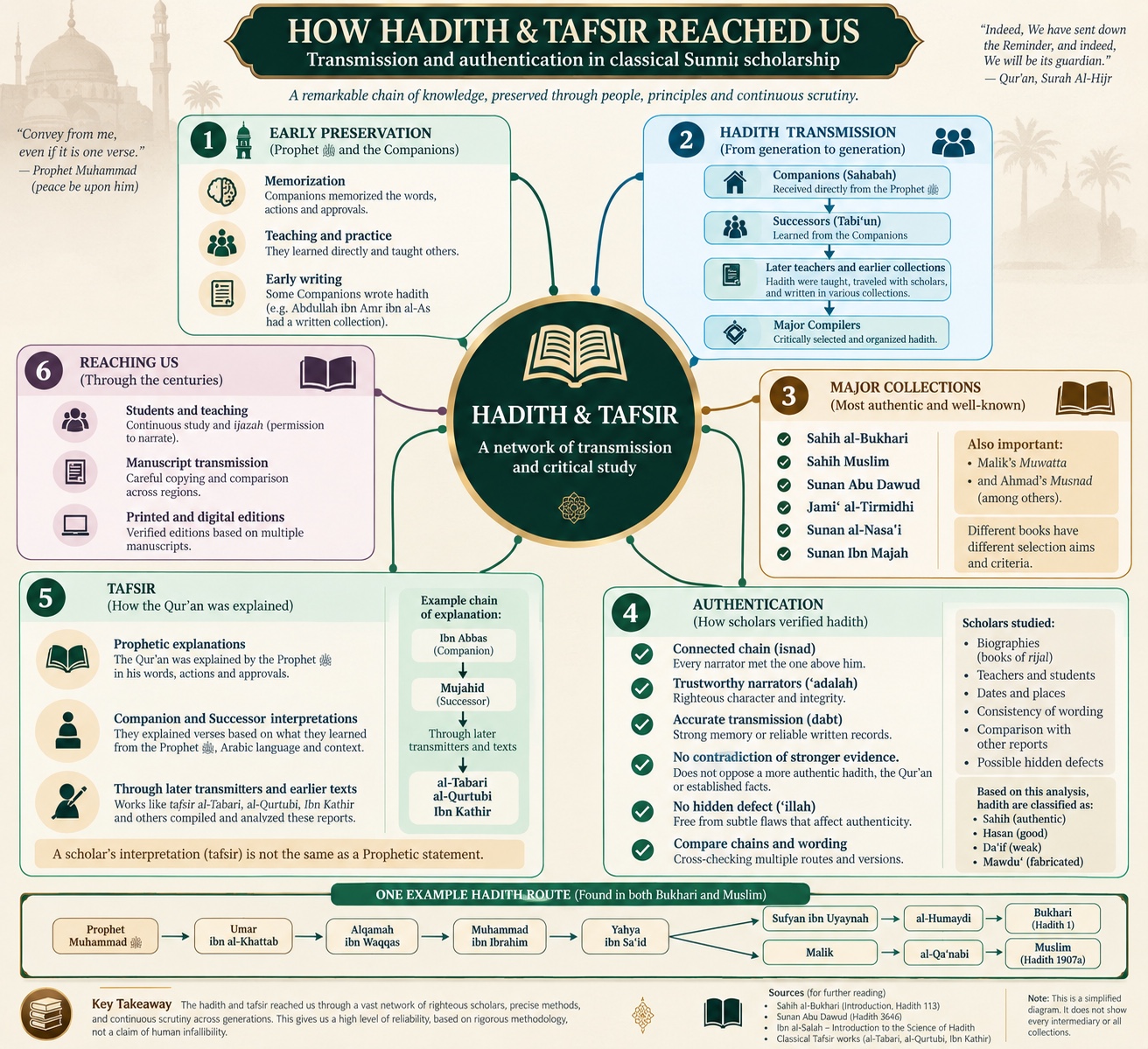
How hadith and tafsir reached us: preservation, transmission, collections, authentication and study
Tap the diagram to open it full size.
SEE THE WHOLE STORY

How hadith reached us

A simplified history of preservation, transmission and compilation; stages overlap.

  1. 1
    Prophetic lifetimeLearning from the Prophet ﷺ

    Companions heard, memorized and practised the teachings; some also wrote them down.

    The Prophet ﷺ and examples of Companions who learned from him

    • Prophet Muhammad ﷺ
    • Abdullah ibn Amr ibn al-As
    • Abu Hurayrah
    • Aishah bint Abi Bakr
    • Anas ibn Malik
    Selected notable names; not an exhaustive list. Activities and generations overlap.Reference ↗
  2. 2
    First century AHThe Companions teach

    Companions passed on what they learned as teaching spread between regions.

    The seven most prolific Companion narrators

    • Abu Hurayrah
    • Abdullah ibn Umar ibn al-Khattab
    • Anas ibn Malik
    • Aishah bint Abi Bakr
    • Abdullah ibn Abbas
    • Jabir ibn Abdullah
    • Abu Said al-Khudri
    Selected notable names; not an exhaustive list. Activities and generations overlap.Reference ↗
  3. 3
    Late first / early second century AHSuccessors and organized recording

    Successors learned from Companions. Umar ibn Abd al-Aziz encouraged recording hadith; writing had already existed earlier.

    Notable Successors and organizers of hadith recording

    • Umar ibn Abd al-Aziz — commissioned recording
    • Muhammad ibn Muslim ibn Shihab al-Zuhri
    • Abu Bakr ibn Muhammad ibn Amr ibn Hazm
    • Amrah bint Abd al-Rahman
    • Al-Qasim ibn Muhammad ibn Abi Bakr
    Selected notable names; not an exhaustive list. Activities and generations overlap.Reference ↗
  4. 4
    Second to early fourth century AHCollections take shape

    Collections grew, including Malik’s Muwatta, later Bukhari and Muslim, and the Sunan, each with its own selection criteria.

    Notable compilers of hadith collections

    • Malik ibn Anas — Al-Muwatta
    • Ahmad ibn Hanbal — Al-Musnad
    • Ishaq ibn Rahawayh — Al-Musnad
    • Muhammad ibn Ismail al-Bukhari — Al-Sahih
    • Muslim ibn al-Hajjaj — Al-Sahih
    • Abu Dawud Sulayman ibn al-Ashath — Al-Sunan
    • Muhammad ibn Isa al-Tirmidhi — Al-Jami
    • Ahmad ibn Shuayb al-Nasai — Al-Sunan
    • Muhammad ibn Yazid Ibn Majah — Al-Sunan
    Selected notable names; not an exhaustive list. Activities and generations overlap.Reference ↗
  5. 5
    Across the centuriesCriticism, commentary and manuscripts

    Scholars continued examining chains and texts, comparing routes, explaining reports and copying books. These activities overlap rather than forming isolated stages.

    Notable scholars of criticism, hidden defects and commentary

    • Shubah ibn al-Hajjaj
    • Yahya ibn Said al-Qattan
    • Ahmad ibn Hanbal
    • Ali ibn al-Madini
    • Yahya ibn Main
    • Abu Hatim al-Razi
    • Yahya ibn Sharaf al-Nawawi — commentary on Sahih Muslim
    • Ahmad ibn Ali Ibn Hajar al-Asqalani — Fath al-Bari
    Selected notable names; not an exhaustive list. Activities and generations overlap.Reference ↗
  6. 6
    Modern periodCritical editions and digital access

    Printed editions and searchable libraries widened access. Availability alone does not authenticate a report; check its source and scholarly assessment.

    IslamWeb

    An online library for reading hadith collections, commentary and scholarly references.

    Visit IslamWeb ↗
One small step at a time

Learn hadith without overwhelm

Each lesson gives one idea, one example and one short question. Pause and return whenever you like.

Start step one →
UnderstandWhat is hadith?
FollowChains
CheckGrades
PractiseBy yourself
Step three

Browse by topic

Choose the topic closest to your question to see explained hadiths.

Show detailed topics
Revelation and Collection of the Qur'an14Modes of Qur'anic Recitation and Tajweed7Qur'anic Exegesis16General Qur'anic Topics14Excellence of the Qur'an31Meanings and Attributes of the Qur'an1Occasions of Revelation5Abrogating and Abrogated Verses1Collecting the Qur'an2Seven Modes of the Qur'anic Revelation2Science of Tajweed4Stops and Starts1Rules and Principles of Exegesis1Rulings of the Qur'an and Codices4Manners of Reading and Memorizing the Qur'an7Refuting Allegations against the Qur'an3Inference from the Qur'an1Merit of Taking Care of the Qur'an13Virtues of Surahs and Verses17General Sunnah Topics10Significance and Status of the Sunnah9Writing the Sunnah3Belief in Allah the Mighty and Majestic133Belief in the Angels30Belief in the Revealed Books3Belief in the Messengers49Belief in the Last Day109Belief in the Divine Decree and Fate25Names and Rulings78The Companions36The Prophet's Family15Allegiance and Dissociation14People of the Sunnah and the Community1Sects and Schools1Oneness of Allah's Lordship8Oneness of Allah's Worship42Oneness of Allah's Names and Attributes75The Angels20The Jinn7Pre-Islamic Scriptures1The Qur'an1Prophethood4Pre-Islamic Prophets and Messengers, peace be upon them22Our Prophet Muhammad, may Allah's peace and blessings be upon him20Miracles of the Pious Allies of Allah4The Barzakh Life (After death Period)19Portents of the Hour27The Hereafter Life45Levels of Divine Decree and Fate9Issues of Divine Decree and Fate9Islam22Nullifiers of Islam5Issues of Pre-Islamic Era8Increase and Decrease of Faith9Branches of Faith7Disbelief7Polytheism10Hypocrisy10Immorality3Religious Innovation7Merit of the Companions30Belief in the the Companions2Degrees of the Companions5Merit of the Prophet's Family6Merit of the Mothers of the Believers4Belief in the Prophet's Family1Rights of the Prophet's Family4Rulings of Allegiance and Dissociation5Forbidden Emulation6Emigration and its Rulings2Desertion and its Conditions2Characteristics of the People of the Sunnah and the Community1Old Sects and Schools1Jurisprudence of Acts of Worship736Jurisprudence of Transactions103Religious Obligations6Family Jurisprudence168Spiritual and Physical Therapy22Foods and Drinks42Crimes22Prescribed Punishments42Judiciary14Principles of Islamic Jurisprudence18Purification132Prayer349Funerals33Zakah39Fasting57Hajj and ‘Umrah63Jihad84Sales19Conditions of Sale1Sale-Related Stipulations2Selling Assets and Fruits3Advance Payment1Usury6Loan3Mortgage1Collateral and Surety1Conciliation and Neighborhood Rulings4Interdiction1Partnership1Sharecropping3Leasing1Racing and Gambling2Usurpation2Preemption1Found Item and Foundling2Endowment6Gift10Bequest4Manumission15Oaths and Vows22Conditions of Inheritance1Impediments of Inheritance3Agnates1Inheritance Shares of Blood Relatives1Inheritance Shares of Embryos1Marriage62Divorce12Remarriage with One's Divorcee1Wife-Initiated Divorce2Oath to Abstain from Intercourse with One's Wife1Zihaar (Likening one's wife to an unmarrriagble woman)3Oath of Condemnation11Waiting Period12Breastfeeding9Custody3Expenses10Clothing and Adornment12Muslim Society7Rulings of Women28Rulings of Newborns8Prophetic Medicine5Rulings of Medication3Ruqyah (Healing and Protective Supplications)9Rulings of Foods and Drinks6Lawful and Unlawful Animals and Birds16Slaughtering9Hunting6Rulings of Animals Slaughtered by the Disbelievers1Forbidden Drinks8Retribution10Blood Money9Rulings of Prescribed Punishments2Conditions of implementing Prescribed Punishments4Prescribed Punishment for Adultery11Prescribed Punishment for Calumny4Prescribed Punishment for Drinking Alcohol8Prescribed Punishment for Theft7Prescribed Punishment for Highway Robbery3Prescribed Punishment for Apostasy3Rulings of Discretionary Punishments2Judiciary: Its Ruling, Merit, and Significance1Manners of Judges2Claims and Proofs7Testimonies3Shariah Ruling5Juristic and Usooli (Juristic Priciples) Rules3Religious Assignment and its Conditions1The Book (the Qur'an)1The Sunnah1Abrogation2Significations and Inference3Personal Reasoning and Imitation1Divergence and Preponderance2Shariah Objectives3Virtues164Jurisprudence of Ethics127Shariah-approved Manners184Jurisprudence of Supplications and Remembrance of Allah113Heart-Softeners and Sermons188Excellence of Knowledge15Excellence of Monotheism11Merits of the Noble Qur'an10Merits of Being Dutiful to One's Parents10Merits of Maintaining Kinship Ties2Merits of Prophet's Family8Merits of the Companions32Merits of Good Deeds33Merits of Remembering Allah25Merits of Supplication4Merits of Heart Acts11Merits of Organs' Acts8Praiseworthy Morals80Blameworthy Morals46Manners of Scholars and Learners12Etiquettes of Reciting the Noble Qur’an3Manners of Greeting and Seeking Permission23Manners of Speaking and Keeping Silent31Manners of Divergence2Manners of Debate1Manners of Eating and Drinking31Manners of the Road and the Market3Manners and Rulings of Travel20Manners of Sleeping and Waking Up7Manners of Visions9Manners of Visiting and Seeking Permission13Manners of Sneezing and Yawning5Manners of Visiting the Sick9Manners of Dressing15Prophetic Guidance on Remembering Allah8Benefits of Remembering Allah15Morning and Evening Dhikr7Timeless Dhikr8Dhikr on Entering and Leaving the House2Dhikr on Entering and Leaving the Bathroom1Dhikr on Entering and Leaving the Mosque2Hard Times Dhikr3Dhikr on Special Occasions20Rulings of Supplication2Types of Supplication1Manners of Supplication7Causes for Answering or not Answering Supplications10Reported Supplications33Acts of Heart26Heart Diseases5Asceticism and Piety13States of the Righteous Believers12Condemning Sins21Condemning Love of the World26Condemning Whims and Desires9Repentance15Purification of Souls16Terrors of the Graves3Descriptions of Paradise and Hell53Calling to Allah (Da‘wah)36Enjoining Good and Forbidding Evil13Shariah-approved Politics51Islamic Culture1Ruling of Calling to Allah1Manners of Calling to Allah2Backgrounds and Duties of the Callers to Allah2Excellence and Merits of Islam14Universality of Islam3Human Rights in Islam5Animal Rights in Islam10Ruling of Enjoining Good and Forbidding Evil4Excellence of Enjoining Good and Forbidding Evil3Manners of Enjoining Good and Forbidding Evil2Principles of Enjoining Good and Forbidding Evil1Requirements of Enjoining Good and Forbidding Evil2Rulings and Issues of Enjoining Good and Forbidding Evil2Ways of Electing the Supreme Muslim Imam (Ruler)2Requirements of the Supreme Imamate (Leadership)4Duties of the Imam17Imam's Rights over the Subjects19Rebelling against the Muslim Ruler6International Relations in Islam1Consultation System in Islam1Islamic Civilization1Prophet's Biography192History17Prophet's Lineage2Prophet's Wives and Family Issues14Prophet's Children3Prophet's Servants1Prophet's Life before Mission2Prophet's Mission1The Makkan Period5The Emigration (Hijrah)3The Madinan Period1Prophet's Battles and Expeditions27Prophet's Correspondences2Prophet's Death18Muhammadan Qualities99Stories and Conditions of Pre-Islamic Nations9History of Makkah, Madinah, and the Aqsa (Jerusalem)1Wars and Battles1Biographies (of Famous Figures)2Countries and Figures1Periodical Occasions3Ahl-us-Sunnah's (Sunni) Stance on Religious Innovators2Rulings of Water6Removing Impurities13Utensils5Toilet Manners13Natural Cleanliness Practices9Ablution42Ritual Bath28Dry Ablution6Menses, Postpartum Bleeding, Extra-Menses Bleeding12Excellence of Ablution7Pillars of Ablution2Recommended Acts and Manners of Ablution12Method of Ablution11Nullifiers of Ablution8Rulings of the Ritual Bath1Causes of Obligatory Ritual Bath3Recommended Manners of the Ritual Bath3Obligation of Prayer and Ruling on Its Abandoner10Virtue of Prayer17The Azan and Iqaamah20Times Not to Pray6Conditions of Prayer28Pillars of Prayer3Obligatory Acts of Prayer1Recommended Acts of Prayer15Method of Prayer53Dhikr (Invocation) during Prayer23Nullifiers of Prayer2Mistakes during Prayer10Prostration of Forgetfulness, Recitation, Gratitude15Virtue and Rulings of Congregational Prayer16Rulings of the Imam and Followers in Prayer27Prayer of the People with Excuses9Jumu‘ah (Friday) Prayer14Voluntary Prayer59Prayer of Fear3Virtue of Friday2Merit of Jumu‘ah Prayer1Rulings of Jumu‘ah Prayer1Rulings of Jumu‘ah Sermon2Virtue of Voluntary Prayer2Regular Sunnah (Recommended) Prayers6Voluntary Night Prayer (Qiyaam)29Prayer of the Two Eids2Prayer of the Solar and Lunar Eclipse4Rain-Seeking Prayer2Forenoon Prayer4Guidance-Seeking Prayer1Death and Its Rulings11Washing the Dead2Method of Praying over the Dead7Carrying and Burying the Dead4Consolation3Visiting the Graves3Doing Good Deeds on behalf of the Deceased and Gifting them the Reward1Obligation of Zakah and Ruling of Its Abandoning3Rulings and Issues of Zakah2Zakah of Gold and Silver1Zakah of Livestock2Zakah of Land Produce2Zakat-ul-Fitr (Minor-Eid Charity)3Channels of Zakah (People Who Receive Zakah)3Voluntary Charity26Obligation of Fasting and Ruling of Its Abandoning2Virtue of Fasting6Recommended Acts of Fasting7Sighting the Crescent1Fasting on the Day of Doubt1Fasting Missed Days of Ramadaan3Fasting of People with Excuses3Nullifiers of Fasting1Fasting Obligations1What is Permissible for the Fasting Person2Fasting Prohibitions4What is Disliked for the Fasting Person1Voluntary Fasting13Seclusion for Worship in Ramadaan (I‘tikaaf)5Last Ten Days of Ramadaan6Obligation of Hajj and ‘Umrah and Ruling of Its Abandoner1Virtue of Hajj and Umrah7First Ten Days of Dhul Hijjah (Twelfth Lunar Month)1Rulings of Al-Masjid Al-Haraam, the Prophet's Mosque, and the Aqsa Mosque6Rulings of Ihraam (the Ritual State of Consecration)2Prohibitions of Ihraam6Ransom and Hunting Expiation2Types of Rituals (Pilgrimage)2Obligations of ‘Umrah1How to Make Hajj (Pilgrimage)9Pillars of Hajj (Pilgrimage)1Obligations of Hajj (Pilgrimage)1Rulings of the Prophet's Mosque1Sacrificial Animals and Expiations6Sacrifice5Rulings and Issues of Hajj and ‘Umrah16Ruling of Jihad1Excellence of Jihad35Categories of Jihad2Rulings and Issues of Jihad30Manners of Jihad7Rulings of Non-Muslims Living in Muslim Country2Rulings of Truce and Security3Rulings of Terrorism, Assassinations, and Explosions1Forbidden Sales10Oaths2Vows3Excellence of Marriage1Manners of Marriage7Rulings and Conditions of Marriage4Women Unlawful to Marry4Conditions of Marriage1Marrying the Disbelievers2Forbidden Marriages3Dowry7Wedding Banquet5Marital Relations17Words of Divorce1Sunnah Divorce and Innovative Divorce3Revocable and Irrevocable Divorce3Rulings and Issues of Divorce5Rulings of the Waiting Period1The Divorced Woman's Waiting Period2Ascertaining Non-Pregnancy1Ruling of Breastfeeding1Conditions of Breastfeeding2Consequences of Breastfeeding1Jurisprudence for Muslim Women1Intermixing1Polygamy1Men-Women Relationships8Naming the Newborn2Sacrificing for the Newborn3Providing for Children1Raising Children1Rulings of Ruqyah (protective and healing supplications)1Merit and Significance of Knowledge3Merits of the Rightly Guided Caliphs1Forbidden Utterances and Tongue Evils9Physical Attributes2Prophet's Dress Code7Prophet's Furniture, Stuff, and Arms1Prophet's Food and Drink7Prophet's Travel2Moral Attributes55Prophet's Guidance27Prophet's Generosity6Prophet's Modesty1Prophet's Humility7Prophet's Courage1Prophet's Gentleness5Prophet's Forgiveness2Prophet's Mercy17Prophet's Speech2Prophet's Laughing1Prophet's Crying1Prophet's Compassion2Prophet's Asceticism2Prophet's Justice2Prophet's Forbearance4Prophet's Guidance on Public Speaking2Prophet's Guidance on Purification3Prophet's Guidance on Prayer11Prophet's Guidance on Fasting2Prophet's Guidance on Funerals1Prophet's Guidance on Marriage and Treating One's Wife3The Battle of Yamaamah1Rulings and Manners of Eid1The rulings of mosques34Ramadan1Wiping Over Leather Socks and the like10Prophetic characteristics19Interpretation of verses11
Show site selections
CharityFastingZakatPrayer SutrahMarital RightsPurificationPrayerDua & DhikrHajj & UmrahParents & Family TiesRaising ChildrenCharacter & SpeechRepentanceSteadfastnessTawhid & BeliefKnowledge & Sincere AdviceIllness & RuqyahHalal & HaramTransactions & DebtsTrials & SteadfastnessNight PrayerDeath & the AfterlifeGathering EtiquetteSigns of the HourParadise & HellfireQadarThe Hawd & SiratIntercessionResurrection & GatheringThe Scales & RecordsSeeing AllahTrumpetAccount & RecompenseAllah’s Names & AttributesAngelsVirtues of the QuranProvision & Reliance on AllahIntentions & SincerityNeighbours & GuestsSacrifice & EidFamily TiesTrusts & FulfilmentIllness & Visiting the SickSleep & WakingFood & DrinkClothing & AdornmentRoad EtiquetteSneezing & YawningTravel EtiquetteGreetings SalamHospitalityPermission & PrivacyKindness to AnimalsToilet EtiquetteCleanliness & BeautyMosque EtiquetteFriday EtiquetteFuneralsControlling AngerCongregational PrayerAdhanPatience in TrialsBrotherhood & HelpNight Prayer & WitrDuha PrayerVoluntary FastingQuran RecitationModesty (Haya)GratitudeJustice & OppressionReconciliationMercy GentlenessPardon & ConcealmentHumility & ArroganceGood Character & SmilingEnjoining GoodEnvy & a Pure HeartGood Assumptions & PrivacyJoking EtiquetteGood CompanyOrphans & People in NeedChastity & Lowering the GazeDisagreement & ArgumentIstikhara & ConsultationSending Blessings on the ProphetLove for Allah’s SakeHealth & the BodyTruthfulnessMercy KindnessBackbiting & Tale-BearingIntoxicantsOaths & VowsChoosing a SpouseLawful WorkVisiting GravesActions of the HeartTime & LifeHope & Thinking Well of AllahContentment & ZuhdFear of Allah & WatchfulnessRights of MuslimsDream EtiquetteRain & WindMercy to ChildrenKindness to DaughtersElders & Vulnerable PeopleKindness to Workers
Browse collections and chains →

Narrators and Companions

Names follow the source attributions. Not every transmitter is a Companion; read the chain for context.

More names · 499
‘Umar ibn al-Khattāb reported that the Messenger of Allah26Ibn Mas‘ūd20Abu Dharr17Abu Mūsa16‘Uqbah ibn ‘Āmir15‘Imrān ibn Husayn15Abu ’Umāmah reported: ‘Amr ibn ‘Abasah related to me that he heard the Prophet say:11Hudhayfah11Buraydah reported: The Messenger of Allah10Abu ad-Dardā’ reported: The Prophet9An-Nu‘mān ibn Bashīr reported that the Prophet9أم سلمة9Sahl ibn Sa‘d reported that the Messenger of Allah said on the Day of Khaybar:9‘Ubādah ibn as-Sāmit9Abu Bakrah reported: The Prophet8Sa‘d ibn Abi Waqqās8Mu‘ādh ibn Jabal8’Ubayy ibn Ka‘b7Abu Sa‘īd reported that the Prophet7’Usāmah ibn Zayd reported: The Prophet7Al-Barā’7Al-Barā’ ibn ‘Āzib7Thawbān reported: The Messenger of Allah7عمرو بن شعيب7Abu Qatādah reported: The Messenger of Allah6Jubayr ibn Mut‘im reported: I heard the Prophet say:6Jarīr ibn ‘Abdullah6Zayd ibn Arqam reported: I only say to you what the Messenger of Allah used to say. He used to say:6Samurah ibn Jundub reported: The Messenger of Allah6عبدالله بن أبي أوفى6Abu ’Umāmah al-Bāhili reported: I heard the Messenger of Allah say:5أبو قتادة الأنصاري5Abu Mas‘ūd reported: The Prophet5Al-Mughīrah ibn Shu‘bah reported that the Prophet5Jābir ibn Samurah5Zayd ibn Thābit5Zayd ibn Khālid al-Juhani5Salamah ibn al-Akwa‘5Sahl ibn Sa‘d as-Sā‘idi reported that the Messenger of Allah5Mu‘āwiyah reported: I heard the Prophet say:5Abu Ayyūb al-Ansāri reported that the Prophet4Az-Zubayr ibn al-‘Awwām reported that the Prophet4’Umm ‘Atiyyah4Hudhayfah ibn al-Yamān4Rāfi‘ ibn Khadīj4‘Abdullāh ibn Zayd4كعب بن مالك4Abu Sa‘īd al-Khudri and Abu Hurayrah reported that the Prophet3Abu Salamah ibn ‘Abdur-Rahmān reported that Jābir ibn ‘Abdullah al-Ansāri said: While narrating about the halt in revelation, he said in his Hadīth:3Abu Mas‘ūd al-Ansāri3أبو مسعود البدري3أبو مسعود عقبة بن عمرو الأنصاري البدري3Asmā’ bint Abi Bakr reported: The Prophet3السائب بن يزيد3An-Nawwās ibn Sim‘ān reported that the Prophet (ﷺ)3Jundub ibn ‘Abdullah3Hakīm ibn Hizām3سمرة3Shaddād ibn Aws reported: There are two things which I learned by heart from the Messenger of Allah; he3Sohaib reported: The Messenger of Allah3Talhah ibn ‘Ubaydullah3عبدالله بن بسر3‘Adyy ibn Hātim reported: The Messenger of Allah3عروة3‘Uqbah ibn ‘Āmir al-Juhani3عمرو بن العاص3عوف بن مالك الأشجعي3Mu‘ādh3Wā’il ibn Hujr3واثلة بن الأسقع3ابن شهاب2Abu Ayyūb reported: The Prophet2Abu Bakr as-Siddīq2أبو ثعلبة الخشني2أبو جحيفة2أبو رافع2أبو رمثة2Abu ‘Abdur-Rahmān ‘Abdullah ibn Mas‘ūd2Abu ‘Abdullah Jābir ibn ‘Abdullah al-Ansāri2Abu Muhammad ‘Abdullah ibn ‘Amr ibn al-‘Ās reported: The Messenger of Allah (ﷺ)2أبو هريرة عن النبي صلى الله عليه وسلم2Abu Wāqid al-Laythi2أسماء2الحسن2Al-‘Abbās ibn ‘Abdul-Muttalib2المقداد2Al-Miqdām ibn Ma‘di Karib reported that the Prophet2An-Nawwās ibn Sim‘ān al-Ansāri2’Umm Salamah, the Mother of the Believers, reported that the Messenger of Allah2Tamīm ad-Dāri reported: I heard the Messenger of Allah say:2جابر بن عبدالله الأنصاري2رفاعة بن رافع الزرقي2Sa‘d2سعيد بن الحارث2سعيد بن جبير2Safīnah2Salmān reported: The Messenger of Allah2Salmān al-Fārisi reported: The Messenger of Allah2Shurayh ibn Hāni’2عائشة بنت أبي بكر2‘Abdur-Rahmān ibn Samurah reported: The Messenger of Allah2عبدالله بن الزبير2‘Abdullah ibn ash-Shikhkhīr2عبدالله بن زيد بن عاصم المازني2عبدالله بن سرجس2‘Abdullāh ibn Mughaffal reported: The Prophet2‘Uthmān ibn ‘Affān reported: The Prophet2‘Uthmān ibn Abi al-‘Ās2‘Uthmān ibn ‘Affān reported: The Messenger of Allah2عروة بن الزبير2عقبة بن الحارث2عمرو بن عبسة2فاطمة بنت قيس2مالك بن الحويرث2Mahmūd ibn Labīd reported that the Messenger of Allah2مسروق2Ma‘qil ibn Yasār reported that the Messenger of Allah2Wā’il al-Hadrami reported: Salamah ibn Yazīd al-Ju‘fi asked the Messenger of Allah, saying:2Abān ibn ‘Uthmān reported: I heard ‘Uthmān ibn ‘Affān say: I heard the Messenger of Allah say:1Ibrāhīm an-Nakha‘i reported that Hammām ibn al-Hārith1Ibn Abi Awfa1ابن أبي عمار1Abu Mulaykah1ابن أبي نعم1ابن الديلمي1ابن جبير1ابن شماسة المهري1ابن عباس -1ابن عباس وعمران بن الحصين1أبو إدريس الخولاني رحمه الله1أبو الأسود1Abu al-Ja‘d ad-Damri, who had a companionship with the Prophet, reported that the Messenger of Allah1أبو الحوراء السعدي1أبو الخطاب قتادة1Abu az-Zubayr1أبو السمح1أبو الشعثاء1Abu al-‘Abbās, ‘Abdullah ibn ‘Abbās reported: I was riding behind the Messenger of Allah (ﷺ) one day and he1أبو العباس سهل بن سعد الساعدي1أبو العلاء بن عمير1أبو الفضل العباس بن عبد المطلب1أبو المنهال1أبو المنهال سيار بن سلامة1Abu al-Hayyāj al-Asadi1أبو أمامة إياس بن ثعلبة الأنصاري الحارثي1Abu ’Umāmah Iyās ibn Tha‘labah al-Hārithi reported that the Messenger of Allah1Abu Burdah reported from his father Abu Mūsa al-Ash‘ari1Abu Burdah al-Ansāri reported that he heard the Messenger of Allah say:1Abu Burdah ibn Abi Mūsa1Abu Barzah al-Aslami reported that the Messenger of Allah1أبو برزة نضلة بن عبيد الأسلمي1Abu Bashīr al-Ansāri1أبو بكرة -ضي الله عنه1أبو بكرة نفيع بن الحارث الثقفي1أبو تميم الجيشاني1أبو ثعلبة1Abu Tha‘labah al-Khushani Jurthūm ibn Nāshir reported that the Messenger of Allah (ﷺ)1أبو جحيفة وهب بن عبدالله1أبو جحيفة وهب بن عبدالله السوائي1أبو جري الهجيمي1أبو جري جابر بن سليم1أبو جعفر عبدالله بن جعفر1أبو جعفر محمد بن علي بن الحسين بن علي بن أبي طالب1أبو جمرة -نصر بن عمران الضبعي1أبو جهيم بن الحارث بن الصمة الأنصاري1Abu Hāzim reported: I accompanied Abu Hurayrah for five years, and I heard him narrate from the Prophet, who1Abu Hāzim ibn Dinār1أبو حمزة أنس بن مالك1Abu Humayd as-Sā‘idi1Abu Humayd or Abu Usayd reported: The Messenger of Allah1أبو خبيب -بضم الخاء المعجمة- عبدالله بن الزبير1أبو خراش حدرد بن أبي حدرد الأسلمي1أبو ذر جندب بن جنادة1أبو ربعي حنظلة بن الربيع الأسيدي الكاتب1أبو رفاعة تميم بن أسيد1أبو رقية تميم بن أوس الداري1أبو رمثة التيمي1Abu Zuhayr ‘Umārah ibn Ru’aybah reported: The Messenger of Allah1أبو زيد الأنصاري1أبو زيد بن أخطب1أبو زيد عمرو بن أخطب الأنصاري1Abu Sa‘īd al-Khudri and Abu Hurayah reported that the Prophet1أبو سعيد رافع بن المعلى1Abu Sa‘īd Sa‘d ibn Mālik ibn Sinān al-Khudri reported that the Messenger of Allah (ﷺ)1أبو سعيد وأبي هريرة1أبو سفيان صخر بن حرب1أبو سلمة بن عبد الرحمن بن عوف1أبو سليمان مالك بن الحويرث1Abu Shurayh reported that the Prophet1أبو شريح -خويلد بن عمرو الخزاعي العدوي1أبو شريح خويلد بن عمرو الخزاعي عن النبي صلى الله عليه وسلم1أبو شريح خويلد بن عمرو الخزاعي و أبي هريرة1Abu Sirmah reported: The Messenger of Allah1أبو صفوان سويد بن قيس1أبو طريف عدي بن حاتم1Abu Talhah reported: The Prophet1أبو طلحة زيد بن سهل1‘Abdur-Rahmān as-Sulami1أبو عبد الرحمن عبدالله بن عمر بن الخطاب1Abu ‘Abdullah al-Jadali reported: I asked ‘Ā’ishah, Mother of the Believers, about the morals of the Messenger of Allah and she1أبو عبدالله النعمان بن بشير1أبو عبدالله جابر بن سمرة1أبو عبدالله جابر بن عبدالله1أبو عبدالله خباب بن الأرت1Abu ‘Abs ‘Abdur-Rahmān ibn Jabr reported that the Messenger of Allah1Abu ‘Ubayd, the ex-slave of Ibn Az'har,1أبو عزة الهذلي1أبو عطية1أبو علي سويد بن مقرن1أبو علي طلق بن علي1أبو عمرو- وقيل1أبو قتادة الحارث بن ربعي1Abu Qatādah as-Salami reported: The Messenger of Allah1أبو قتادة وأنس بن مالك1أبو قلابة عبدالله بن زيد الجرمي البصري1أبو كبشة عمرو بن سعد الأنماري1أبو لبابة بشير بن عبد المنذر1أبو مالك الأشجعي سعد بن طارق1Abu Mālik al-Ash‘ari reported: The Messenger of Allah1Abu Mālik al-Hārith ibn ‘Āsim al-Ash‘ari reported: The Messenger of Allah (ﷺ)1أبو محمد الحسن بن علي بن أبي طالب - سبط رسول الله صلى الله عليه وسلم وريحانته1Abu Marthad al-Ghanawi reported: The Messenger of Allah1أبو مريم الأزدي1Abu Muslim al-Khawlāni reported: The dear and trustworthy one, as he is dear to me and I deem him trustworthy, ‘Awf ibn Mālik al-Ashja‘i said to me:1أبو ميمونة سلمى مولى من أهل المدينة رجل صدق1أبو نجيح العرباض بن سارية1أبو نجيد عمران بن حصين الخزاعي1أبو نضرة1أبو هريرة -1Abu Hurayrah ‘Abdur-Rahmān ibn Sakhr reported: I heard the Messenger of Allah (ﷺ) say:1Abu Hurayrah reported: The Messenger of Allah1أبو هريرة وأبي قتادة وأبي إبراهيم الأشهلي عن أبيه -وأبوه صحابي1أبو هريرة وجابر1أبو هريرة وزيد بن خالد الجهني1أبو هريرة وعبدالله بن عباس1أبو هريرة وعبدالله بن عمرو وعائشة1أبو هريرة-1أبو واقد الحارث بن عوف1أبو يحيى خريم بن فاتك1Abu Ya‘la Shaddād ibn Aws reported that the Messenger of Allah (ﷺ)1أبو يونس سليم بن جبير مولى أبي هريرة1أسامة1أسامة بن زيد بن حارثة1أسماء بنت أبي بكر الصديق1أسماء بنت عميس1أسيد بن أبي أسيد التابعي1أسيد بن حضير وأنس بن مالك1أسير بن عمرو1Al-Aswad ibn Yazīd1Al-Agharr, who was one of the Prophet's Companions, reported that the Messenger of Allah1البراء بن عازب –1الجعد1Al-Husayn ibn ‘Ali ibn Abi Tālib reported: The Messenger of Allah1الحكم1الزبير بن عدي1السائب بن يزيد الصحابي1الصعب بن جثامة1الضحاك بن فيروز1العالية بنت سبيع1Al-‘Irbād ibn Sāriyah1الفريعة بنت مالك بن سنان1المستورد بن شداد1المسور بن مخرمة1المعرور بن سويد1Al-Mughīrah1Al-Miqdād ibn al-Aswad reported: I heard the Messenger of Allah say:1Al-Miqdād ibn ‘Amr al-Kindi1المقدام1Al-Miqdām ibn Ma‘dikarib reported: The Messenger of Allah1’Umm ad-Dardā’ and Abu ad-Dardā’ reported that the Prophet used to say:1The Mother of the Believers, ’Umm ‘Abdullah ‘Ā’ishah reported: The Messenger of Allah (ﷺ)1أم المؤمنين ميمونة بنت الحارث1أم ثابت كبشة بنت ثابت أخت حسان بن ثابت1’Umm Habībah, the Prophet's wife, reported: I heard the Messenger of Allah say:1أم حبيبة بنت أبي سفيان1’Umm Salamah, Mother of the Believers and wife of the Prophet, reported: The Messenger of Allah1أم شريك1أم عطية نسيبة الأنصارية1’Umm Qays bint Mihsan1أم كلثوم بنت عقبة بن أبي معيط1أم ورقة بنت عبدالله بن الحارث الأنصارية1The Commander of the Believers, Abu Hafs ‘Umar ibn al-Khattāb reported: I heard the Messenger of Allah (ﷺ) say:1’Umaymah bint Ruqayqah1أنس -1أنس بن سيرين1أنس بن مالك وأبي هريرة1إياس بن سلمة1Iyās ibn ‘Abdullah ibn Abi Dhubāb reported: The Messenger of Allah1أيوب1بجالة1Buraydah ibn al-Hasīb1بريدة بن الحصيب الأسلمي1بسر بن سعيد1Some of the Prophet's wives reported that the Prophet1Bahz ibn Hakīm reported from his father from his grandfather that he1ثابت بن الضحاك1ثابت عن أنس1ثوبان مولى رسول الله صلى الله عليه وسلم1جابر بن عبدالله وأبو هريرة1جابر بن يزيد بن الأسود1جابر عن النبي صلى الله عليه وسلم1جبلة بن سحيم1جذامة بنت وهب1Jarīr reported: The Prophet1جعفر بن محمد1Jundub1جندب بن سفيان البجلي1جندب بن عبدالله البجلي1Jundub ibn ‘Abdullāh al-Qasri reported: The Messenger of Allah1Juwayriyah, Mother of the Believers,1Hārithah ibn Wahb al-Khuzā‘i reported: I heard the Prophet say:1حبيب بن مسلمة الفهري1حذيفة -1حذيفة بن اليمان وأبي هريرة1حسان بن بلال1حصين بن عبد الرحمن1حطان بن عبدالله الرقاشي1حفصة1حفصة زوج النبي1حمران مولى عثمان بن عفان1حمنة بنت جحش1حميد بن عبد الرحمن1حنظلة بن حذيم1حنظلة بن قيس1خالد بن عرفطة1Khuraym ibn Fātik reported: The Messenger of Allah1Khawlah al-Ansāriyyah reported: I heard the Messenger of Allah say:1Khawlah bint Hakīm reported: I heard the Messenger of Allah say:1خيثمة1رافع بن خديج الأنصاري الأوسي1رافع بن سنان1رويفع1رويفع بن ثابت الأنصاري1Zirr ibn Hubaysh1زهدم بن مضرب الجرمي1زياد بن جبير1زياد بن علاقة1Ziyād ibn Labīd1زيد بن ثابت الأنصاري -1Zayd ibn Khālid reported: The Messenger of Allah1زيد مولى رسول الله صلى الله عليه وسلم1زينب بنت أبي سلمة1Zaynab bint Jahsh reported: The Prophet came to her in an alarmed state, saying:1سالم بن أبي الجعد1سالم بن عبدالله بن عمر بن الخطاب1سبرة بن معبد الجهني1سبيعة الأسلمية1Sa‘d ibn ‘Ubādah reported that he1Sa‘īd ibn al-Musayyab reported that his father1سعيد بن زيد1سفيان بن عبدالله الثقفي1سلمة بن صخر1Sulaymān ibn Surad1سليمان بن يسار رحمه الله1Samurah ibn Jundab and Al-Mughīrah ibn Shu‘bah reported: The Messenger of Allah1Sahl reported that the Prophet1Sahl ibn Hunayf reported: The Prophet1سهل بن عمرو1Sahl ibn Mu‘ādh ibn Anas related from his father that the Messenger of Allah1سهيل1شقيق بن سلمة رحمه الله1شكل بن حميد1صالح بن خوات بن جبير1صخر بن وداعة الغامدي1صفوان بن أمية1Safwān ibn Muhriz reported: A man said to Ibn ‘Umar: What did you hear the Messenger of Allah say about the Najwa (secret talk)? He said: I heard him say:1صفوان بن يعلى1صفية بنت حيي1صفية بنت شيبة1طارق المحاربي1Tāriq ibn Ashīm al-Ashja‘i reported: I heard the Messenger of Allah say:1طارق بن شهاب البجلي الأحمسي1Tāwūs reported: I found some of the Prophet's Companions say: "Everything is decreed." I heard ‘Abdullah ibn ‘Umar say: The Messenger of Allah1طلق بن علي1عائذ بن عمرو1عائذ بن عمرو المزني1‘Ā’ishah and ‘Abdullāh ibn ‘Abbās1عائشة وابن عباس1عائشة وأم سلمة1عاصم1عاصم الأحول1عامر1عامر بن ربيعة1عامر بن عبدالله بن الزبير1‘Ubādah reported that the Prophet1عبد الرحمن بن أبي بكرة1عبد الرحمن بن أبي عميرة وكان من أصحاب رسول الله صلى الله عليه وسلم عن النبي صلى الله عليه وسلم1‘Abdur-Rahmān ibn Abi Layla reported: I came across Ka‘b ibn ‘Ujrah who said: Shall I offer you a present?1عبد الرحمن بن أبي ليلى أنهم كانوا عند حذيفة1عبد الرحمن بن عوف1عبد الرحمن بن غنم1عبد الرحمن بن يزيد النخعي1عبد العزيز بن رفيع1عبد خير1عبد خيرقال1عبدالله ابن عباس1عبدالله بن أبي بكر بن حزم1عبدالله بن بحينة1عبدالله بن بسر الأسلمي1عبدالله بن جعفر1عبدالله بن حنين1‘Abdullah ibn Khubayb1عبدالله بن زمعة1عبدالله بن زيد بن عاصم1عبدالله بن سلام1عبدالله بن شقيق1عبدالله بن عبد الرحمان بن أبي صعصعة1عبدالله بن عتبة بن مسعود1عبدالله بن عكيم1‘Abdullah ibn ‘Umar and Abu Hurayrah reported that they heard the Messenger of Allah speak on his wooden pulpit and say:1عبدالله بن عمر وأبي هريرة وأبي ذر1عبدالله بن عمرو بن العاص عن رسول الله صلى الله عليه وسلم1عبدالله بن عمرو بن العاصي1‘Abdullah ibn ‘Anamah1عبدالله بن كعب بن مالك1Abdullah ibn Mālik ibn Buhaynah1عبدالله بن معقل1عبدالله بن مغفل المزني1عبدالله بن وقدان السعدي1‘Abdullah ibn Yazīd al-Khatmi reported: Al-Barā’—and he is not a liar—said to me:1عبيد الله بن عبدالله بن عتبة1‘Ubaydullah ibn ‘Adiyy ibn al-Khiyār1‘Ubaidullah ibn Mihsan al-Ansāri reported: The Messenger of Allah1عثمان الشحام1عثمان بن أبي العاص الثقفي1‘Adiyy ibn Hātim reported that the Prophet1عدي بن عميرة الكندي1‘Arfajah reported: I heard the Messenger of Allah say:1عروة بن الزبير عن عائشة زوج النبي صلى الله عليه وسلم1‘Ikrimah1علقمة1علي بن الحسين1علي بن ربيعة1‘Ammār ibn Yāsir1عمر الجمعي1‘Umar ibn Abi Salamah1‘Amr ibn al-Hārith, the brother-in-law of the Messenger of Allah (ﷺ) and the brother of the Mother of the Believers, Juwayriyah bint al-Hārith,1عمرو بن تغلب1عمرو بن خارجة1‘Amr ibn Sulaym al-Ansāri reported: I bear witness that Abu Sa‘īd said: I bear witness that the Messenger of Allah1‘Amr ibn Shu‘ayb reported from his father on the authority of his grandfather that the Messenger of Allah1‘Amr ibn ‘Āmir related that Anas ibn Mālik1عمرو بن عوف الأنصاري1عوف بن مالك -أو1عياض بن حمار أخي بني مجاشع1عياض بن حمار المجاشعي1فضالة بن عبيد1فضالة بن عبيد وسلمان الفارسي وعقبة بن عامر الجهني1Qatādah1Qatādah related:1Qutbah ibn Mālik reported: The Prophet used to say:1قيس بن أبي حازم1قيس بن طلق1Qays ibn ‘Āsim1قيس بن عباد1كبشة بنت كعب بن مالك -وكانت تحت ابن أبي قتادة1كثير بن زياد1Ka‘b ibn ‘Ujrah reported that the Messenger of Allah1كعب بن عياض1Laqīt ibn Sabirah1مالك بن أوس بن الحدثان1مجاهد1محمد بن زيد1محمد بن عباد بن جعفر1محمد بن عمرو بن عطاء1محمد بن مسلمة1محمد بن يحيى بن حبان1مرداس الأسلمي1مسلمة سعيد بن يزيد1Mus‘ab ibn Sa‘d reported: Sa‘d saw that he had superiority over those beneath him. So, the Prophet1Matar ibn ‘Ukāmis reported: The Messenger of Allah1مطرف بن عبدالله1معاذ بن أنس1معاذ بن انس1معاذ بن أنس الجهني1Mu‘ādhah1معاذة العدوية1Mu‘āwiyah al-Qushayri1معاوية بن الحكم السلمي1معاوية بن حيدة1Ma‘dān ibn Abi Talhah al-Ya‘mari1Ma‘qil ibn Yasār reported: I heard the Messenger of Allah say:1معن بن يزيد بن الأخنس1ميمونة1Maymūnah, Mother of the believers,1نافع بن عتبة1هانئ مولى عثمان1هشام بن حكيم بن حزام1Wābisah1Wahshiyy ibn Harb1Warrād, the scribe of Al-Mughīrah ibn Shu‘bah, related: Al-Mughīrah ibn Shu‘bah dictated to me in a letter to Mu‘āwiyah:1Yahya ibn ‘Umārah al-Māzini1يزيد بن الأسود1يزيد بن الأصم1يزيد بن حيان1يزيد بن شريك بن طارق1يسار مولى ابن عمر1يعلى بن أمية1يوسف بن عبدالله بن سلام1

Hadith scholars: compilers of the six books

Scholars whose assessments appear in the data