Explained encyclopedia results · 209

Clear search

Seerah and History

Narrated by Bukhari & MuslimAuthentic hadith

None spoke in the cradle, except three

Narrator in the source: Abu Hurayrah reported: I heard the Messenger of Allah say:

Abu Hurayrah (may Allah be pleased with him) reported that the Prophet (may Allah's peace and blessings be upon him) said: “None spoke in the cradle, except three: ‘Īsa, the son of Maryam and the companion of Jurayj. Jurayj was a worshiper. He had a hermitage and while he was there, his mother came in and called him while he was praying. He asked: ‘My Lord, my mother or my prayer?’ And he continued his prayer, so she left. The next day she came again and called him while he was in prayer. He asked: ‘My Lord, my mother or my prayer?’ and he continued his prayer. The following day she came again and called him while he was in prayer. He asked: ‘My Lord, my mother or my prayer?’ and he continued his prayer. She said: ‘O Allah, do not let him die until he sees the faces of prostitutes.’ The Children of Israel talked about Jurayj and his worship. There was a prostitute who they took to be an icon of beauty. She offered to seduce him. She tried to do so, but he did not pay her any attention. So she approached a herdsman who used to take refuge in Jurayj’s hermitage. She offered herself to him and he had sexual intercourse with her. She became pregnant, and when she gave birth she claimed that it was Jurayj’s son. The people went to him, invoked curses upon him, destroyed his hermitage, and attacked him. He said: ‘Why are you doing this?’ They replied: ‘You fornicated with this woman and she bore you a child.’ He asked: ‘Where is the child?’ So, they brought the child to him. He said: ‘Leave me until I pray.’ When he had finished praying he came to the boy and poked him in the stomach, and said: ‘O boy, who is your father?’ The boy responded: ‘So-and-so, the herdsman.’ So the people turned to Jurayj, kissing him and touching him, seeking his blessing. They offered to rebuild his hermitage with gold, but he refused and asked them to rebuild it with mud, just as it had been before, and so they did. There was also a baby, who was suckling from his mother when a rider dressed in fine garments passed by on an agile animal. His mother said: ‘O Allah, make my child like this one.’ The baby stopped suckling and looked at the man, and said: ‘O Allah, do not make me like him.’ He then continued suckling.” Abu Hurayrah said: “It is as if I can see the Messenger of Allah (may Allah’s peace and blessings be upon him) right now demonstrating the baby suckling with his forefinger in his mouth.” He (may Allah's peace and blessings be upon him) continued: “And some people passed by holding a slave girl, who they were beating and accusing of fornication and theft. She was saying: ‘Sufficient is Allah for me, and the best of Guardians is He.’ The mother said: ‘O Allah, do not make my child like her.’ Again the baby stopped suckling, looked at her and said: ‘O Allah, make me like her.’ At this point they spoke to each other. The mother said: ‘A good looking man passed by and I asked Allah to make my son like him, and you asked Allah not to make you like him. Then, the people passed by with this slave girl who was being beaten and accused of fornication and theft, and I asked Allah not to make my son like her and you asked Allah to make you like her!’ The child said: ‘The man was a tyrant, so I asked Allah not to make me like him. They were accusing the girl of fornication but she had not committed it, and they were accusing her of stealing, but she had not stolen. So I asked Allah to make me like her.’”
Sources and grading
Grade in the source
Authentic hadith
Reported by
Narrated by Bukhari & Muslim
Original Arabic wording
عن أبي هريرة رضي الله عنه عن النبي صلى الله عليه وسلم قال: «لم يتكلَّم في المهد إلا ثلاثة: عيسى ابن مريم، وصاحب جرَيج، وكان جُريج رجلًا عابِدا، فاتخذ صَوْمَعَة فكان فيها، فأتته أمه وهو يصلي، فقالت: يا جريج، فقال: يا رَبِّ أُمِّي وصلاتي فأقبل على صلاته فانْصَرفت. فلمَّا كان من الغَدِ أتَتْهُ وهو يصلي، فقالت: يا جُريج، فقال: أي رَبِّ أمِّي وصلاتي، فأقبل على صلاته، فلمَّا كان من الغَدِ أتَتْهُ وهو يصلي، فقالت: يا جُريج، فقال: أي رَبِّ أمِّي وصلاتي، فأقبل على صلاته، فقالت: اللَّهُمَّ لاَ تُمِتْهُ حتى يَنظر إلى وجوه المُومِسَاتِ. فتذاكر بَنُو إسرائيل جُريجا وعبادته، وكانت امرأة بَغِيٌّ يُتَمَثَّلُ بحُسنها، فقالت: إن شِئتم لأَفْتِنَنَّهُ، فتَعرَّضت له، فلم يَلتَفت إليها، فأتت راعِيا كان يَأوِي إلى صَوْمَعَتِهِ، فَأَمْكَنَتْه من نَفسِها فوقع عليها، فحملت، فلمَّا ولدت، قالت: هو من جُريج، فَأتَوْهُ فَاسْتَنْزَلُوهُ وهدَمُوا صَومَعتَه، وجَعَلوا يَضربونه، فقال: ما شَأنُكم؟ قالوا: زَنَيْتَ بهذه البَغِيِّ فولَدَت منك. قال: أين الصَّبي؟ فجاؤَوا به فقال: دَعوني حتى أُصلَّي، فصلَّى فلمَّا انْصرف أتى الصَّبي فَطَعن في بَطنه، وقال: يا غُلام مَنْ أبوك؟ قال: فلانٌ الراعي، فأقبلوا على جُريج يقبلونه ويَتمسَّحون به، وقالوا: نَبْنِي لك صَوْمَعَتَكَ من ذهب. قال: لا، أعِيدُوها من طين كما كانت، ففعلوا. وبينا صبي يَرضع من أُمِّهِ فمرَّ رجل راكب على دابة فَارِهة وَشَارَةٍ حسَنَة، فقالت أمه: اللهم اجعل ابْني مثل هذا، فَترك الثَّدْي وأقْبَلَ إليه فنَظَر إليه، فقال: اللَّهم لا تجعلني مثْلَه، ثم أقْبَلَ على ثَدْيه فجعل يَرتضع»، فكأني أنظر إلى رسول الله صلى الله عليه وسلم وهو يَحكي ارتْضَاعه بِأصْبَعِهِ السَّبَّابَة في فِيه، فجعل يَمُصُّهَا، قال: «ومَرُّوا بجارية وهم يَضْرِبُونها، ويقولون: زَنَيْتِ سَرقت، وهي تقول: حَسبي الله ونعم الوكيل. فقالت أمه: اللَّهم لا تجعل ابني مِثلها، فترك الرَّضاع ونظر إليها، فقال: اللَّهم اجعلني مِثْلَها، فَهُنَالك تَرَاجَعَا الحديث، فقالت: مرَّ رجلٌ حَسَنُ الهَيْئَةِ ، فقلت: اللَّهم اجعل ابْنِي مِثْلَه، فقلت: اللَّهم لا تَجْعَلْنِي مِثْله، ومَرُّوا بهذه الأَمَة وهم يَضربونها ويقولون: زَنَيْتِ سَرقت، فقلت: اللَّهم لا تجعل ابني مِثلها، فقلت: اللَّهم اجعلني مِثلها؟! قال: إن ذلك الرَّجُل كان جبَّارا، فقلت: اللَّهم لا تجعلني مِثْله، وإن هذه يقولون: زَنَيْتِ، ولم تَزْنِ وسَرقْتِ، ولم تَسْرِقْ، فقلت: اللَّهم اجْعَلْنِي مِثْلَهَا».
Understand this hadith

Abu Hurayrah (may Allah be pleased with him) reported that our Prophet (may Allah's peace and blessings be upon him) said: “None spoke in the cradle, except three…”they were: 1. ‘Īsa, the son of Maryam (peace be upon him) and this was one of the signs of Allah, the Exalted, as he spoke while he was in the cradle. 2. The companion of Jurayj. Jurayj was a man of worship and Allah exonerated him of the accusation that the people wished to attach to him. He revealed this sign as a miracle for Jurayj, when the child spoke declaring his innocence. 3. A child who was suckling from his mother, when a fine looking man passed by on an agile horse. The Prophet (may Allah's peace and blessings be upon him) demonstrated the child’s suckling by putting his forefinger in his mouth and sucking it, actualizing the situation (may Allah’s peace and blessings be upon him). The child said: "O Allah, do not make me like him." Then some people came by with a slave girl. The woman was being beaten and accused of fornication and theft, but she was saying: "Sufficient is Allah for me, and the best of Guardians is He." So the mother of the child, while she was breastfeeding him, said: "O Allah, do not make my child like her." So he stopped suckling and looked at the slave girl and said: "O Allah, make me like her." So he began speaking with his mother - the infant sat up and talked to her. She said: "I passed by - or this handsome man passed by - and I said: 'O Allah, make my child like him,' then you said: 'O Allah, do not make me like him.’" He said: "Yes, this man was a stubborn tyrant, so I asked Allah not to make me like him. Regarding the woman; they were accusing her of fornication and theft, but she was saying: 'Sufficient is Allah for me, and the best of Guardians is He', so I said: 'O Allah, make me like her – make me pure of fornication and theft, entrusting my affairs to Allah, as indicated by her statement: 'Sufficient is Allah for me, and the best of Guardians He is.''"

References (original Arabic)

كنوز رياض الصالحين، تأليف: حمد بن ناصر بن العمار، الناشر: دار كنوز أشبيليا، الطبعة الأولى: 1430 هـ. بهجة الناظرين، تأليف: سليم بن عيد الهلالي، الناشر: دار ابن الجوزي ، سنة النشر: 1418 هـ- 1997م. نزهة المتقين، تأليف: جمعٌ من المشايخ، الناشر: مؤسسة الرسالة، الطبعة الأولى: 1397 هـ، الطبعة الرابعة عشر 1407 هـ. شرح رياض الصالحين، تأليف: محمد بن صالح العثيمين، الناشر: دار الوطن للنشر، الطبعة: 1426 هـ. رياض الصالحين، تأليف: محيي الدين يحيى بن شرف النووي، تحقيق: د. ماهر بن ياسين الفحل ، الطبعة: الأولى، 1428 هـ. دليل الفالحين، تأليف: محمد بن علان، الناشر: دار الكتاب العربي، نسخة الإلكترونية ، لا يوجد بها بيانات نشر. صحيح البخاري، تأليف: محمد بن إسماعيل البخاري، تحقيق: محمد زهير الناصر، الناشر: دار طوق النجاة الطبعة: الأولى، 1422هـ. صحيح مسلم، تأليف: مسلم بن الحجاج النيسابوري، تحقيق: محمد فؤاد عبد الباقي الناشر: دار إحياء التراث العربي – بيروت. دروس وعبر من صحيح القصص النبوي، تأليف: شحاتة محمد صقر، الناشر: مكتبة دار العلوم، البحيرة، مصر.
An-Nasaa’i - Narrated by MuslimAuthentic hadith

Did the Messenger of Allah (may Allah's peace and blessings be upon him) asked forgiveness for you? He said: Yes, and for you, and he recited this verse: {And ask forgiveness for your sin and for the believing men and believing women} [Sūrat Muhammad: 19]

Narrator in the source: عاصم الأحول

‘Āsim Al-Ahwal reported that ‘Abdullāh ibn Sarjis (may Allah be pleased with him) reported: I said to the Messenger of Allah (may Allah's peace and blessings be upon him): "O Messenger of Allah, may Allah forgive you." He said: "And you." ‘Āsim added: "I asked him: 'Did the Messenger of Allah (may Allah's peace and blessings be upon him) asked forgiveness for you?' He said: ‘Yes, and for you, and he recited this verse: {And ask forgiveness for your sin and for the believing men and believing women.} [Sūrat Muhammad: 19]"
Sources and grading
Grade in the source
Authentic hadith
Reported by
An-Nasaa’i - Narrated by Muslim
Original Arabic wording
عن عاصم الأحول، عن عبد الله بن سَرْجِسَ رضي الله عنه قال: قلت لرسول الله صلى الله عليه وسلم : يا رسول الله، غفر الله لك، قال: «ولك». قال عاصم: فقلت له: أستغفر لك رسول الله صلى الله عليه وسلم ؟ قال: نعم ولك، ثم تلا هذه الآية: {واستغفر لذنبك وللمؤمنين والمؤمنات}.
Understand this hadith

‘Abdullāh ibn Sarjis (may Allah be pleased with him) informed us that he supplicated Allah, the Almighty, to forgive the Prophet (may Allah's peace and blessings be upon him) and so the Prophet supplicated Allah to forgive him as well. ‘Āsim asked Al-Ahwal ‘Abdullāh ibn Sarjis (may Allah be pleased with him) about whether the Prophet (may Allah's peace and blessings be upon him) had actually asked forgiveness for him, and he replied: "Yes, and for you as well", citing the verse in which Allah, the Almighty, commands the Prophet, saying: {And ask forgiveness for your sin and for the believing men and believing women.} [Sūrat Muhammad: 19]

References (original Arabic)

صحيح مسلم، المحقق: محمد فؤاد عبد الباقي - الناشر: دار إحياء التراث العربي – بيروت. مسند أحمد بن حنبل، لأبي عبد الله أحمد بن محمد بن حنبل، تحقيق أبو المعاطي النوري، عالم الكتب. نزهة المتقين شرح رياض الصالحين، تأليف د/ مصطفى الخن، د/ مصطفى البغا، محيي الدين مستو، علي الشربجي، محمد أمين لطفي، مؤسسة الرسالة، ط: الرابعة عشر1407هـ. دليل الفالحين لطرق رياض الصالحين، تأليف محمد علي بن محمد علان. بهجة الناظرين شرح رياض الصالحين، تأليف سليم بن عيد الهلالي، دار ابن الجوزي. كنوز رياض الصالحين، تأليف حمد بن ناصر العمار، دار كنوز إشبيليا، ط1-1430هـ.

Narrated by Muslim as part of a long HadīthAuthentic

Indeed, the Prophet's character was the Qur’an

Narrator in the source: ‘Ā’ishah, Mother of the Believers, reported saying:

As he visited ‘Ā’ishah (may Allah be pleased with her), Sa‘d ibn Hishām ibn ‘Āmir said: "O mother of the believers, tell me about the character of the Prophet (may Allah's peace and blessings be upon him)." She said: "Do you not recite the Qur’an?" He said: 'Yes.' She said: "Indeed, the Prophet's character was the Qur’an."
Sources and grading
Grade in the source
Authentic
Reported by
Narrated by Muslim as part of a long Hadīth
Original Arabic wording
قال سعد بن هشام بن عامر -عندما دخل على عائشة رضي الله عنها-: يَا أُمَّ الْمُؤْمِنِينَ، أَنْبِئِينِي عَنْ خُلُقِ رَسُولِ اللهِ صَلَّى اللهُ عَلَيْهِ وَسَلَّمَ، قَالَتْ: أَلَسْتَ تَقْرَأُ الْقُرْآنَ؟ قُلْتُ: بَلَى، قَالَتْ: فَإِنَّ خُلُقَ نَبِيِّ اللهِ صَلَّى اللهُ عَلَيْهِ وَسَلَّمَ كَانَ الْقُرْآنَ.
Understand this hadith

The mother of the believers' Ā’ishah (may Allah be pleased with her) was asked about the Prophet's character, and she replied with one comprehensive sentence, referring the questioner to the noble Qur'an, which comprises all attributes of perfection. She said that the Prophet (may Allah's peace and blessings be upon him) possessed the morals of the Qur'an. Whatever the Qur'an commanded him to do or prohibited him from doing, he would comply. So, his character was to act upon the Qur'an, observe its limits, assume its ethics, and take lessons from its parables and stories.

Lessons from the hadith
  • The Hadīth urges us to follow the Prophet's example in adopting the morals of the Qur’an.
  • It praises the Prophet's manners and describes them as emanating from divine revelation.
  • The Qur’an is a source of all noble manners.
  • Morals in Islam pertain to the entire religion, by observing its commands and prohibitions.
References (original Arabic)

صحيح مسلم (1/ 512) (746). بهجة الناظرين شرح رياض الصالحين، لسليم الهلالي (3/ 308). شرح رياض الصالحين، لابن عثيمين (6/ 660). نزهة المتقين شرح رياض الصالحين، لمصطفى الخن وغيره (2/ 1253). كنوز رياض الصالحين، لمجموعة من الباحثين (21/ 556).

Narrated by MuslimAuthentic hadith

I witnessed the Day of Hunayn with the Messenger of Allah (may Allah's peace and blessings be upon him). Abu Sufyān ibn al-Hārith ibn ‘Abd al-Muttalib and I stuck with the Messenger of Allah (may Allah's peace and blessings be upon him) and we did not leave him. The Messenger of Allah (may Allah's peace and blessings be upon him) was riding on his white mule

Narrator in the source: أبو الفضل العباس بن عبد المطلب

Abu al-Fadl Al-‘Abbās ibn ‘Abd al-Muttalib (may Allah be pleased with him) reported: I witnessed the Day of Hunayn with the Messenger of Allah (may Allah's peace and blessings be upon him). Abu Sufyān ibn al-Hārith ibn ‘Abd al-Muttalib and I stuck with the Messenger of Allah (may Allah's peace and blessings be upon him) and we did not leave him. The Messenger of Allah (may Allah's peace and blessings be upon him) was riding on his white mule. When the Muslims met the disbelievers on the battlefield, the Muslims retreated, but the Messenger of Allah (may Allah's peace and blessings be upon him) began to spur his mule on towards the disbelievers. I was holding onto the Messenger’s mule’s bridle (may Allah's peace and blessings be upon him) restraining it from going very fast. Abu Sufyān who was holding the Messenger’s mule’s stirrup (may Allah's peace and blessings be upon him) said: "O Al-‘Abbās, call out to the people of Samurah." Al-‘Abbās (who was a man with a loud voice) called out at the top of his voice: "Where are the people of Samurah?" Al-‘Abbās said: "And by Allah, when they heard my voice, they came back (to us) as cows come back to their calves, and they said: 'We are here, we are here!'" Al-‘Abbās said: “They began to fight the disbelievers. Then there was a call to the Ansār. Those (who called out to them) shouted: ‘O you people of the Ansār!' O people of the Ansār!‘ Banu al-Hārith ibn al-Khazraj were the last to be called. The Messenger of Allah (may Allah's peace and blessings be upon him) who was riding on his mule watched at their fight, stretched his neck forward, and said: ‘This is the time when the fight is raging hot.' Then the Messenger of Allah (may Allah's peace and blessings be upon him) took (some) pebbles and threw them in the faces of the disbelievers and said: ‘By the Lord of Muhammad, they are defeated.'" Al-‘Abbās said: “I went round and saw that the battle was in the same condition that I had seen it. And, by Allah! It remained in that same condition until he threw the pebbles. I continued to watch until I saw that their force had faded and they began to retreat."
Sources and grading
Grade in the source
Authentic hadith
Reported by
Narrated by Muslim
Original Arabic wording
عن أبي الفضل العباس بن عبد المطلب رضي الله عنه قال: شهدت مع رسول الله صلى الله عليه وسلم يوم حُنَيْنٍ، فلَزِمْتُ أنا وأبو سفيان بن الحارث بن عبد المطلب رسول الله صلى الله عليه وسلم فلم نفارقه، ورسول الله صلى الله عليه وسلم على بَغْلَةٍ له بيضاء، فلما التقى المسلمون والمشركون وَلَّى المسلمون مدبرين، فطَفِقَ رسول الله صلى الله عليه وسلم يَرْكُضُ بَغْلَتَهُ قِبَلَ الكفار، وأنا آخِذٌ بلِجامِ بَغْلَةِ رسول الله صلى الله عليه وسلم أَكُفُّها إِرَادَةَ أن لا تُسرع، وأبو سفيان آخِذٌ برِكاب رسول الله صلى الله عليه وسلم فقال رسول الله صلى الله عليه وسلم : «أي عباس، نادِ أصحاب السَّمُرَةِ». قال العباس - وكان رجلا صَيِّتًا - فقلت بأعلى صوتي: أين أصحاب السَّمُرَةِ، فوالله لكأن عَطْفَتَهُم حين سمعوا صوتي عَطْفَةَ البقر على أولادها، فقالوا: يا لبيك يا لبيك، فاقتتلوا هم والكفار، والدعوةُ في الأنصار يقولون: يا معشر الأنصار، يا معشر الأنصار، ثم قُصِرَتِ الدعوة على بني الحارث بن الخَزْرَجِ، فنظر رسول الله صلى الله عليه وسلم وهو على بغلته كالمتطاول عليها إلى قتالهم، فقال: «هذا حِينَ حَمِيَ الوَطِيسُ»، ثم أخذ رسول الله صلى الله عليه وسلم حَصَيَاتٍ فرمى بهن وجوه الكفار، ثم قال: «انْهَزَمُوا ورَبَّ مُحَمَّدٍ»، فذهبت أنظر فإذا القتال على هيئته فيما أرى، فوالله ما هو إلا أن رماهم بحَصياته، فما زِلْت أرى حَدَّهُم كَلِيلًا وأمرَهم مُدبرًا.
Understand this hadith

Abu al-Fadl al-‘Abbās ibn ‘Abd al-Muttalib (may Allah be pleased with him) reported that he witnessed the battle of Hunayn with the Messenger of Allah (may Allah's peace and blessings be upon him). When the Muslims and the disbelievers met and fought vigorously, some of the Muslims fled. So, the Messenger of Allah (may Allah's peace and blessings be upon him) spurred his mule toward the disbelievers, but Al-‘Abbās was holding the bridle, restraining it from rushing toward the enemy, and Abu Sufyān was holding the Prophet's stirrup. The Prophet (may Allah's peace and blessings be upon him) asked Al-‘Abbās to call the People of the Samurah; the people who had given the Prophet, may Allah's peace and blessings be upon him the pledge of allegiance under a tree called Samurah on the Day of Hudaybiyah, in the sixth year after Hijrah. Al-‘Abbās, who was endowed with a loud voice, called to the people of Samurah, as if reminding them not to forget their pledge to the Prophet (may Allah's peace and blessings be upon him) under that tree. When they heard the call, they returned quickly, as if they were a herd of cattle coming back to their absent calves. They said in one voice that they were there, ready to fight. So, the Muslims and the disbelievers fought. The Ansār were called later and then Banu al-Hārith; a big tribe from the Khazraj, were the only tribe left to be called. The Prophet (may Allah's peace and blessings be upon him) watched the fight from on top of his mule and said that it was the time for the fighting to become fierce. He then took some pebbles and threw them in the faces of the disbelievers and said optimistically, or by way of an announcement, that the disbelievers were defeated, swearing by the Lord of Muhammad. Al-‘Abbās went to check this out and found the fighting still going on, but when the Prophet (may Allah's peace and blessings be upon him) threw the pebbles the disbelievers began to grow weak and disgraced.

References (original Arabic)

صحيح مسلم المحقق: محمد فؤاد عبد الباقي - الناشر: دار إحياء التراث العربي - بيروت. بهجة الناظرين شرح رياض الصالحين، تأليف سليم بن عيد الهلالي، دار ابن الجوزي. رياض الصالحين، للنووي، نشر: دار ابن كثير للطباعة والنشر والتوزيع، دمشق - بيروت، تحقيق: ماهر ياسين الفحل، الطبعة: الأولى، 1428هـ - 2007م. نزهة المتقين شرح رياض الصالحين، تأليف د/ مصطفى الخن، د/ مصطفى البغا، محيي الدين مستو، علي الشربجي، محمد أمين لطفي، مؤسسة الرسالة، ط:الرابعة عشر1407. دليل الفالحين لطرق رياض الصالحين، تأليف محمد علي بن محمد علان. تطريز رياض الصالحين، تأليف فَيْصَلْ بنِ عَبْدِ العَزِيْزِ آل مُبَارَك. كنوز رياض الصالحين، تأليف حمد بن ناصر العمار، دار كنوز إشبيليا، ط1-1430هـ.

Narrated by Bukhari & MuslimAuthentic hadith

During the Prophet's lifetime, the moon split into two halves. The mountain covered one half, and the other half was above the mountain. The Messenger of Allah (may Allah’s peace and blessings be upon him) said: O Allah, bear witness to this

Narrator in the source: ‘Abdullah ibn Mas‘ūd reported that the Messenger of Allah

‘Abdullāh ibn Mas‘ūd (may Allah be pleased with him) reported that during the Prophet's lifetime, the moon split into two halves. The mountain covered one half, and the other half was above the mountain. The Messenger of Allah (may Allah’s peace and blessings be upon him) said: "O Allah, bear witness to this!"
Sources and grading
Grade in the source
Authentic hadith
Reported by
Narrated by Bukhari & Muslim
Original Arabic wording
عن عبد الله بن مسعود رضي الله عنه مرفوعاً: انشقَّ القمر على عهد رسول الله صلى الله عليه وسلم فِلْقَتين، فستر الجبل فِلْقَة، وكانت فِلْقَة فوق الجبل، فقال رسول الله صلى الله عليه وسلم : «اللهمَّ اشهَدْ».
Understand this hadith

During the time of the Messenger of Allah (may Allah’s peace and blessings be upon him), the moon split into two separate pieces each piece in a place. Thereupon, the Messenger of Allah (may Allah’s peace and blessings be upon him) said: "O Allah, bear witness to this!" i.e. O Allah, bear witness to the fact that I showed them a sign and a miracle that proves my prophet-hood.

References (original Arabic)

صحيح البخاري، نشر: دار طوق النجاة (مصورة عن السلطانية بإضافة ترقيم محمد فؤاد عبد الباقي)، الطبعة: الأولى، 1422ه. صحيح مسلم، تحقيق: محمد فؤاد عبد الباقي، نشر: دار إحياء التراث العربي – بيروت. كشف المشكل من حديث الصحيحين، لجمال الدين أبي الفرج عبد الرحمن بن علي بن محمد الجوزي، المحقق: علي حسين البواب، الناشر: دار الوطن – الرياض. مرقاة المفاتيح شرح مشكاة المصابيح، لعلي بن سلطان الملا الهروي القاري، الناشر: دار الفكر، بيروت – لبنان، الطبعة: الأولى، 1422هـ - 2002م.

Narrated by BukhariAuthentic hadith

Fear Allah and keep your wife

Narrator in the source: Anas

Anas ibn Mālik (may Allah be pleased with him) reported: Zayd ibn Hārithah came to the Prophet (may Allah's peace and blessings be upon him) complaining (about his wife). The Prophet (may Allah's peace and blessings be upon him) kept on saying to him: "Fear Allah and keep your wife." Anas said: "If the Messenger of Allah (may Allah's peace and blessings be upon him) were to conceal anything (of the Qur'an), he would have concealed this (verse)." Then Anas said: "Zaynab used to boast before the Prophet's wives and say: 'You were given in marriage by your families, while I was given in marriage by Allah, the Almighty, from above seven Heavens.'" Thābit narrated that the Qur'anic verse: {while you concealed within yourself that which Allah is to disclose, and you feared the people} [Sūrat al-Ahzāb: 37] was revealed in connection to the story of Zaynab bint Jahsh and Zayd ibn Hārithah (may Allah be pleased with both of them).
Sources and grading
Grade in the source
Authentic hadith
Reported by
Narrated by Bukhari
Original Arabic wording
عن أنس بن مالك رضي الله عنه قال: جاء زيدُ بنُ حارثة يشكو، فجعل النبيُّ صلى الله عليه وسلم يقول: «اتَّقِ اللهَ، وأمسِكْ عليك زوجَك»، قال أنس: لو كان رسولُ الله صلى الله عليه وسلم كاتمًا شيئًا لكتم هذه، قال: فكانت زينبُ تَفْخرُ على أزواج النبي صلى الله عليه وسلم تقول: زوَّجَكنَّ أهاليكنَّ، وزوَّجني اللهُ تعالى من فوق سبع سموات، وعن ثابت: {وتُخفي في نفسِك ما اللهُ مُبْدِيهِ وتخشى الناسَ} [الأحزاب: 37]، «نزلت في شأن زينبَ وزيد بن حارثة».
Understand this hadith

Zayd ibn Hārithah (may Allah be pleased with him) came to the Messenger of Allah (may Allah's peace and blessings be upon him) complaining about his wife Zaynab bint Jahsh (may Allah be pleased with her) and consulting him about divorcing her. Allah, the Almighty, had revealed to His Messenger that he would eventually marry Zaynab. This was revealed to him before Zayd divorced her. When Zayd came complaining about her to the Prophet and consulting him about divorcing her, the Prophet (may Allah's peace and blessings be upon him) said to him: "Fear Allah, O Zayd, and keep your wife." Allah, the Almighty, reproached him for that in the Qur'anic verse: {And remember (O Muhammad) when you said to the one on whom Allah bestowed favor and you bestowed favor, "Keep your wife and fear Allah," while you concealed within yourself that which Allah is to disclose. And you feared the people, while Allah has more right that you fear Him. So when Zayd had no longer any need for her, We married her to you in order that there not be upon the believers any discomfort concerning the wives of their adopted sons when they no longer have need of them. And ever is the command of Allah accomplished.} [Sūrat al-Ahzāb: 37] What the Prophet (may Allah's peace and blessings be upon him) concealed within himself was dislike to marry her in fear of the people's expected disapproval of him marrying the ex-wife of his adopted son (adoption was legitimate among the Arabs before the advent of Islam). The statement of Anas: "If the Messenger of Allah (may Allah's peace and blessings be upon him) were to conceal anything (of the Qur'an), he would have concealed this (verse)”, means that were he enabled to conceal anything from the revelation that he receives - which was definitely impermissible for him to do - then he would have concealed this verse; however, it was impossible for him to do so. This verse is among the greatest proofs of the truthfulness of the Prophet (may Allah's peace and blessings be upon him) as Allah, the Almighty, informed us about what the Prophet felt of fearing the people's reaction. The Prophet conveyed this verse just as Allah, the Almighty, revealed it, even though it included Allah's reproach to him. This is contrary to what a liar would do; he would avoid everything that might blemish his character. The same can be said of the verse: {He frowned and turned away. Because the blind man came unto him.} [Sūrat ‘Abasa: 1-2], and similar verses in the Qur'an. The statement of Anas: "Zaynab used to boast before the wives of the Prophet (may Allah's peace and blessings be upon him)" means that she used to say that her marriage to the Prophet (may Allah's peace and blessings be upon him) was ordained by Allah, and that this is a great virtue in which none of the Prophet’s wives is equal to her. She used to say to them: "Your families have given you in marriage, while I was given in marriage by Allah, the Almighty, from above seven heavens." This part of the Hadīth establishes Allah’s presence above the heavens and how it is acknowledged by the believers. It is axiomatic to all Muslims. Rather, it is axiomatic to all the creation except the ones whose natural disposition has been altered. It is one of the attributes of Allah that is known through texts, intellect, and natural disposition of everyone whose natural disposition has not deviated from its original sound state. The meaning of "I was given in marriage by Allah" is that Allah ordered His Messenger to marry her in the verse: {So when Zayd had no longer any need for her, We married her to you.} It is as if Allah, the Almighty, was her guardian who concluded her marriage contract to the Prophet (may Allah's peace and blessings be upon him).

References (original Arabic)

صحيح البخاري، نشر: دار طوق النجاة (مصورة عن السلطانية بإضافة ترقيم محمد فؤاد عبد الباقي)، الطبعة: الأولى، 1422ه. شرح كتاب التوحيد من صحيح البخاري، لعبد الله بن محمد الغنيمان، الناشر: مكتبة الدار، المدينة المنورة، الطبعة: الأولى، 1405 هـ.

Narrated by BukhariAuthentic hadith

While the mother of Isma‘īl was breastfeeding her son Isma‘īl, Ibrahīm brought them to a place near the House; under a tree on the spot of Zamzam and the highest place in the Mosque. During those days there was nobody in Makkah nor was there any water

Narrator in the source: Ibn ‘Abbās

Ibn ‘Abbās (may Allah be pleased with him) reported: “While the mother of Isma‘īl was breastfeeding her son Isma‘īl, Ibrahīm (peace be upon him) brought them to a place near the House (the Ka‘bah); under a tree on the spot of Zamzam and the highest place in the Mosque. During those days there was nobody in Makkah nor was there any water. He settled them there and placed a leather bag containing some dates and a small waterskin containing some water near them, and then set off homeward. Isma‘īl's mother followed him saying: ‘O Ibrahīm, where are you going and leaving us in this valley where there is no one whose company we may enjoy nor is there anything here?’ She repeated it many times, but he did not look back at her. So she asked him: ‘Has Allah ordered you to do this?’ He said: ‘Yes.’ She said: ’Then He will not neglect us.’ She returned and Ibrahīm proceeded onwards, and, on reaching the Thaniyyah where they could not see him, he faced the Ka‘bah and raising both hands, invoked Allah with the following supplications: {Our Lord, I have settled some of my descendants in an uncultivated valley near Your sacred House, our Lord, that they may establish prayer. So make hearts among the people incline toward them and provide for them from the fruits that they might be grateful} [Sūrat Ibrahīm: 37]. Isma‘īl's mother continued breastfeeding him (Isma‘īl) and drinking the water (she had). When the water in the waterskin had all been used up, she became thirsty and her child also became thirsty. She started looking at him tossing in agony. She left him, because she could not endure looking at him, and found that Mount Safa was the nearest mountain to her in that area. She stood on it and started looking down the valley keenly to see if she could see anybody, but she could not. She descended from Safa and when she reached the valley, she lifted up her robe and ran along the valley like a person in distress, until she had crossed the valley and reached Mount Marwah, on which she stood and started looking, expecting to see somebody, but she did not see anybody. She repeated that (running between Safa and Marwah) seven times. The Prophet (may Allah's peace and blessings be upon him) said: ‘This is the source of the tradition of walking between them (Safa and Marwah).’ When she reached Marwah (for the last time) she heard a voice and she told herself to be quiet and listened attentively. She heard the voice again and said: 'O (whoever you may be), you have made me hear your voice; have you got something to help me?’ And behold, she saw an angel in the Zamzam area, digging the earth with his heel (or his wing) until water flowed from that place. She started to make something like a basin around it, using her hand in this way, and started using her hands to fill her waterskin with water. The water was flowing out after she had scooped some of it. The Prophet (may Allah's peace and blessings be upon him) commented: ‘May Allah bestow Mercy on Isma‘īl's mother! Had she let Zamzam (to flow without trying to control it or had she not scooped that water to fill her waterskin), Zamzam would just have been a stream flowing on the surface of the earth.’ The Prophet (may Allah's peace and blessings be upon him) further added: ‘Then she drank and breastfed her child.’ The angel said to her: 'Do not be afraid of being neglected; this is the House of Allah, which will be built by this boy and his father, and Allah never neglects His people.' The House (the Ka‘bah) at that time was on a high place resembling a hillock, and when torrents (of rain) came, they flowed to its right and left. She lived that way until some people from the tribe of Jurhum - or a family from Jurhum - passed by her and her child, as they (the Jurhum) were coming through the Way of Kadā'. They settled in the lower part of Makkah where they saw a bird hovering. They said: 'This bird must be flying around water; although we know that there is no water in this valley.' They sent out one or two messengers, who discovered the source of water and returned to inform them of it. So, they all came (towards the water). They arrived while Isma‘īl's mother was sitting near the water and asked her: 'Would you allow us to stay with you?' She replied: 'Yes, but you will have no right over the water.' They agreed to that. The Prophet (may Allah's peace and blessings be upon him) further said: ’Isma‘īl's mother was pleased with the whole situation, as she loved having the company of people.’ So, they settled there and later they sent for their families, who came and settled with them, so some of the families became permanent residents there. The child (Isma‘īl) grew up and learnt Arabic from them and (his virtues) caused them to love and admire him as he grew up. When he reached the age of puberty, they made him marry a woman from among them. After Isma‘īl's mother had died and after Isma‘īl's marriage, Ibrahīm arrived to see the family that he had left there previously, but he did not find Isma‘īl there. When he asked Isma‘īl's wife about him, she replied: 'He has gone in search of our livelihood.' Then he asked her about their way of living and their condition, and she replied: 'We are living in misery, we are living in hardship and destitution,' complaining to him. He said: 'When your husband returns, convey my greetings to him and tell him to change the threshold of the door (of his house).' When Isma‘īl came back, he felt something unusual, so he asked his wife, 'Has anyone visited you?' She replied, 'Yes, an old man of such-and-such description came and asked me about you, and I told him (how you were). He also asked how we were living, and I told him that we were living in hardship and poverty.' So Isma‘īl asked: 'Did he advise you of anything?' She replied: 'Yes, he told me to convey his greetings to you and to tell you to change the threshold of your door.' Isma‘īl said: 'That was my father and he has told me to divorce you. Go back to your family.' So Isma‘īl divorced her and married another woman from among them (the Jurhum). Ibrahīm stayed away from them for a period that lasted as long as Allah wished and then called on them again, but again did not find Isma‘īl. So he went to Isma‘īl's wife and asked her about him. She said: 'He has gone in search of our livelihood.' Ibrahīm asked her: 'How are you getting on?' asking her about their sustenance and living. She replied: 'We are prosperous and well-off (we have everything in abundance).' Then she thanked Allah. Ibrahīm asked: 'What kind of food do you eat?' She said: 'Meat.' He asked: 'What do you drink?' She said: 'Water.’ He supplicated, ‘O Allah, bless their meat and water.’ The Prophet (may Allah's peace and blessings be upon him) added: ‘At that time they did not have grain, and if they had had grain, he would have also invoked Allah to bless it.’ The Prophet (may Allah's peace and blessings be upon him) added: ‘If somebody has only these two things for sustenance, his health and disposition will be badly affected, unless he lives in Makkah.’ In another narration: [Ibrahīm] came and asked: ’Where is Isma‘īl?’ His wife said: ’'He went to hunt.’ His wife said: ’Will you not come in to eat and drink?’ He said: ‘What is your food and drink?’ She said: ‘Our food is meat and our drink is water.’ He said: ‘O Allah, Bless their food and drink.’ The Prophet (may Allah's peace and blessings be upon him) said: ‘Such is the blessing of the prayer of Ibrahīm.’ Then Ibrahīm said to Isma‘īl's wife: ‘When your husband comes back, give my regards to him and tell him that he should keep the threshold of his door firm.' When Isma‘īl came back, he asked his wife: 'Did anyone call on you?' She replied: 'Yes, a good-looking old man came to see me,' and she praised him and added: 'He asked about you, and I told him, and he asked about our livelihood and I told him that we are in a good condition.' Isma‘īl asked her: 'Did he give you any advice?' She said: 'Yes, he told me to convey his regards to you and said that you should keep firm the threshold of your door.' On that Isma‘īl said: 'That was my father, and you are the threshold (of the door). He has told me to keep you with me.' Then Ibrahīm stayed away from them for a period that lasted for as long as Allah wished and called on them after that. He saw Isma‘īl under a tree near Zamzam, sharpening his arrows. When he saw Ibrahīm, he rose up to welcome him (and they greeted each other as a father does to his son or a son does to his father). Ibrahīm said: 'O Isma‘īl, Allah has given me an order.' Ishmael said: 'Do what your Lord has ordered you to do.' Ibrahīm asked: 'Will you help me?' Isma‘īl said: 'I will help you.' Ibrahīm said: ‘Allah has ordered me to build a house here,' pointing to a hillock higher than the land surrounding it. The Prophet (may Allah's peace and blessings be upon him) added: ‘They then raised the foundations of the House. Isma‘īl was bringing the stones and Ibrahīm was building them, and when the walls were high, Isma‘īl brought this stone and placed it for Ibrahīm who stood over it and carried on building. While Isma‘īl was handing him the stones, both of them were saying: {O our Lord! Accept (this service) from us, Verily, You are the All-Hearing, the All-Knowing.} In another narration: ''Ibrahīm took Isma‘īl and the mother of Isma‘īl and went away. They had a waterskin with them containing some water. Isma‘īl's mother would drink water from the water-skin, so her milk would flow for her child. When Ibrahīm reached Makkah, he told her to stay under a tree and afterwards returned home. Isma‘īl's mother followed him, and when they reached Kadā', she called to him from behind: 'O Ibrahīm, to whom are you leaving us?' He replied: 'To Allah.' She said: 'I am pleased to be with Allah.' She returned to her place and started drinking water from the waterskin, and her milk flowed for her child. When the water had all been used up, she said to herself: 'I should go and look to see if I can see somebody.' She ascended Mount Safa and looked in vain, hoping to see somebody. When she came down to the valley, she ran until she reached Mount Marwah. She ran to and fro (between the two mountains) many times. Then she said to herself: 'I should go and see how the child is,' she went and found him in a state; on the point of dying. She could not endure to watch him dying and said (to herself): 'If I go and look, I might find somebody.' She ascended Mount Safa and looked for a long while, but could not see anybody. In this way, she completed seven rounds (running) between Safa and Marwah. Again she said (to herself): 'I should go back and see how the child is.' Suddenly she heard a voice and she said to that strange voice: 'Help us if you can offer any help.' Lo and behold, it was Jibrīl (whose voice she had heard). Jibrīl hit the earth with his heel like this, and water gushed out. Isma‘īl's mother was astonished and started scooping..."
Sources and grading
Grade in the source
Authentic hadith
Reported by
Narrated by Bukhari
Original Arabic wording
عن ابن عباس رضي الله عنهما قال: جاء إبراهيم صلى الله عليه وسلم بأم إسماعيل وبابنها إسماعيل وهي ترضعه، حتى وضعها عند البيت، عند دَوْحَة فوق زمزم في أعلى المسجد، وليس بمكة يومئذ أحد، وليس بها ماء، فوضعهما هناك، ووضع عندهما جِرَابًا فيه تمر، وسِقاء فيه ماء، ثم قَفَّى إبراهيم منطلقا، فتبعته أم إسماعيل فقالت: يا إبراهيم، أين تذهب وتتركنا بهذا الوادي الذي ليس فيه أنيس ولا شيء؟ فقالت له ذلك مِرارا، وجعل لا يلتفت إليها، قالت له: آلله أمرك بهذا؟ قال: نعم، قالت: إذا لا يُضَيِّعُنَا؛ ثم رجعت، فانطلق إبراهيم صلى الله عليه وسلم حتى إذا كان عند الثَّنِيَّة حيث لا يرونه، استقبل بوجهه البيت، ثم دعا بهؤلاء الدَّعَوَات، فرفع يديه فقال: {رب إني أسكنت من ذريتي بواد غير ذِي زَرْعٍ} حتى بلغ {يشكرون} [إبراهيم: 37]. وجعلت أم إسماعيل ترضع إسماعيل وتشرب من ذلك الماء، حتى إذا نفد ما في السِّقَاء عطشت، وعطش ابنها، وجعلت تنظر إليه يتلوى -أو قال يَتَلَبَّطُ- فانطلقت كراهية أن تنظر إليه، فوجدت الصفا أقرب جبل في الأرض يليها، فقامت عليه، ثم استقبلت الوادي تنظر هل ترى أحدا؟ فلم تر أحدا. فَهَبَطَتْ من الصفا حتى إذا بلغت الوادي، رفعت طَرَفَ دِرْعِهَا، ثم سعَت سعي الإنسان المجهود حتى جاوزت الوادي، ثم أتت المروة فقامت عليها، فنظرت هل ترى أحدا؟ فلم تر أحدا، ففعلت ذلك سبع مرات. قال ابن عباس رضي الله عنهما: قال النبي صلى الله عليه وسلم: «فلذلك سعى الناس بينهما»، فلما أشرفت على المروة سمعت صوتا، فقالت: صَهْ -تريد نفسها- ثم تَسَمَّعَتْ، فسمعت أيضا، فقالت: قد أسمعت إن كان عندك غَوَاث، فإذا هي بالملك عند موضع زمزم، فبحث بعقبه -أو قال بجناحه- حتى ظهر الماء، فجعلت تُحَوِّضُهُ وتقول بيدها هكذا، وجعلت تَغْرِفُ من الماء في سِقائها وهو يفور بعد ما تَغْرِفُ. وفي رواية: بقدر ما تَغْرِفُ. قال ابن عباس رضي الله عنهما : قال النبي صلى الله عليه وسلم : «رحم الله أم إسماعيل لو تركت زمزم - أو قال لو لم تَغْرِفُ من الماء - لكانت زمزم عَيْنًا مَعِينًا» قال: فشربت وأرضعت ولدها، فقال لها الملك: لا تخافوا الضَّيْعَةَ فإن هاهنا بيتا لله يبنيه هذا الغلام وأبوه، وإن الله لا يضيع أهله، وكان البيت مرتفعا من الأرض كَالرَّابِيَةِ، تأتيه السيول، فتأخذ عن يمينه وعن شماله، فكانت كذلك حتى مرت بهم رُفْقَةٌ مِنْ جُرْهُم، أو أهل بيت من جُرْهُم مقبلين من طريق كَدَاءَ، فنزلوا في أسفل مكة؛ فرأوا طائرا عائِفًا، فقالوا: إنّ هذا الطائر ليدور على ماء، لعهدنا بهذا الوادي وما فيه ماء. فأرسلوا جَرِيًّا أَوْ جَرِيَّيْن، فإذا هم بالماء. فرجعوا فأخبروهم؛ فأقبلوا وأم إسماعيل عند الماء، فقالوا: أتأذنين لنا أن ننزل عندك؟ قالت: نعم، ولكن لا حق لكم في الماء، قالوا: نعم. قال ابن عباس: قال النبي صلى الله عليه وسلم : «فَألْفَى ذلك أم إسماعيل، وهي تحب الأنس» فنزلوا، فأرسلوا إلى أهلهم فنزلوا معهم، حتى إذا كانوا بها أهل أبيات، وشَبَّ الغلام وتعلم العربية منهم، وأنفسهم وأعجبهم حين شَبَّ، فلما أدرك زوجوه امرأة منهم: وماتت أم إسماعيل، فجاء إبراهيم بعدما تزوج إسماعيل يطالع تركته، فلم يجد إسماعيل؛ فسأل امرأته عنه فقالت: خرج يبتغي لنا - وفي رواية: يصيد لنا - ثم سألها عن عيشهم وهيئتهم، فقالت: نحن بشر، نحن في ضيق وشدة؛ وشكت إليه، قال: فإذا جاء زوجك اقرئي عليه السلام، وقولي له يغير عَتَبَةَ بابه. فلما جاء إسماعيل كأنه آنس شيئا، فقال: هل جاءكم من أحد؟ قالت: نعم، جاءنا شيخ كذا وكذا، فسألنا عنك فأخبرته، فسألني: كيف عيشنا، فأخبرته أنا في جَهْد وشدة. قال: فهل أوصاك بشيء؟ قالت: نعم، أمرني أن أقرأ عليك السلام، ويقول: غير عَتَبَةَ بابك، قال: ذاك أبي وقد أمرني أن أفارقك! الْحَقِي بأهلك. فطلقها وتزوج منهم أخرى، فلبث عنهم إبراهيم ما شاء الله، ثم أتاهم بعد فلم يجده، فدخل على امرأته فسأل عنه. قالت: خرج يبتغي لنا قال: كيف أنتم؟ وسألها عن عيشهم وهيئتهم، فقالت: نحن بخير وسَعَة، وأثنت على الله. فقال: ما طعامكم؟ قالت: اللحم، قال: فما شرابكم؟ قالت: الماء، قال: اللهم بارك لهم في اللحم والماء. قال النبي - صلى الله عليه وسلم: ولم يكن لهم يومئذ حَبّ، ولو كان لهم دعا لهم فيه، قال: فهما لا يخلو عليهما أحد بغير مكة إلا لم يوافقاه. وفي رواية: فجاء فقال: أين إسماعيل؟ فقالت امرأته: ذهب يصيد؛ فقالت امرأته: ألا تنزل، فتطعم وتشرب؟ قال: وما طعامكم وما شرابكم؟ قالت: طعامنا اللحم وشرابنا الماء، قال: اللهم بارك لهم في طعامهم وشرابهم. قال: فقال أبو القاسم - صلى الله عليه وسلم: بركة دعوة إبراهيم. قال: فإذا جاء زوجك فَاقْرَئِي عليه السلام مُرِيِهِ يُثَبِّتُ عَتَبَةَ بابه. فلما جاء إسماعيل قال: هل أتاكم من أحد؟ قالت: نعم، أتانا شيخ حسن الهيئة، وأثنت عليه، فسألني عنك فأخبرته، فسألني كيف عيشنا فأخبرته أنا بخير. قال: فأوصاك بشيء؟ قالت: نعم، يقرأ عليك السلام ويأمرك أن تُثَبِّتَ عَتَبَةَ بابك. قال: ذاك أبي، وأنت العَتَبة، أمرني أن أُمْسِكَك. ثم لبث عنهم ما شاء الله، ثم جاء بعد ذلك وإسماعيل يَبْرِي نَبْلًا له تحت دَوْحَةٍ قريبا من زمزم، فلما رآه قام إليه، فصنعا كما يصنع الوالد بالولد والولد بالوالد. قال: يا إسماعيل، إن الله أمرني بأمر، قال: فاصنع ما أمرك ربك؟ قال: وَتُعِينُنِي، قال: وأعينك، قال: فإن الله أمرني أن أبني بيتا هاهنا، وأشار إلى أكَمَة مرتفعة على ما حولها، فعند ذلك رفع القواعد من البيت، فجعل إسماعيل يأتي بالحجارة وإبراهيم يبني حتى إذا ارتفع البناء، جاء بهذا الحجر فوضعه له فقام عليه، وهو يبني وإسماعيل يناوله الحجارة وهما يقولان: {ربنا تَقَبَّلْ منا إنك أنت السميع العليم} [البقرة: 127]. وفي رواية: إن إبراهيم خرج بإسماعيل وأم إسماعيل، معهم شَنَّةٌ فيها ماء، فجعلت أم إسماعيل تشرب من الشَّنَّة فَيَدِرُّ لبنها على صبيها، حتى قدم مكة، فوضعها تحت دَوْحَة، ثم رجع إبراهيم إلى أهله، فاتبعته أم إسماعيل حتى لما بلغوا كَدَاءَ نادته من ورائه: يا إبراهيم إلى من تتركنا؟ قال: إلى الله، قالت: رضيتُ بالله، فرجعتْ وجعلتْ تشرب من الشَّنَّة ويدر لبنها على صبيها، حتى لما فني الماء قالت: لو ذهبت فنظرت لعلي أحس أحدا. قال: فذهبت فصعدت الصفا، فنظرت ونظرت هل تحس أحدا، فلم تحس أحدا، فلما بلغت الوادي سعت، وأتت المروة، وفعلت ذلك أشواطا، ثم قالت: لو ذهبت فنظرت ما فعل الصبي، فذهبت فنظرت فإذا هو على حاله، كأنه يَنْشَغُ للموت، فلم تُقِرَّهَا نفسها فقالت: لو ذهبت فنظرت لعلي أحس أحدا، فذهبت فصعدت الصفا، فنظرت ونظرت فلم تحس أحدا، حتى أتمت سبعا، ثم قالت: لو ذهبت فنظرت ما فعل، فإذا هي بصوت، فقالت: أَغِثْ إنْ كان عندك خير، فإذا جبريل فقال بِعقِبِهِ هكذا، وغمز بِعقِبِهِ على الأرض، فانبثق الماء فدهشت أم إسماعيل، فجعلت تَحْفِنُ ... وذكر الحديث بطوله".
Understand this hadith

Ibn ‘Abbās (may Allah be pleased with him) reported that Ibrahīm (may Allah's peace and blessings be upon him) brought the mother of Isma‘īl,— Hajar, the Copt, whom the King of Egypt had gifted to his wife Sarah — and her son Isma‘īl - who was then being breastfed - to the vicinity of the Ka‘bah. He left them near a big tree over Zamzam, on a high place upon which the Sacred Mosque would later be built. At that time there were no people there nor was there any water. He left them a leather container of dates and a waterskin. Then Ibrahīm departed to the Levant. The mother of Isma‘īl followed him and wondered where he was going and leaving them in a valley with no people or anything to eat and drink. She asked that many times, but Ibrahīm did not turn to her and instead continued on. Then she asked if Allah had asked him to do this and Ibrahīm said: 'Yes.' She said that Allah would not let them down and returned to her son, while Ibrahīm moved on. When he reached the Thaniyyah near Al-Hajūn, where they could not see him, he stood in the direction of the Ka‘bah and supplicated, raising his hands, saying that he had left his offspring behind in a valley in Makkah with no vegetation, so they would be devoted to worshipping Allah at the Sacred House (where it is forbidden to hunt, cut trees, and fight) and do their prayers. He supplicated to Allah to make people’s hearts quick to love them and to provide them with fruit, so they might thank Allah for His blessings. Allah answered the prayers of Ibrahīm. Hajar breastfed Isma‘īl, drank the water, and ate the dates that she had until there were no more water or dates. She and her son became thirsty then, so she looked at her son writhing in pain, hitting the ground, and rolling around on it. Hajar left as she could not look at him in such a state. She found Safa, the closest mountain to her, and stood on it. Then she looked towards Makkah trying to find people. When she reached the low valley, she did not want to look at her son, so she hastened like an exhausted person, arriving on Marwah. She went seven times between Safa and Marwah in the hope that she would find someone, but she did not. This is the origin of the Sa‘i ritual that people perform during Hajj and ‘Umrah. When she stood on Marwah, she heard a voice and told herself to listen. As she stayed silent, she heard something again. So, she knew that she had really heard it and needed relief. It was the Archangel Jibrīl in the Zamzam area. He dug with his heel or with his wing until water emerged. So Hajar made something like a basin and scooped water into her waterskin and the water gushed forth as she was scooping. Ibn ‘Abbās reported that the Prophet (may Allah's peace and blessings be upon him) said: “May Allah bestow Mercy on Isma‘īl's mother! Had she not scooped that water, Zamzam would just have been a stream flowing on the surface of the earth.” By this the Prophet (may Allah's peace and blessings be upon him) meant that the water would have been a stream. Hajar drank and let her child drink. The angel told her: “Do not be afraid of being neglected; this is the House of Allah, which will be built by this boy and his father, and Allah never neglects His people.'' The place for the House was elevated like a hillock. Torrents would come down from both sides, but would not submerge it. Later, some people from the tribe of Jurhum passed by Hajar and Isma‘īl. They were coming by the Way of Kadā' and stopped in the low area of Makkah. They saw a bird hovering over a place and concluded that the bird was hovering over water, although they had never seen water in that valley before. They sent one or two messengers to check it out. Those who were sent came back with the news of there being water. So the people went to the place and Isma‘īl’s mother was sitting by the water, so they asked her permission to camp in her area. She allowed them to do so, on condition that they would have no right to the water; meaning that she had full rights to the water and that she could give or withhold it if she wished. They agreed. Isma‘īl’s mother was comfortable with them being there, as she hated staying alone. So the Jurhum sent for their families to come and stay there too. They all lived together and increased in numbers. Isma‘īl grew up and learned Arabic from them and their liking for him grew. When he attained puberty, they married him to a woman from their tribe. Isma‘īl’s mother later died. Ibrahīm came to visit his son after he had married, but did not find him. So he asked his wife where he was and she told him that he had gone out to hunt for them. He asked her about their livelihood and condition, and she told him that they were living in a terrible condition. Finding her complaining and dissatisfied with what Allah was testing them with, Ibrahīm feared that his son would develop the same feelings, so he told him to divorce her by saying to the woman: “When your husband returns, convey my greetings to him and tell him to change the threshold of the door (of his house).” This is a metaphor for divorce, as a woman is to her husband like a threshold to a door. When Isma‘īl came back from hunting, he felt as if something had happened at his home. So he asked his wife if someone had visited them. She told him that a man had been. She described him and said that he asked her about their condition and that she had told him that they were in distress. Isma‘īl asked her if the man had given her any advice. She said that the man had sent him his greetings and asked him to change the threshold of his door. Isma‘īl recognized the man to be his father and realized that he had told him to divorce his wife. So he asked the woman to rejoin her family; meaning that she was divorced. He married another woman from the Jurhum tribe. After a while, Ibrahīm came to visit Isma‘īl but did not find him. His wife said that he had gone out to seek provisions. Another report says that she invited Ibrahīm to come and have some food and water. He asked her about their condition and she said that they were doing well and thanked Allah. He asked her what kind of food they ate and she said meat and the water of Zamzam and rain water was what they drank. So Ibrahīm prayed that Allah would bless their meat and water. The Prophet (may Allah's peace and blessings be upon him) said that if they also had grain at that time, Ibrahīm would have invoked divine blessings on it too. Ibn ‘Abbās said that if anyone outside Makkah only eats meat and water, they would suffer from stomachaches and a bad temperament. Then Ibrahīm asked the woman to convey his greetings to Isma‘īl and told him to keep the threshold of his door. When Isma‘īl returned from hunting, he felt as if something had happened. Another narration says that he perceived the scent of his father. He asked his wife what had happened, so she told him, speaking in good terms of an old man and reporting his questions about their livelihood. She also told him that the old man had greeted Isma‘īl and asked him to keep the threshold of his door. Upon this, Isma‘īl said that that man had been his father who had told him to keep his wife. After a while, Ibrahīm came again while Isma‘īl was under a tree close to Zamzam repairing his arrow before attaching the arrowhead to it. When he saw him, he stood up and welcomed him. They did as a son and a father would do; shaking hands and embracing. Ibrahīm told Isma‘īl that Allah had given him an order to build a house on an elevated place; on the hillock. Ibrahīm raised the foundations of the House there and built on them. Isma‘īl brought the stones and Ibrahīm would descend from the Maqām to take the stones from him and climb up to put them where appropriate. When the building was very tall, he brought the Maqām stone. When he reached the corner, he put it in its place, thus making the Maqām connected to the House. While he was building and Isma‘īl was handing him the stones, they were both praying that Allah would accept their building of the House, as Allah heard their prayers and knew their work. The statement that Isma‘īl learned Arabic is strong proof that the Arabic language is an ancient language and that it existed even before Ibrahīm. However, Isma‘īl was the first to have pronounced clear Arabic. A Hadīth says: “The first (person) whose tongue spoke clear Arabic was Isma‘īl when he was a fourteen-year old boy.'' [Ash-Shirāzi; classified as Sahīh by Al-Albāni]

References (original Arabic)

صحيح البخاري، تحقيق: محمد زهير بن ناصر الناصر، الطبعة الأولى، دار طوق النجاة (مصورة عن السلطانية بإضافة ترقيم: محمد فؤاد عبد الباقي)، 1422ه. كنوز رياض الصالحين، تأليف: حمد بن ناصر بن العمار، الناشر: دار كنوز أشبيليا، الطبعة الأولى: 1430 هـ. بهجة الناظرين، تأليف: سليم بن عيد الهلالي، الناشر: دار ابن الجوزي، سنة النشر: 1418 هـ- 1997م. رياض الصالحين، تأليف: محيي الدين يحيى بن شرف النووي ، تحقيق: د. ماهر بن ياسين الفحل، الطبعة: الأولى، 1428 هـ. دليل الفالحين، تأليف: محمد بن علان، الناشر: دار الكتاب العربي، بيروت. تطريز رياض الصالحين للشيخ فيصل المبارك، الطبعة الأولى، تحقيق: عبد العزيز بن عبد الله آل حمد، دار العاصمة، الرياض، 1423 هـ. صحيح الجامع الصغير وزياداته، محمد ناصر الدين الألباني، الناشر: المكتب الإسلامي.

Narrated by Bukhari & MuslimAuthentic hadith

Once we traveled with the Prophet (may Allah's peace and blessings be upon him). We set out traveling at night until the last part of it. Hence, we (halted at a place) and slept (deeply). There is nothing sweeter than sleep for a traveler in the last part of the night. It was only the heat of the sun that woke us up. The first to wake up was so and so, then so and so, then so and so, and then ‘Umar ibn al-Khattāb

Narrator in the source: ‘Imrān ibn Husayn

‘Imrān ibn Husayn (may Allah be pleased with him) reported: Once we traveled with the Prophet (may Allah's peace and blessings be upon him). We set out traveling at night until the last part of it. Hence, we (stopped at a place) and slept (deeply). There is nothing sweeter than sleep for a traveler in the last part of the night. It was only the heat of the sun that woke us up. The first to wake up was so and so, then so and so, then so and so, and then ‘Umar ibn al-Khattāb. Whenever the Prophet (may Allah's peace and blessings be upon him) wanted to sleep, nobody would wake him up until he himself wakes up, because we did not know what was happening to him in his sleep. So when ‘Umar woke up and saw what happened to the people, and being a strict man, he said: "Allah Akbar" raising his voice with Takbīr. He kept on making Takbīr raising his voice with it until the Prophet (may Allah's peace and blessings be upon him) woke up by his voice. When he got up, people complained to him about what had happened to them. He said: "There is no harm (or it does not matter). Depart!" So he departed. He walked not too long, and then dismounted and asked for water and made ablution. The call for the prayer was made, and he led people in prayer. After finishing the prayer, he saw a man in isolation. He did not pray with the people. So [the Prophet] asked, "O so and so! What prevented you from praying with the people?" He replied, "I have had a ritual impurity and there is no water." So he said: "Use earth; it is sufficient for you." Then the Prophet proceeded on and people complained to him of thirst. Thereupon, he dismounted and called a person and 'Ali. He said to them: “Go and find water.” So they departed and met a woman who was sitting on her camel between two bags of water. They asked: "Where is water?" She said: "I was at water this hour yesterday, and our men are absent." They said to her, “Then go.” She asked: "Where?" They said: "To the Messenger of Allah (may Allah's peace and blessings be upon him)." She said: "The one who is called Sābi' (apostate/who renounce his forefathers' religion)?" They said: "He is the one whom you mean. So come along." They brought her to the Prophet (may Allah's peace and blessings be upon him) and told him the story. He said: "Help her to dismount her camel." The Prophet asked for a pot and poured in it water from the mouths of the two bags. Then he tied their mouths and released their bottoms. People were called upon to drink and water their animals. So whoever wanted to drink did so, and whoever wanted to water their animals did so. Last of all, the Prophet gave a pot of water to the person who had a ritual impurity and said: “Go and pour it on you.” The woman was there looking at what was being done with her water. By Allah, when it was done with [her bags], they looked to us as if they were fuller than it was when they started taking [water] from the bags. Then the Prophet (may Allah's peace and blessings be upon him) said: “Collect something for her.” So they collected for her some ‘Ajwa (dates of Madīnah), flour and some dough, until some food was gathered for her, which they put in a piece of cloth. They helped her mount her camel and put that cloth in front of her. The Prophet (may Allah's peace and blessings be upon him) said to her: "You know, we have not taken any of your water; it was Allah who has given us water." She went to her people, when she was delayed from her people. So they said: "O so and so what has delayed you?" She said: "A strange thing! Two men met me and took me to the man who is called Sābi' who did such and such a thing. By Allah, he is either the greatest magician between this and this (gesturing with her index and middle fingers toward the sky and earth) or he is really the Messenger of Allah." Afterward, Muslims used to attack the pagans around her abode but never touched the area to which it belonged. One day she said to her people, "I do not think that these people leave you on purpose. So have you got any inclination to Islam?" They obeyed her and all of them embraced Islam.
Sources and grading
Grade in the source
Authentic hadith
Reported by
Narrated by Bukhari & Muslim
Original Arabic wording
عن عمران بن حصين رضي الله عنهما قال: كنا في سفر مع النبي صلى الله عليه وسلم، وإنا أَسْرَيْنا حتى كنا في آخر الليل، وَقَعْنا وَقْعَة، ولا وَقْعَة أحلى عند المسافر منها، فما أيقظنا إلا حَرُّ الشمس، وكان أول من استيقظ فلان، ثم فلان، ثم فلان، ثم عمر بن الخطاب، وكان النبي صلى الله عليه وسلم إذا نام لم يوقظ حتى يكون هو يستيقظ، لأنا لا ندري ما يحدث له في نومه، فلما استيقظ عمر ورأى ما أصاب الناس وكان رجلا جليدا، فكبَّر ورفع صوته بالتكبير، فما زال يكبر ويرفع صوته بالتكبير حتى استيقظ بصوته النبي صلى الله عليه وسلم، فلما استيقظ شكوا إليه الذي أصابهم، قال: «لا ضير -أو لا يضير- ارتحلوا». فارتحل، فسار غير بعيد، ثم نزل فدعا بالوَضوء، فتوضأ، ونُودِيَ بالصلاة، فصلَّى بالناس، فلما انفتل من صلاته إذا هو برجل معتزل لم يُصَلِّ مع القوم، قال: «ما منعك يا فلان أن تصلي مع القوم؟». قال: أصابتني جنابة ولا ماء، قال: «عليك بالصعيد، فإنه يكفيك». ثم سار النبي صلى الله عليه وسلم، فاشتكى إليه الناس من العطش، فنزل فدعا فلانا، ودعا عَلِيًّا فقال: «اذهبا، فابتغيا الماء». فانطلقا، فتلقيا امرأة بين مزادتين -أو سطيحتين- من ماء على بعير لها، فقالا لها: أين الماء؟ قالت: عهدي بالماء أمسِ هذه الساعةَ، ونَفَرُنا خُلُوف. قالا لها: انطلقي. إذًا قالت: إلى أين؟ قالا: إلى رسول الله صلى الله عليه وسلم. قالت: الذي يقال له: الصابئ؟ قالا: هو الذي تَعْنين، فانطلقي، فجاءا بها إلى النبي صلى الله عليه وسلم، وحدثاه الحديث، قال: فاستَنْزَلوها عن بعيرها، ودعا النبي صلى الله عليه وسلم بإناء، ففرَّغ فيه من أفواه المزادتين -أو سطيحتين- وأَوْكَأ أفواههما وأطلق العَزَالِيَ، ونودي في الناس: اسقوا واستقوا، فسقى مَن شاء واستقى مَن شاء، وكان آخر ذاك أن أعطى الذي أصابته الجنابة إناء من ماء، قال: «اذهب فأفرغه عليك». وهي قائمة تنظر إلى ما يُفْعَل بمائها، وايمُ الله لقد أقلع عنها، وإنه ليُخَيَّل إلينا أنها أشد مَلَأَة منها حين ابتدأ فيها، فقال النبي صلى الله عليه وسلم: «اجمعوا لها». فجمعوا لها من بين عَجْوة ودقيقة وسويقة حتى جمعوا لها طعاما، فجعلوها في ثوب وحملوها على بعيرها، ووضعوا الثوب بين يديها، قال لها: «تعلمين، ما رزئنا من مائك شيئا، ولكنَّ الله هو الذي أسقانا». فأتت أهلها وقد احتبست عنهم، قالوا: ما حبسك يا فلانة؟ قالت: العجب، لقيني رجلان، فذهبا بي إلى هذا الذي يقال له الصابئ، ففعل كذا وكذا، فوالله إنه لأسحر الناس من بين هذه وهذه، وقالت بإصبعيها الوسطى والسبابة، فرفعتهما إلى السماء –تعني: السماء والأرض- أو إنه لرسول الله حقا، فكان المسلمون بعد ذلك يَغِيرون على من حولها من المشركين، ولا يصيبون الصِّرْم الذي هي منه، فقالت يوما لقومها: ما أرى أن هؤلاء القوم يدعونكم عمدا، فهل لكم في الإسلام؟ فأطاعوها، فدخلوا في الإسلام.
Understand this hadith

This Hadīth contains a few rulings and miracles that appeared to the Companions (may Allah be pleased with them). They were on a journey and overslept until the time of dawn prayer (Fajr) was over. So the Prophet showed them what they had to do in such a situation, which was to make up the prayer. Another issue was at hand that one of the Companions had a ritual impurity, but there was no water. So the Prophet (may Allah's peace and blessings be upon him) ordered him to make a dry ablution, which would serve in the absence of water with which one would bathe. The third thing was a miracle of the Prophet, that is when the people complained of thirst and lack of water. So he sent two Companions to go and find water. They did not find any water, but they came across a woman who had water is two containers. They took her to the Prophet (may Allah's peace and blessings be upon him). So he took some water from her bags and supplicated Allah until water was abundant. The Companions drank and watered their animals. Even the one who was ritually impure took some water and bathed. Then the woman took her containers back and said: “It is as if they are fuller than before.” To reward her, the Prophet ordered that some food be collected for her. This situation and treatment made her and her tribe later embrace Islam.

References (original Arabic)

صحيح البخاري، أبو عبد الله محمد بن إسماعيل بن إبراهيم الجعفي البخاري, تحقيق محمد زهير بن ناصر الناصر - الناشر: دار طوق النجاة - الطبعة: الأولى 1422هـ. توضيح الأحكام من بلوغ المرام، عبدالله بن عبد الرحمن البسام، مكتبة الأسدي، مكة، ط الخامسة، 1423هـ. منحة العلام في شرح بلوغ المرام، تأليف : عبد الله بن صالح الفوزان، ط 1، 1427هـ، دار ابن الجوزي. صحيح مسلم؛ للإمام مسلم بن الحجاج، حققه ورقمه محمد فؤاد عبدالباقي، دار عالم الكتب-الرياض، الطبعة الأولى، 1417هـ. عمدة القاري شرح صحيح البخاري؛ تأليف بدر الدين العيني الحنفي، طبعة إحياء التراث العربي، بيروت، بدون تاريخ.

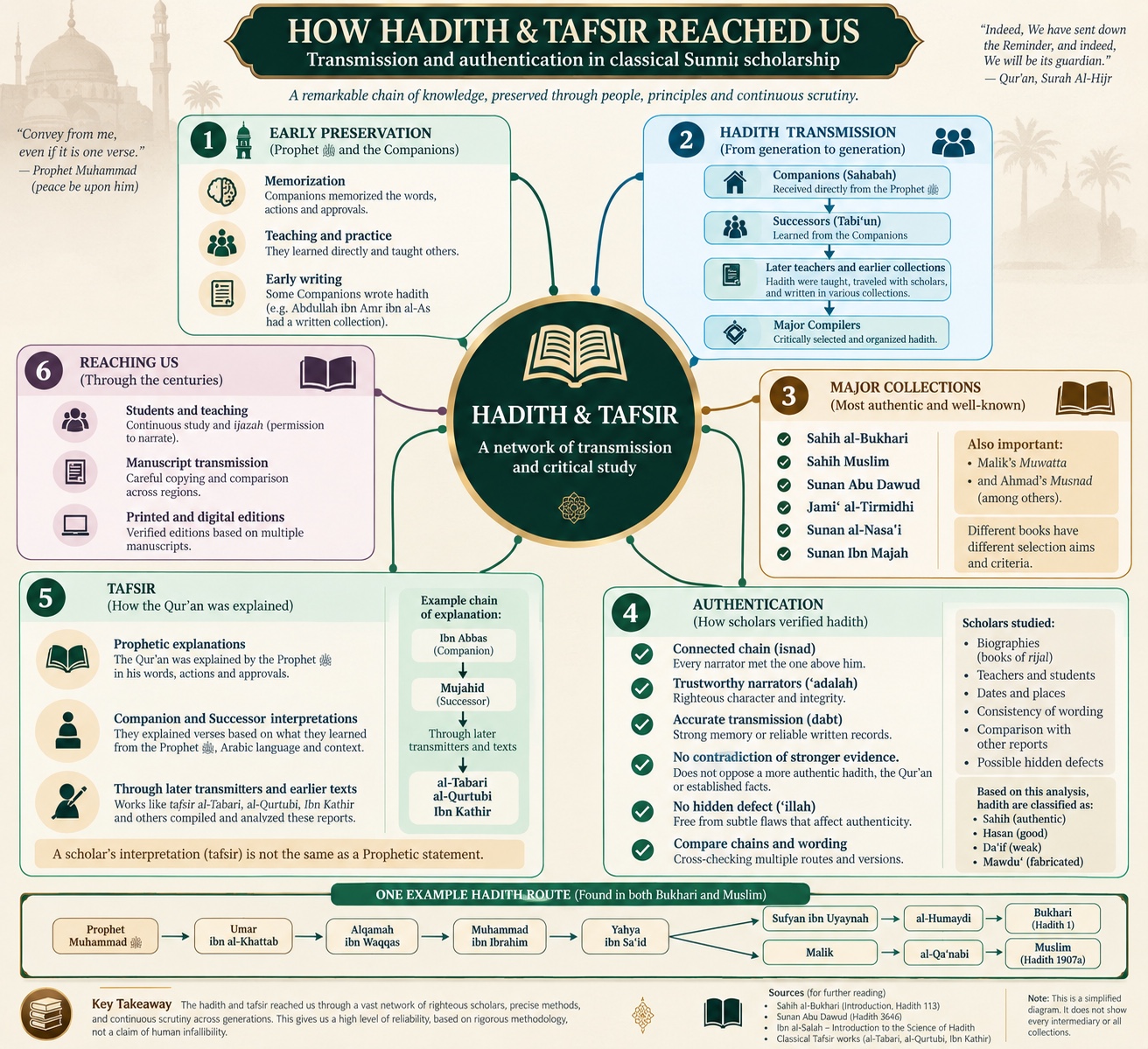
How hadith and tafsir reached us: preservation, transmission, collections, authentication and study
Tap the diagram to open it full size.
SEE THE WHOLE STORY

How hadith reached us

A simplified history of preservation, transmission and compilation; stages overlap.

  1. 1
    Prophetic lifetimeLearning from the Prophet ﷺ

    Companions heard, memorized and practised the teachings; some also wrote them down.

    The Prophet ﷺ and examples of Companions who learned from him

    • Prophet Muhammad ﷺ
    • Abdullah ibn Amr ibn al-As
    • Abu Hurayrah
    • Aishah bint Abi Bakr
    • Anas ibn Malik
    Selected notable names; not an exhaustive list. Activities and generations overlap.Reference ↗
  2. 2
    First century AHThe Companions teach

    Companions passed on what they learned as teaching spread between regions.

    The seven most prolific Companion narrators

    • Abu Hurayrah
    • Abdullah ibn Umar ibn al-Khattab
    • Anas ibn Malik
    • Aishah bint Abi Bakr
    • Abdullah ibn Abbas
    • Jabir ibn Abdullah
    • Abu Said al-Khudri
    Selected notable names; not an exhaustive list. Activities and generations overlap.Reference ↗
  3. 3
    Late first / early second century AHSuccessors and organized recording

    Successors learned from Companions. Umar ibn Abd al-Aziz encouraged recording hadith; writing had already existed earlier.

    Notable Successors and organizers of hadith recording

    • Umar ibn Abd al-Aziz — commissioned recording
    • Muhammad ibn Muslim ibn Shihab al-Zuhri
    • Abu Bakr ibn Muhammad ibn Amr ibn Hazm
    • Amrah bint Abd al-Rahman
    • Al-Qasim ibn Muhammad ibn Abi Bakr
    Selected notable names; not an exhaustive list. Activities and generations overlap.Reference ↗
  4. 4
    Second to early fourth century AHCollections take shape

    Collections grew, including Malik’s Muwatta, later Bukhari and Muslim, and the Sunan, each with its own selection criteria.

    Notable compilers of hadith collections

    • Malik ibn Anas — Al-Muwatta
    • Ahmad ibn Hanbal — Al-Musnad
    • Ishaq ibn Rahawayh — Al-Musnad
    • Muhammad ibn Ismail al-Bukhari — Al-Sahih
    • Muslim ibn al-Hajjaj — Al-Sahih
    • Abu Dawud Sulayman ibn al-Ashath — Al-Sunan
    • Muhammad ibn Isa al-Tirmidhi — Al-Jami
    • Ahmad ibn Shuayb al-Nasai — Al-Sunan
    • Muhammad ibn Yazid Ibn Majah — Al-Sunan
    Selected notable names; not an exhaustive list. Activities and generations overlap.Reference ↗
  5. 5
    Across the centuriesCriticism, commentary and manuscripts

    Scholars continued examining chains and texts, comparing routes, explaining reports and copying books. These activities overlap rather than forming isolated stages.

    Notable scholars of criticism, hidden defects and commentary

    • Shubah ibn al-Hajjaj
    • Yahya ibn Said al-Qattan
    • Ahmad ibn Hanbal
    • Ali ibn al-Madini
    • Yahya ibn Main
    • Abu Hatim al-Razi
    • Yahya ibn Sharaf al-Nawawi — commentary on Sahih Muslim
    • Ahmad ibn Ali Ibn Hajar al-Asqalani — Fath al-Bari
    Selected notable names; not an exhaustive list. Activities and generations overlap.Reference ↗
  6. 6
    Modern periodCritical editions and digital access

    Printed editions and searchable libraries widened access. Availability alone does not authenticate a report; check its source and scholarly assessment.

    IslamWeb

    An online library for reading hadith collections, commentary and scholarly references.

    Visit IslamWeb ↗
One small step at a time

Learn hadith without overwhelm

Each lesson gives one idea, one example and one short question. Pause and return whenever you like.

Start step one →
UnderstandWhat is hadith?
FollowChains
CheckGrades
PractiseBy yourself
Step three

Browse by topic

Choose the topic closest to your question to see explained hadiths.

Show detailed topics
Revelation and Collection of the Qur'an14Modes of Qur'anic Recitation and Tajweed7Qur'anic Exegesis16General Qur'anic Topics14Excellence of the Qur'an31Meanings and Attributes of the Qur'an1Occasions of Revelation5Abrogating and Abrogated Verses1Collecting the Qur'an2Seven Modes of the Qur'anic Revelation2Science of Tajweed4Stops and Starts1Rules and Principles of Exegesis1Rulings of the Qur'an and Codices4Manners of Reading and Memorizing the Qur'an7Refuting Allegations against the Qur'an3Inference from the Qur'an1Merit of Taking Care of the Qur'an13Virtues of Surahs and Verses17General Sunnah Topics10Significance and Status of the Sunnah9Writing the Sunnah3Belief in Allah the Mighty and Majestic133Belief in the Angels30Belief in the Revealed Books3Belief in the Messengers49Belief in the Last Day109Belief in the Divine Decree and Fate25Names and Rulings78The Companions36The Prophet's Family15Allegiance and Dissociation14People of the Sunnah and the Community1Sects and Schools1Oneness of Allah's Lordship8Oneness of Allah's Worship42Oneness of Allah's Names and Attributes75The Angels20The Jinn7Pre-Islamic Scriptures1The Qur'an1Prophethood4Pre-Islamic Prophets and Messengers, peace be upon them22Our Prophet Muhammad, may Allah's peace and blessings be upon him20Miracles of the Pious Allies of Allah4The Barzakh Life (After death Period)19Portents of the Hour27The Hereafter Life45Levels of Divine Decree and Fate9Issues of Divine Decree and Fate9Islam22Nullifiers of Islam5Issues of Pre-Islamic Era8Increase and Decrease of Faith9Branches of Faith7Disbelief7Polytheism10Hypocrisy10Immorality3Religious Innovation7Merit of the Companions30Belief in the the Companions2Degrees of the Companions5Merit of the Prophet's Family6Merit of the Mothers of the Believers4Belief in the Prophet's Family1Rights of the Prophet's Family4Rulings of Allegiance and Dissociation5Forbidden Emulation6Emigration and its Rulings2Desertion and its Conditions2Characteristics of the People of the Sunnah and the Community1Old Sects and Schools1Jurisprudence of Acts of Worship736Jurisprudence of Transactions103Religious Obligations6Family Jurisprudence168Spiritual and Physical Therapy22Foods and Drinks42Crimes22Prescribed Punishments42Judiciary14Principles of Islamic Jurisprudence18Purification132Prayer349Funerals33Zakah39Fasting57Hajj and ‘Umrah63Jihad84Sales19Conditions of Sale1Sale-Related Stipulations2Selling Assets and Fruits3Advance Payment1Usury6Loan3Mortgage1Collateral and Surety1Conciliation and Neighborhood Rulings4Interdiction1Partnership1Sharecropping3Leasing1Racing and Gambling2Usurpation2Preemption1Found Item and Foundling2Endowment6Gift10Bequest4Manumission15Oaths and Vows22Conditions of Inheritance1Impediments of Inheritance3Agnates1Inheritance Shares of Blood Relatives1Inheritance Shares of Embryos1Marriage62Divorce12Remarriage with One's Divorcee1Wife-Initiated Divorce2Oath to Abstain from Intercourse with One's Wife1Zihaar (Likening one's wife to an unmarrriagble woman)3Oath of Condemnation11Waiting Period12Breastfeeding9Custody3Expenses10Clothing and Adornment12Muslim Society7Rulings of Women28Rulings of Newborns8Prophetic Medicine5Rulings of Medication3Ruqyah (Healing and Protective Supplications)9Rulings of Foods and Drinks6Lawful and Unlawful Animals and Birds16Slaughtering9Hunting6Rulings of Animals Slaughtered by the Disbelievers1Forbidden Drinks8Retribution10Blood Money9Rulings of Prescribed Punishments2Conditions of implementing Prescribed Punishments4Prescribed Punishment for Adultery11Prescribed Punishment for Calumny4Prescribed Punishment for Drinking Alcohol8Prescribed Punishment for Theft7Prescribed Punishment for Highway Robbery3Prescribed Punishment for Apostasy3Rulings of Discretionary Punishments2Judiciary: Its Ruling, Merit, and Significance1Manners of Judges2Claims and Proofs7Testimonies3Shariah Ruling5Juristic and Usooli (Juristic Priciples) Rules3Religious Assignment and its Conditions1The Book (the Qur'an)1The Sunnah1Abrogation2Significations and Inference3Personal Reasoning and Imitation1Divergence and Preponderance2Shariah Objectives3Virtues164Jurisprudence of Ethics127Shariah-approved Manners184Jurisprudence of Supplications and Remembrance of Allah113Heart-Softeners and Sermons188Excellence of Knowledge15Excellence of Monotheism11Merits of the Noble Qur'an10Merits of Being Dutiful to One's Parents10Merits of Maintaining Kinship Ties2Merits of Prophet's Family8Merits of the Companions32Merits of Good Deeds33Merits of Remembering Allah25Merits of Supplication4Merits of Heart Acts11Merits of Organs' Acts8Praiseworthy Morals80Blameworthy Morals46Manners of Scholars and Learners12Etiquettes of Reciting the Noble Qur’an3Manners of Greeting and Seeking Permission23Manners of Speaking and Keeping Silent31Manners of Divergence2Manners of Debate1Manners of Eating and Drinking31Manners of the Road and the Market3Manners and Rulings of Travel20Manners of Sleeping and Waking Up7Manners of Visions9Manners of Visiting and Seeking Permission13Manners of Sneezing and Yawning5Manners of Visiting the Sick9Manners of Dressing15Prophetic Guidance on Remembering Allah8Benefits of Remembering Allah15Morning and Evening Dhikr7Timeless Dhikr8Dhikr on Entering and Leaving the House2Dhikr on Entering and Leaving the Bathroom1Dhikr on Entering and Leaving the Mosque2Hard Times Dhikr3Dhikr on Special Occasions20Rulings of Supplication2Types of Supplication1Manners of Supplication7Causes for Answering or not Answering Supplications10Reported Supplications33Acts of Heart26Heart Diseases5Asceticism and Piety13States of the Righteous Believers12Condemning Sins21Condemning Love of the World26Condemning Whims and Desires9Repentance15Purification of Souls16Terrors of the Graves3Descriptions of Paradise and Hell53Calling to Allah (Da‘wah)36Enjoining Good and Forbidding Evil13Shariah-approved Politics51Islamic Culture1Ruling of Calling to Allah1Manners of Calling to Allah2Backgrounds and Duties of the Callers to Allah2Excellence and Merits of Islam14Universality of Islam3Human Rights in Islam5Animal Rights in Islam10Ruling of Enjoining Good and Forbidding Evil4Excellence of Enjoining Good and Forbidding Evil3Manners of Enjoining Good and Forbidding Evil2Principles of Enjoining Good and Forbidding Evil1Requirements of Enjoining Good and Forbidding Evil2Rulings and Issues of Enjoining Good and Forbidding Evil2Ways of Electing the Supreme Muslim Imam (Ruler)2Requirements of the Supreme Imamate (Leadership)4Duties of the Imam17Imam's Rights over the Subjects19Rebelling against the Muslim Ruler6International Relations in Islam1Consultation System in Islam1Islamic Civilization1Prophet's Biography192History17Prophet's Lineage2Prophet's Wives and Family Issues14Prophet's Children3Prophet's Servants1Prophet's Life before Mission2Prophet's Mission1The Makkan Period5The Emigration (Hijrah)3The Madinan Period1Prophet's Battles and Expeditions27Prophet's Correspondences2Prophet's Death18Muhammadan Qualities99Stories and Conditions of Pre-Islamic Nations9History of Makkah, Madinah, and the Aqsa (Jerusalem)1Wars and Battles1Biographies (of Famous Figures)2Countries and Figures1Periodical Occasions3Ahl-us-Sunnah's (Sunni) Stance on Religious Innovators2Rulings of Water6Removing Impurities13Utensils5Toilet Manners13Natural Cleanliness Practices9Ablution42Ritual Bath28Dry Ablution6Menses, Postpartum Bleeding, Extra-Menses Bleeding12Excellence of Ablution7Pillars of Ablution2Recommended Acts and Manners of Ablution12Method of Ablution11Nullifiers of Ablution8Rulings of the Ritual Bath1Causes of Obligatory Ritual Bath3Recommended Manners of the Ritual Bath3Obligation of Prayer and Ruling on Its Abandoner10Virtue of Prayer17The Azan and Iqaamah20Times Not to Pray6Conditions of Prayer28Pillars of Prayer3Obligatory Acts of Prayer1Recommended Acts of Prayer15Method of Prayer53Dhikr (Invocation) during Prayer23Nullifiers of Prayer2Mistakes during Prayer10Prostration of Forgetfulness, Recitation, Gratitude15Virtue and Rulings of Congregational Prayer16Rulings of the Imam and Followers in Prayer27Prayer of the People with Excuses9Jumu‘ah (Friday) Prayer14Voluntary Prayer59Prayer of Fear3Virtue of Friday2Merit of Jumu‘ah Prayer1Rulings of Jumu‘ah Prayer1Rulings of Jumu‘ah Sermon2Virtue of Voluntary Prayer2Regular Sunnah (Recommended) Prayers6Voluntary Night Prayer (Qiyaam)29Prayer of the Two Eids2Prayer of the Solar and Lunar Eclipse4Rain-Seeking Prayer2Forenoon Prayer4Guidance-Seeking Prayer1Death and Its Rulings11Washing the Dead2Method of Praying over the Dead7Carrying and Burying the Dead4Consolation3Visiting the Graves3Doing Good Deeds on behalf of the Deceased and Gifting them the Reward1Obligation of Zakah and Ruling of Its Abandoning3Rulings and Issues of Zakah2Zakah of Gold and Silver1Zakah of Livestock2Zakah of Land Produce2Zakat-ul-Fitr (Minor-Eid Charity)3Channels of Zakah (People Who Receive Zakah)3Voluntary Charity26Obligation of Fasting and Ruling of Its Abandoning2Virtue of Fasting6Recommended Acts of Fasting7Sighting the Crescent1Fasting on the Day of Doubt1Fasting Missed Days of Ramadaan3Fasting of People with Excuses3Nullifiers of Fasting1Fasting Obligations1What is Permissible for the Fasting Person2Fasting Prohibitions4What is Disliked for the Fasting Person1Voluntary Fasting13Seclusion for Worship in Ramadaan (I‘tikaaf)5Last Ten Days of Ramadaan6Obligation of Hajj and ‘Umrah and Ruling of Its Abandoner1Virtue of Hajj and Umrah7First Ten Days of Dhul Hijjah (Twelfth Lunar Month)1Rulings of Al-Masjid Al-Haraam, the Prophet's Mosque, and the Aqsa Mosque6Rulings of Ihraam (the Ritual State of Consecration)2Prohibitions of Ihraam6Ransom and Hunting Expiation2Types of Rituals (Pilgrimage)2Obligations of ‘Umrah1How to Make Hajj (Pilgrimage)9Pillars of Hajj (Pilgrimage)1Obligations of Hajj (Pilgrimage)1Rulings of the Prophet's Mosque1Sacrificial Animals and Expiations6Sacrifice5Rulings and Issues of Hajj and ‘Umrah16Ruling of Jihad1Excellence of Jihad35Categories of Jihad2Rulings and Issues of Jihad30Manners of Jihad7Rulings of Non-Muslims Living in Muslim Country2Rulings of Truce and Security3Rulings of Terrorism, Assassinations, and Explosions1Forbidden Sales10Oaths2Vows3Excellence of Marriage1Manners of Marriage7Rulings and Conditions of Marriage4Women Unlawful to Marry4Conditions of Marriage1Marrying the Disbelievers2Forbidden Marriages3Dowry7Wedding Banquet5Marital Relations17Words of Divorce1Sunnah Divorce and Innovative Divorce3Revocable and Irrevocable Divorce3Rulings and Issues of Divorce5Rulings of the Waiting Period1The Divorced Woman's Waiting Period2Ascertaining Non-Pregnancy1Ruling of Breastfeeding1Conditions of Breastfeeding2Consequences of Breastfeeding1Jurisprudence for Muslim Women1Intermixing1Polygamy1Men-Women Relationships8Naming the Newborn2Sacrificing for the Newborn3Providing for Children1Raising Children1Rulings of Ruqyah (protective and healing supplications)1Merit and Significance of Knowledge3Merits of the Rightly Guided Caliphs1Forbidden Utterances and Tongue Evils9Physical Attributes2Prophet's Dress Code7Prophet's Furniture, Stuff, and Arms1Prophet's Food and Drink7Prophet's Travel2Moral Attributes55Prophet's Guidance27Prophet's Generosity6Prophet's Modesty1Prophet's Humility7Prophet's Courage1Prophet's Gentleness5Prophet's Forgiveness2Prophet's Mercy17Prophet's Speech2Prophet's Laughing1Prophet's Crying1Prophet's Compassion2Prophet's Asceticism2Prophet's Justice2Prophet's Forbearance4Prophet's Guidance on Public Speaking2Prophet's Guidance on Purification3Prophet's Guidance on Prayer11Prophet's Guidance on Fasting2Prophet's Guidance on Funerals1Prophet's Guidance on Marriage and Treating One's Wife3The Battle of Yamaamah1Rulings and Manners of Eid1The rulings of mosques34Ramadan1Wiping Over Leather Socks and the like10Prophetic characteristics19Interpretation of verses11
Show site selections
CharityFastingZakatPrayer SutrahMarital RightsPurificationPrayerDua & DhikrHajj & UmrahParents & Family TiesRaising ChildrenCharacter & SpeechRepentanceSteadfastnessTawhid & BeliefKnowledge & Sincere AdviceIllness & RuqyahHalal & HaramTransactions & DebtsTrials & SteadfastnessNight PrayerDeath & the AfterlifeGathering EtiquetteSigns of the HourParadise & HellfireQadarThe Hawd & SiratIntercessionResurrection & GatheringThe Scales & RecordsSeeing AllahTrumpetAccount & RecompenseAllah’s Names & AttributesAngelsVirtues of the QuranProvision & Reliance on AllahIntentions & SincerityNeighbours & GuestsSacrifice & EidFamily TiesTrusts & FulfilmentIllness & Visiting the SickSleep & WakingFood & DrinkClothing & AdornmentRoad EtiquetteSneezing & YawningTravel EtiquetteGreetings SalamHospitalityPermission & PrivacyKindness to AnimalsToilet EtiquetteCleanliness & BeautyMosque EtiquetteFriday EtiquetteFuneralsControlling AngerCongregational PrayerAdhanPatience in TrialsBrotherhood & HelpNight Prayer & WitrDuha PrayerVoluntary FastingQuran RecitationModesty (Haya)GratitudeJustice & OppressionReconciliationMercy GentlenessPardon & ConcealmentHumility & ArroganceGood Character & SmilingEnjoining GoodEnvy & a Pure HeartGood Assumptions & PrivacyJoking EtiquetteGood CompanyOrphans & People in NeedChastity & Lowering the GazeDisagreement & ArgumentIstikhara & ConsultationSending Blessings on the ProphetLove for Allah’s SakeHealth & the BodyTruthfulnessMercy KindnessBackbiting & Tale-BearingIntoxicantsOaths & VowsChoosing a SpouseLawful WorkVisiting GravesActions of the HeartTime & LifeHope & Thinking Well of AllahContentment & ZuhdFear of Allah & WatchfulnessRights of MuslimsDream EtiquetteRain & WindMercy to ChildrenKindness to DaughtersElders & Vulnerable PeopleKindness to Workers
Browse collections and chains →

Narrators and Companions

Names follow the source attributions. Not every transmitter is a Companion; read the chain for context.

More names · 499
‘Umar ibn al-Khattāb reported that the Messenger of Allah26Ibn Mas‘ūd20Abu Dharr17Abu Mūsa16‘Uqbah ibn ‘Āmir15‘Imrān ibn Husayn15Abu ’Umāmah reported: ‘Amr ibn ‘Abasah related to me that he heard the Prophet say:11Hudhayfah11Buraydah reported: The Messenger of Allah10Abu ad-Dardā’ reported: The Prophet9An-Nu‘mān ibn Bashīr reported that the Prophet9أم سلمة9Sahl ibn Sa‘d reported that the Messenger of Allah said on the Day of Khaybar:9‘Ubādah ibn as-Sāmit9Abu Bakrah reported: The Prophet8Sa‘d ibn Abi Waqqās8Mu‘ādh ibn Jabal8’Ubayy ibn Ka‘b7Abu Sa‘īd reported that the Prophet7’Usāmah ibn Zayd reported: The Prophet7Al-Barā’7Al-Barā’ ibn ‘Āzib7Thawbān reported: The Messenger of Allah7عمرو بن شعيب7Abu Qatādah reported: The Messenger of Allah6Jubayr ibn Mut‘im reported: I heard the Prophet say:6Jarīr ibn ‘Abdullah6Zayd ibn Arqam reported: I only say to you what the Messenger of Allah used to say. He used to say:6Samurah ibn Jundub reported: The Messenger of Allah6عبدالله بن أبي أوفى6Abu ’Umāmah al-Bāhili reported: I heard the Messenger of Allah say:5أبو قتادة الأنصاري5Abu Mas‘ūd reported: The Prophet5Al-Mughīrah ibn Shu‘bah reported that the Prophet5Jābir ibn Samurah5Zayd ibn Thābit5Zayd ibn Khālid al-Juhani5Salamah ibn al-Akwa‘5Sahl ibn Sa‘d as-Sā‘idi reported that the Messenger of Allah5Mu‘āwiyah reported: I heard the Prophet say:5Abu Ayyūb al-Ansāri reported that the Prophet4Az-Zubayr ibn al-‘Awwām reported that the Prophet4’Umm ‘Atiyyah4Hudhayfah ibn al-Yamān4Rāfi‘ ibn Khadīj4‘Abdullāh ibn Zayd4كعب بن مالك4Abu Sa‘īd al-Khudri and Abu Hurayrah reported that the Prophet3Abu Salamah ibn ‘Abdur-Rahmān reported that Jābir ibn ‘Abdullah al-Ansāri said: While narrating about the halt in revelation, he said in his Hadīth:3Abu Mas‘ūd al-Ansāri3أبو مسعود البدري3أبو مسعود عقبة بن عمرو الأنصاري البدري3Asmā’ bint Abi Bakr reported: The Prophet3السائب بن يزيد3An-Nawwās ibn Sim‘ān reported that the Prophet (ﷺ)3Jundub ibn ‘Abdullah3Hakīm ibn Hizām3سمرة3Shaddād ibn Aws reported: There are two things which I learned by heart from the Messenger of Allah; he3Sohaib reported: The Messenger of Allah3Talhah ibn ‘Ubaydullah3عبدالله بن بسر3‘Adyy ibn Hātim reported: The Messenger of Allah3عروة3‘Uqbah ibn ‘Āmir al-Juhani3عمرو بن العاص3عوف بن مالك الأشجعي3Mu‘ādh3Wā’il ibn Hujr3واثلة بن الأسقع3ابن شهاب2Abu Ayyūb reported: The Prophet2Abu Bakr as-Siddīq2أبو ثعلبة الخشني2أبو جحيفة2أبو رافع2أبو رمثة2Abu ‘Abdur-Rahmān ‘Abdullah ibn Mas‘ūd2Abu ‘Abdullah Jābir ibn ‘Abdullah al-Ansāri2Abu Muhammad ‘Abdullah ibn ‘Amr ibn al-‘Ās reported: The Messenger of Allah (ﷺ)2أبو هريرة عن النبي صلى الله عليه وسلم2Abu Wāqid al-Laythi2أسماء2الحسن2Al-‘Abbās ibn ‘Abdul-Muttalib2المقداد2Al-Miqdām ibn Ma‘di Karib reported that the Prophet2An-Nawwās ibn Sim‘ān al-Ansāri2’Umm Salamah, the Mother of the Believers, reported that the Messenger of Allah2Tamīm ad-Dāri reported: I heard the Messenger of Allah say:2جابر بن عبدالله الأنصاري2رفاعة بن رافع الزرقي2Sa‘d2سعيد بن الحارث2سعيد بن جبير2Safīnah2Salmān reported: The Messenger of Allah2Salmān al-Fārisi reported: The Messenger of Allah2Shurayh ibn Hāni’2عائشة بنت أبي بكر2‘Abdur-Rahmān ibn Samurah reported: The Messenger of Allah2عبدالله بن الزبير2‘Abdullah ibn ash-Shikhkhīr2عبدالله بن زيد بن عاصم المازني2عبدالله بن سرجس2‘Abdullāh ibn Mughaffal reported: The Prophet2‘Uthmān ibn ‘Affān reported: The Prophet2‘Uthmān ibn Abi al-‘Ās2‘Uthmān ibn ‘Affān reported: The Messenger of Allah2عروة بن الزبير2عقبة بن الحارث2عمرو بن عبسة2فاطمة بنت قيس2مالك بن الحويرث2Mahmūd ibn Labīd reported that the Messenger of Allah2مسروق2Ma‘qil ibn Yasār reported that the Messenger of Allah2Wā’il al-Hadrami reported: Salamah ibn Yazīd al-Ju‘fi asked the Messenger of Allah, saying:2Abān ibn ‘Uthmān reported: I heard ‘Uthmān ibn ‘Affān say: I heard the Messenger of Allah say:1Ibrāhīm an-Nakha‘i reported that Hammām ibn al-Hārith1Ibn Abi Awfa1ابن أبي عمار1Abu Mulaykah1ابن أبي نعم1ابن الديلمي1ابن جبير1ابن شماسة المهري1ابن عباس -1ابن عباس وعمران بن الحصين1أبو إدريس الخولاني رحمه الله1أبو الأسود1Abu al-Ja‘d ad-Damri, who had a companionship with the Prophet, reported that the Messenger of Allah1أبو الحوراء السعدي1أبو الخطاب قتادة1Abu az-Zubayr1أبو السمح1أبو الشعثاء1Abu al-‘Abbās, ‘Abdullah ibn ‘Abbās reported: I was riding behind the Messenger of Allah (ﷺ) one day and he1أبو العباس سهل بن سعد الساعدي1أبو العلاء بن عمير1أبو الفضل العباس بن عبد المطلب1أبو المنهال1أبو المنهال سيار بن سلامة1Abu al-Hayyāj al-Asadi1أبو أمامة إياس بن ثعلبة الأنصاري الحارثي1Abu ’Umāmah Iyās ibn Tha‘labah al-Hārithi reported that the Messenger of Allah1Abu Burdah reported from his father Abu Mūsa al-Ash‘ari1Abu Burdah al-Ansāri reported that he heard the Messenger of Allah say:1Abu Burdah ibn Abi Mūsa1Abu Barzah al-Aslami reported that the Messenger of Allah1أبو برزة نضلة بن عبيد الأسلمي1Abu Bashīr al-Ansāri1أبو بكرة -ضي الله عنه1أبو بكرة نفيع بن الحارث الثقفي1أبو تميم الجيشاني1أبو ثعلبة1Abu Tha‘labah al-Khushani Jurthūm ibn Nāshir reported that the Messenger of Allah (ﷺ)1أبو جحيفة وهب بن عبدالله1أبو جحيفة وهب بن عبدالله السوائي1أبو جري الهجيمي1أبو جري جابر بن سليم1أبو جعفر عبدالله بن جعفر1أبو جعفر محمد بن علي بن الحسين بن علي بن أبي طالب1أبو جمرة -نصر بن عمران الضبعي1أبو جهيم بن الحارث بن الصمة الأنصاري1Abu Hāzim reported: I accompanied Abu Hurayrah for five years, and I heard him narrate from the Prophet, who1Abu Hāzim ibn Dinār1أبو حمزة أنس بن مالك1Abu Humayd as-Sā‘idi1Abu Humayd or Abu Usayd reported: The Messenger of Allah1أبو خبيب -بضم الخاء المعجمة- عبدالله بن الزبير1أبو خراش حدرد بن أبي حدرد الأسلمي1أبو ذر جندب بن جنادة1أبو ربعي حنظلة بن الربيع الأسيدي الكاتب1أبو رفاعة تميم بن أسيد1أبو رقية تميم بن أوس الداري1أبو رمثة التيمي1Abu Zuhayr ‘Umārah ibn Ru’aybah reported: The Messenger of Allah1أبو زيد الأنصاري1أبو زيد بن أخطب1أبو زيد عمرو بن أخطب الأنصاري1Abu Sa‘īd al-Khudri and Abu Hurayah reported that the Prophet1أبو سعيد رافع بن المعلى1Abu Sa‘īd Sa‘d ibn Mālik ibn Sinān al-Khudri reported that the Messenger of Allah (ﷺ)1أبو سعيد وأبي هريرة1أبو سفيان صخر بن حرب1أبو سلمة بن عبد الرحمن بن عوف1أبو سليمان مالك بن الحويرث1Abu Shurayh reported that the Prophet1أبو شريح -خويلد بن عمرو الخزاعي العدوي1أبو شريح خويلد بن عمرو الخزاعي عن النبي صلى الله عليه وسلم1أبو شريح خويلد بن عمرو الخزاعي و أبي هريرة1Abu Sirmah reported: The Messenger of Allah1أبو صفوان سويد بن قيس1أبو طريف عدي بن حاتم1Abu Talhah reported: The Prophet1أبو طلحة زيد بن سهل1‘Abdur-Rahmān as-Sulami1أبو عبد الرحمن عبدالله بن عمر بن الخطاب1Abu ‘Abdullah al-Jadali reported: I asked ‘Ā’ishah, Mother of the Believers, about the morals of the Messenger of Allah and she1أبو عبدالله النعمان بن بشير1أبو عبدالله جابر بن سمرة1أبو عبدالله جابر بن عبدالله1أبو عبدالله خباب بن الأرت1Abu ‘Abs ‘Abdur-Rahmān ibn Jabr reported that the Messenger of Allah1Abu ‘Ubayd, the ex-slave of Ibn Az'har,1أبو عزة الهذلي1أبو عطية1أبو علي سويد بن مقرن1أبو علي طلق بن علي1أبو عمرو- وقيل1أبو قتادة الحارث بن ربعي1Abu Qatādah as-Salami reported: The Messenger of Allah1أبو قتادة وأنس بن مالك1أبو قلابة عبدالله بن زيد الجرمي البصري1أبو كبشة عمرو بن سعد الأنماري1أبو لبابة بشير بن عبد المنذر1أبو مالك الأشجعي سعد بن طارق1Abu Mālik al-Ash‘ari reported: The Messenger of Allah1Abu Mālik al-Hārith ibn ‘Āsim al-Ash‘ari reported: The Messenger of Allah (ﷺ)1أبو محمد الحسن بن علي بن أبي طالب - سبط رسول الله صلى الله عليه وسلم وريحانته1Abu Marthad al-Ghanawi reported: The Messenger of Allah1أبو مريم الأزدي1Abu Muslim al-Khawlāni reported: The dear and trustworthy one, as he is dear to me and I deem him trustworthy, ‘Awf ibn Mālik al-Ashja‘i said to me:1أبو ميمونة سلمى مولى من أهل المدينة رجل صدق1أبو نجيح العرباض بن سارية1أبو نجيد عمران بن حصين الخزاعي1أبو نضرة1أبو هريرة -1Abu Hurayrah ‘Abdur-Rahmān ibn Sakhr reported: I heard the Messenger of Allah (ﷺ) say:1Abu Hurayrah reported: The Messenger of Allah1أبو هريرة وأبي قتادة وأبي إبراهيم الأشهلي عن أبيه -وأبوه صحابي1أبو هريرة وجابر1أبو هريرة وزيد بن خالد الجهني1أبو هريرة وعبدالله بن عباس1أبو هريرة وعبدالله بن عمرو وعائشة1أبو هريرة-1أبو واقد الحارث بن عوف1أبو يحيى خريم بن فاتك1Abu Ya‘la Shaddād ibn Aws reported that the Messenger of Allah (ﷺ)1أبو يونس سليم بن جبير مولى أبي هريرة1أسامة1أسامة بن زيد بن حارثة1أسماء بنت أبي بكر الصديق1أسماء بنت عميس1أسيد بن أبي أسيد التابعي1أسيد بن حضير وأنس بن مالك1أسير بن عمرو1Al-Aswad ibn Yazīd1Al-Agharr, who was one of the Prophet's Companions, reported that the Messenger of Allah1البراء بن عازب –1الجعد1Al-Husayn ibn ‘Ali ibn Abi Tālib reported: The Messenger of Allah1الحكم1الزبير بن عدي1السائب بن يزيد الصحابي1الصعب بن جثامة1الضحاك بن فيروز1العالية بنت سبيع1Al-‘Irbād ibn Sāriyah1الفريعة بنت مالك بن سنان1المستورد بن شداد1المسور بن مخرمة1المعرور بن سويد1Al-Mughīrah1Al-Miqdād ibn al-Aswad reported: I heard the Messenger of Allah say:1Al-Miqdād ibn ‘Amr al-Kindi1المقدام1Al-Miqdām ibn Ma‘dikarib reported: The Messenger of Allah1’Umm ad-Dardā’ and Abu ad-Dardā’ reported that the Prophet used to say:1The Mother of the Believers, ’Umm ‘Abdullah ‘Ā’ishah reported: The Messenger of Allah (ﷺ)1أم المؤمنين ميمونة بنت الحارث1أم ثابت كبشة بنت ثابت أخت حسان بن ثابت1’Umm Habībah, the Prophet's wife, reported: I heard the Messenger of Allah say:1أم حبيبة بنت أبي سفيان1’Umm Salamah, Mother of the Believers and wife of the Prophet, reported: The Messenger of Allah1أم شريك1أم عطية نسيبة الأنصارية1’Umm Qays bint Mihsan1أم كلثوم بنت عقبة بن أبي معيط1أم ورقة بنت عبدالله بن الحارث الأنصارية1The Commander of the Believers, Abu Hafs ‘Umar ibn al-Khattāb reported: I heard the Messenger of Allah (ﷺ) say:1’Umaymah bint Ruqayqah1أنس -1أنس بن سيرين1أنس بن مالك وأبي هريرة1إياس بن سلمة1Iyās ibn ‘Abdullah ibn Abi Dhubāb reported: The Messenger of Allah1أيوب1بجالة1Buraydah ibn al-Hasīb1بريدة بن الحصيب الأسلمي1بسر بن سعيد1Some of the Prophet's wives reported that the Prophet1Bahz ibn Hakīm reported from his father from his grandfather that he1ثابت بن الضحاك1ثابت عن أنس1ثوبان مولى رسول الله صلى الله عليه وسلم1جابر بن عبدالله وأبو هريرة1جابر بن يزيد بن الأسود1جابر عن النبي صلى الله عليه وسلم1جبلة بن سحيم1جذامة بنت وهب1Jarīr reported: The Prophet1جعفر بن محمد1Jundub1جندب بن سفيان البجلي1جندب بن عبدالله البجلي1Jundub ibn ‘Abdullāh al-Qasri reported: The Messenger of Allah1Juwayriyah, Mother of the Believers,1Hārithah ibn Wahb al-Khuzā‘i reported: I heard the Prophet say:1حبيب بن مسلمة الفهري1حذيفة -1حذيفة بن اليمان وأبي هريرة1حسان بن بلال1حصين بن عبد الرحمن1حطان بن عبدالله الرقاشي1حفصة1حفصة زوج النبي1حمران مولى عثمان بن عفان1حمنة بنت جحش1حميد بن عبد الرحمن1حنظلة بن حذيم1حنظلة بن قيس1خالد بن عرفطة1Khuraym ibn Fātik reported: The Messenger of Allah1Khawlah al-Ansāriyyah reported: I heard the Messenger of Allah say:1Khawlah bint Hakīm reported: I heard the Messenger of Allah say:1خيثمة1رافع بن خديج الأنصاري الأوسي1رافع بن سنان1رويفع1رويفع بن ثابت الأنصاري1Zirr ibn Hubaysh1زهدم بن مضرب الجرمي1زياد بن جبير1زياد بن علاقة1Ziyād ibn Labīd1زيد بن ثابت الأنصاري -1Zayd ibn Khālid reported: The Messenger of Allah1زيد مولى رسول الله صلى الله عليه وسلم1زينب بنت أبي سلمة1Zaynab bint Jahsh reported: The Prophet came to her in an alarmed state, saying:1سالم بن أبي الجعد1سالم بن عبدالله بن عمر بن الخطاب1سبرة بن معبد الجهني1سبيعة الأسلمية1Sa‘d ibn ‘Ubādah reported that he1Sa‘īd ibn al-Musayyab reported that his father1سعيد بن زيد1سفيان بن عبدالله الثقفي1سلمة بن صخر1Sulaymān ibn Surad1سليمان بن يسار رحمه الله1Samurah ibn Jundab and Al-Mughīrah ibn Shu‘bah reported: The Messenger of Allah1Sahl reported that the Prophet1Sahl ibn Hunayf reported: The Prophet1سهل بن عمرو1Sahl ibn Mu‘ādh ibn Anas related from his father that the Messenger of Allah1سهيل1شقيق بن سلمة رحمه الله1شكل بن حميد1صالح بن خوات بن جبير1صخر بن وداعة الغامدي1صفوان بن أمية1Safwān ibn Muhriz reported: A man said to Ibn ‘Umar: What did you hear the Messenger of Allah say about the Najwa (secret talk)? He said: I heard him say:1صفوان بن يعلى1صفية بنت حيي1صفية بنت شيبة1طارق المحاربي1Tāriq ibn Ashīm al-Ashja‘i reported: I heard the Messenger of Allah say:1طارق بن شهاب البجلي الأحمسي1Tāwūs reported: I found some of the Prophet's Companions say: "Everything is decreed." I heard ‘Abdullah ibn ‘Umar say: The Messenger of Allah1طلق بن علي1عائذ بن عمرو1عائذ بن عمرو المزني1‘Ā’ishah and ‘Abdullāh ibn ‘Abbās1عائشة وابن عباس1عائشة وأم سلمة1عاصم1عاصم الأحول1عامر1عامر بن ربيعة1عامر بن عبدالله بن الزبير1‘Ubādah reported that the Prophet1عبد الرحمن بن أبي بكرة1عبد الرحمن بن أبي عميرة وكان من أصحاب رسول الله صلى الله عليه وسلم عن النبي صلى الله عليه وسلم1‘Abdur-Rahmān ibn Abi Layla reported: I came across Ka‘b ibn ‘Ujrah who said: Shall I offer you a present?1عبد الرحمن بن أبي ليلى أنهم كانوا عند حذيفة1عبد الرحمن بن عوف1عبد الرحمن بن غنم1عبد الرحمن بن يزيد النخعي1عبد العزيز بن رفيع1عبد خير1عبد خيرقال1عبدالله ابن عباس1عبدالله بن أبي بكر بن حزم1عبدالله بن بحينة1عبدالله بن بسر الأسلمي1عبدالله بن جعفر1عبدالله بن حنين1‘Abdullah ibn Khubayb1عبدالله بن زمعة1عبدالله بن زيد بن عاصم1عبدالله بن سلام1عبدالله بن شقيق1عبدالله بن عبد الرحمان بن أبي صعصعة1عبدالله بن عتبة بن مسعود1عبدالله بن عكيم1‘Abdullah ibn ‘Umar and Abu Hurayrah reported that they heard the Messenger of Allah speak on his wooden pulpit and say:1عبدالله بن عمر وأبي هريرة وأبي ذر1عبدالله بن عمرو بن العاص عن رسول الله صلى الله عليه وسلم1عبدالله بن عمرو بن العاصي1‘Abdullah ibn ‘Anamah1عبدالله بن كعب بن مالك1Abdullah ibn Mālik ibn Buhaynah1عبدالله بن معقل1عبدالله بن مغفل المزني1عبدالله بن وقدان السعدي1‘Abdullah ibn Yazīd al-Khatmi reported: Al-Barā’—and he is not a liar—said to me:1عبيد الله بن عبدالله بن عتبة1‘Ubaydullah ibn ‘Adiyy ibn al-Khiyār1‘Ubaidullah ibn Mihsan al-Ansāri reported: The Messenger of Allah1عثمان الشحام1عثمان بن أبي العاص الثقفي1‘Adiyy ibn Hātim reported that the Prophet1عدي بن عميرة الكندي1‘Arfajah reported: I heard the Messenger of Allah say:1عروة بن الزبير عن عائشة زوج النبي صلى الله عليه وسلم1‘Ikrimah1علقمة1علي بن الحسين1علي بن ربيعة1‘Ammār ibn Yāsir1عمر الجمعي1‘Umar ibn Abi Salamah1‘Amr ibn al-Hārith, the brother-in-law of the Messenger of Allah (ﷺ) and the brother of the Mother of the Believers, Juwayriyah bint al-Hārith,1عمرو بن تغلب1عمرو بن خارجة1‘Amr ibn Sulaym al-Ansāri reported: I bear witness that Abu Sa‘īd said: I bear witness that the Messenger of Allah1‘Amr ibn Shu‘ayb reported from his father on the authority of his grandfather that the Messenger of Allah1‘Amr ibn ‘Āmir related that Anas ibn Mālik1عمرو بن عوف الأنصاري1عوف بن مالك -أو1عياض بن حمار أخي بني مجاشع1عياض بن حمار المجاشعي1فضالة بن عبيد1فضالة بن عبيد وسلمان الفارسي وعقبة بن عامر الجهني1Qatādah1Qatādah related:1Qutbah ibn Mālik reported: The Prophet used to say:1قيس بن أبي حازم1قيس بن طلق1Qays ibn ‘Āsim1قيس بن عباد1كبشة بنت كعب بن مالك -وكانت تحت ابن أبي قتادة1كثير بن زياد1Ka‘b ibn ‘Ujrah reported that the Messenger of Allah1كعب بن عياض1Laqīt ibn Sabirah1مالك بن أوس بن الحدثان1مجاهد1محمد بن زيد1محمد بن عباد بن جعفر1محمد بن عمرو بن عطاء1محمد بن مسلمة1محمد بن يحيى بن حبان1مرداس الأسلمي1مسلمة سعيد بن يزيد1Mus‘ab ibn Sa‘d reported: Sa‘d saw that he had superiority over those beneath him. So, the Prophet1Matar ibn ‘Ukāmis reported: The Messenger of Allah1مطرف بن عبدالله1معاذ بن أنس1معاذ بن انس1معاذ بن أنس الجهني1Mu‘ādhah1معاذة العدوية1Mu‘āwiyah al-Qushayri1معاوية بن الحكم السلمي1معاوية بن حيدة1Ma‘dān ibn Abi Talhah al-Ya‘mari1Ma‘qil ibn Yasār reported: I heard the Messenger of Allah say:1معن بن يزيد بن الأخنس1ميمونة1Maymūnah, Mother of the believers,1نافع بن عتبة1هانئ مولى عثمان1هشام بن حكيم بن حزام1Wābisah1Wahshiyy ibn Harb1Warrād, the scribe of Al-Mughīrah ibn Shu‘bah, related: Al-Mughīrah ibn Shu‘bah dictated to me in a letter to Mu‘āwiyah:1Yahya ibn ‘Umārah al-Māzini1يزيد بن الأسود1يزيد بن الأصم1يزيد بن حيان1يزيد بن شريك بن طارق1يسار مولى ابن عمر1يعلى بن أمية1يوسف بن عبدالله بن سلام1

Hadith scholars: compilers of the six books

Scholars whose assessments appear in the data