Story chaptersAn argument against worshipping created things
01An argument against worshipping created things

Ibrahim's people worshipped idols and heavenly bodies. He challenged the idea that something which rises, changes and disappears could be the Lord of creation.
The Qur'an describes this as an argument Allah granted Ibrahim against his people. It ends with his rejection of their worship and his turning to the Creator. The passage should not be presented as a journey from polytheism to faith.
The star, moon and sun appear in succession. Each sets, demonstrating that it belongs to the changing creation rather than being its eternal Lord.
The issue was not their beauty or size. Ibrahim's argument led to a positive declaration: he devoted himself to the One who created the heavens and earth.
On another occasion, he asked Allah to show him how He gives life to the dead. Ibrahim affirmed that he already believed; he sought further reassurance for his heart.
The Prophet Muhammad's authentic statement that “we have more right to doubt than Ibrahim” is a rhetorical denial of doubt, not an accusation that Ibrahim lacked faith.
02The idols and the fire
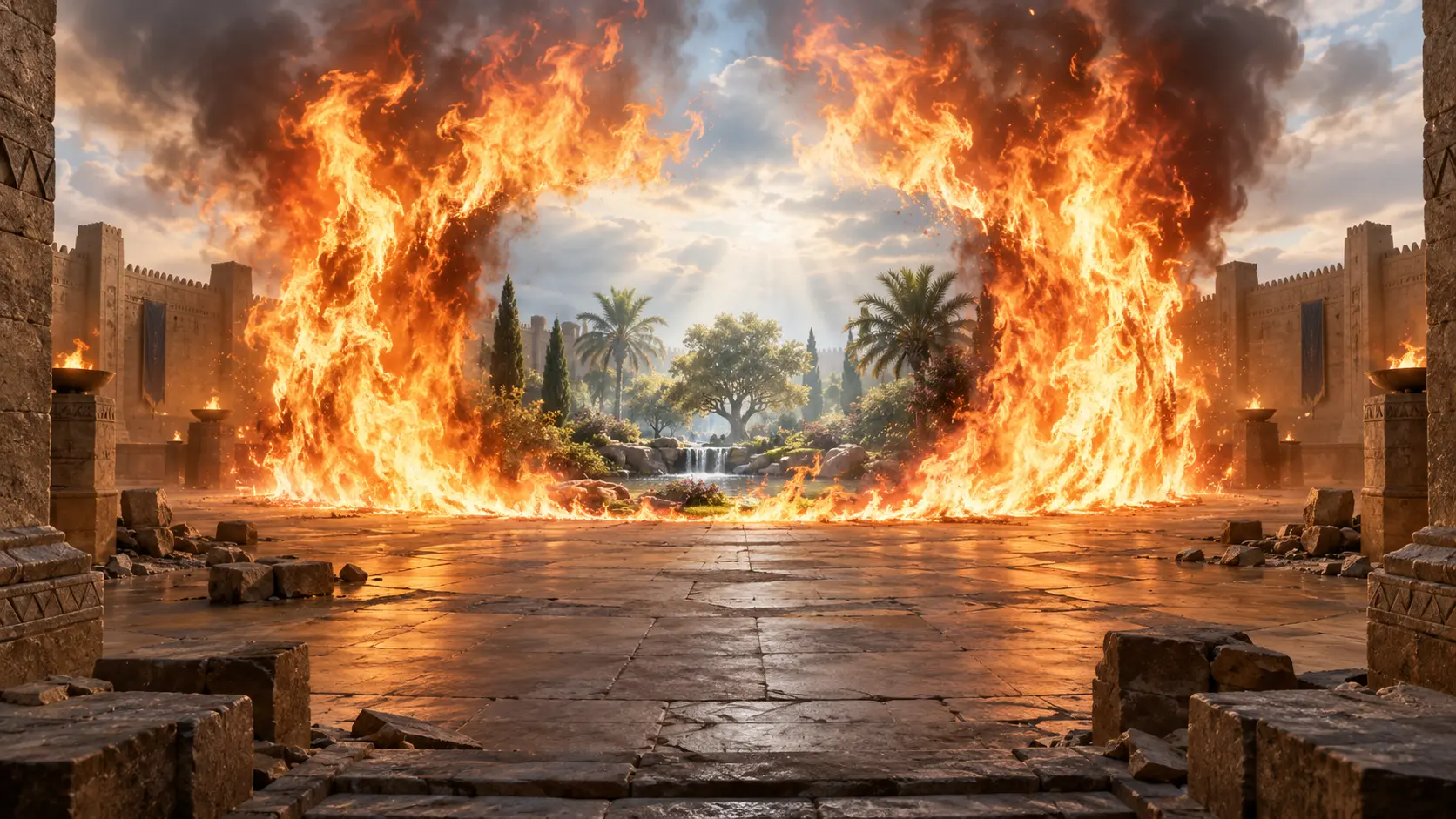
Ibrahim questioned his father and his people about their idols. Following ancestral customs, he showed, does not make those customs true.
He broke the idols, leaving the largest. When questioned, he directed his people to ask the idols, exposing the contradiction in worshipping things unable to speak or defend themselves.
When argument failed, they ordered him burned. Allah commanded the fire to be cool and safe for Ibrahim. The Qur'anic account does not require invented descriptions of the fire's size or the machinery used.
His rescue was a miracle from Allah, not a natural skill Ibrahim possessed. The command included safety as well as coolness: the fire caused him no harm.
An authentic hadith mentions three statements described as “lies”: his saying he was ill, his reference to the largest idol, and his description of Sarah as his sister. Scholars explain their intended meanings in the contexts of religious argument and protection; Sarah was his sister in faith.
These statements should not be treated as treachery or ordinary blameworthy deception. The first two served his stand for Allah's religion, and the third protected Sarah in danger. Their context matters when explaining prophetic integrity.
03Debate, migration and protection
An unnamed ruler argued with Ibrahim about life and death. Ibrahim moved the discussion beyond the ruler's wordplay to a sign in the created world.
Allah brings the sun from the east; Ibrahim challenged the ruler to bring it from the west. The ruler was confounded. Naming him is not necessary to understand the Qur'anic lesson.
Lut believed in Ibrahim, and Ibrahim declared that he would migrate for his Lord. His departure was an act of faith and devotion.
Allah rescued Ibrahim and Lut to a blessed land. Historical attempts to reconstruct every stop on their journey should not be presented with the certainty of revelation.
An authentic account describes an oppressive ruler threatening Sarah. Allah protected her in response to her prayer. Ibrahim's description of her as his sister referred to their shared faith.
The central lesson is reliance on Allah in the face of a ruler's power. Uncertain names and geographical details need not be added to make the account meaningful.
04Hajar, Ismail and Zamzam
Sahih Al-Bukhari recounts Ibrahim bringing Ismail’s mother and her nursing infant to the site of the Sacred House, where there were then neither inhabitants nor water. He left dates and a waterskin before departing.
She asked whether Allah had commanded this. When he confirmed it, she expressed confidence that Allah would not abandon them. Trust followed recognition of His command, not denial of the valley’s isolation.
When the water ran out, she climbed As-Safa searching for help, then hurried towards Al-Marwah. She repeated the journey seven times, the origin of the ritual walking between the two hills.
Despite her faith, she did not simply sit waiting. The scene combines reliance on Allah with every practical effort available.
An angel appeared at Zamzam and dug with a heel or wing until water emerged. She gathered and contained it. Muhammad ﷺ prayed for mercy upon Ismail’s mother and said that, had she left it, it would have flowed openly.
People of Jurhum noticed a circling bird, recognised the sign of water and sought her permission to settle there. Ismail grew up among them and learned Arabic from them, as the hadith recounts.
05The dream of sacrifice: which son was it?
When the son was old enough to work alongside him, Ibrahim told him of the dream and invited his response. A prophet’s dream is revelation; the conversation revealed his son’s willing obedience and patience.
His son encouraged him to fulfil the command, expressing hope of being patient if Allah willed. He did not attribute that strength to himself alone.
Both submitted. When Ibrahim placed his son for sacrifice and their obedience was demonstrated, Allah called to him that he had fulfilled the vision. The trial established sincere submission, not a need for the child’s blood.
Allah ransomed him with a great sacrifice and preserved Ibrahim’s honourable remembrance. The Quran links the trial with goodness and reward, within divine mercy.
The sacrifice passage does not explicitly name the son. Many scholars identify Ismail from the context and sequence of announcements in Surah As-Saffat; reports from some early scholars identify Ishaq.
We acknowledge the disagreement while stating that Ismail is the preferred identification of many scholars. There is no basis for claiming unanimous agreement. Ibrahim’s sincerity, his son’s patience and Allah’s ransom remain the central lesson.
06The guests and the good news
Visitors greeted Ibrahim with peace. He quietly went to his household and brought a generous meal, placing a roasted calf close to them and inviting them to eat.
His hospitality was attentive rather than showy. Surah Hud describes the calf as roasted, while Surah Adh-Dhariyat describes it as fattened; the descriptions complement one another.
When the visitors did not eat, Ibrahim felt afraid. They reassured him: they were angels sent on a mission concerning Lut's people.
Eating together ordinarily signalled peaceful intentions, so their refusal caused concern. The account does not require assuming that Ibrahim already knew their names or number.
Sarah received the news of Ishaq and, after Ishaq, Yaqub. She wondered at bearing a child in old age after being barren. The angels reminded her that this was Allah's command and mercy.
The Creator of ordinary causes is not limited by them. The additional news of Yaqub also promised that Ishaq would live to have a son who would continue the prophetic line.
07Ibrahim and Ismail build the Kaaba
The Quran describes Ibrahim raising the House’s foundations with Ismail. Ibn Abbas’s authentic report states that Ismail brought stones while his father built.
Their great act of obedience did not remove concern about acceptance. As they worked, they prayed for their Lord to accept it. Worship calls for sincerity and need of Allah, not self-satisfaction.
The authentic report describes Ibrahim telling Ismail that Allah had commanded him to build a house there and asking for his help. Ismail agreed: two prophets cooperating in obedience.
The report mentions the elevated site and raising the building. These established details differ from long unverified accounts of earlier construction by angels or Adam.
They prayed to submit to Allah, for a submitting nation among their descendants, to learn their rites and to receive His acceptance of repentance. They also prayed for a messenger to recite His verses, teach scripture and wisdom, and purify their descendants.
The House’s construction is connected to worship of Allah alone, prayer, learning and purification. Its purpose is more important than unsupported architectural detail.
08Prayers for Makkah and its people
Ibrahim prayed for the security of Makkah and for protection from idol worship for himself and his descendants. His concern embraced both physical safety and faith.
Even this great prophet of monotheism asked Allah to keep him and his family away from idols. The prayer teaches humility and the continual need for steadfastness.
He explained that he had settled some of his descendants near the Sacred House so that they would establish prayer. He asked that people's hearts incline towards them and that they receive provision and give thanks.
Worship comes first in the prayer. Provision supports a life of gratitude rather than becoming its ultimate purpose.
Authentic reports speak of Ibrahim declaring Makkah sacred and Muhammad declaring Madinah sacred. Allah established the sanctuary's sanctity; Ibrahim proclaimed it to people.
The sanctuary has rules concerning security, hunting and vegetation, explained in their proper legal context. Ibrahim's legacy is a living commitment to worship, not simply a collection of historical remains.
Story sources
- IslamWeb · 28 (Arabic)
- Dorar · Tafsir 6/20 (Arabic)
- IslamWeb · 211483 (Arabic)
- Dorar · Hadith commentary sharh/25658 (Arabic)
- IslamWeb · 8570 (Arabic)
- IslamWeb · 131530 (Arabic)
- IslamWeb · 30 (Arabic)
- Dorar · Hadith commentary sharh/14372 (Arabic)
- IslamWeb · 32 (Arabic)
- Dorar · Hadith commentary sharh/1884 (Arabic)
- IslamWeb · 152105 (Arabic)
- IslamWeb · 33 (Arabic)
- Dorar · Tafsir 37/9 (Arabic)
- IslamWeb · 112167 (Arabic)
- IslamWeb · 54063 (Arabic)
- Dorar · Hadith commentary sharh/4361 (Arabic)
- IslamWeb · 34 (Arabic)
- IslamWeb · 35 (Arabic)
- Dorar · Hadith commentary sharh/9862 (Arabic)